• Home
  • Projects
    • Hydraulics
    • Kinematics
  • Automobile
    • Automotive Innovators
    • Electric vehicles
  • Inventions
    • Inventions
    • Intresting Facts
    • Stories
  • Aviation
    • Aircrafts
    • Drones
  • About Us
    • About Us
    • Terms in use
    • Privacy Policy
    • Disclaimer
  • Contact Us
  • Sitemap

The Engineeringity

 On a December afternoon in Chicago during the epicenter of World War II scientists cracked open the nucleus at the center of the uranium atom and turned nuclear mass into energy over and over again. They did this by creating a chain reaction inside a new engineering marvel the nuclear reactor for the first time. Since then the ability to mind great amounts of energy from uranium nuclei has led some to build nuclear power as a plentiful unrealistic source of electricity.

A modern nuclear reactor generates enough electricity from 1 kilogram of fuel to power an average household for almost 34 years but rather than conquer the international electricity market. Atomic power has declined from an all-time high of 18 % in 1996 to 11 % today and it's envisioned to drop further in the coming decades.

Nuclear Power Plant Working

What happened to the great promise of this technology?

It turns out nuclear power faces many hurdles including high construction costs and public opposition and behind these problems lie a series of unique engineering challenges.

How does nuclear power work?

Nuclear power depends on the fission of uranium nuclei and a controlled chain reaction that multiplies this splitting into numerous more hearts. The atomic nucleus is densely packed with protons and neutrons found by a strong nuclear force. Most uranium atoms have a total of 238 protons and neutrons but roughly 1in every 140 lakhs three neutrons and this lighter isotope is less tightly bound. Compared to its abundant cousin a strike by a neutron can easily split the u-235 nuclei into lighter radioactive elements called fission products. In addition, 2-3 neutrons gamma rays, and a few neutrinos.

During fission some nuclear mass converts into energy a fraction of the newfound energy powers the fast-moving neutrons and if some of them hit uranium nuclei fission results in a second larger generation of neutrons. If this second generation of neutrons strikes more additional uranium nuclei then more fission results in an even larger third generation and the chain goes so on. But inside a nuclear reactor, this spiraling chain reaction is tamed using control rods made of elements that capture excess neutrons and keep their number in check. With a controlled chain reaction a reactor draws power steadily and is stable for years. The neutron lead chain reaction is a potent process driving nuclear power but there's a catch that can result in unique demands on the production of its fuel. It turns out most of the neutrons emitted from fission have too much kinetic energy to be captured by uranium nuclei the fission rate is too low and the chain reaction fizzles out.

Light water reactor

The main nuclear reactor created in Chicago used graphite as a moderator to disperse and slow down neutrons just enough to grow their capture by uranium and boost the rate of fission. Modern reactors commonly use purified water as a moderator but the scattered neutrons are still a little too fast to compensate and keep up the chain reaction the concentration of u-235 is enriched to 4 to 7 times its natural abundance. Today enrichment is often done by passing a gaseous uranium compound through centrifuges to separate lighter u-235 from heavier u-238. But the same process can be resumed to highly enriched u-235 up to 130 times its natural abundance and create an explosive chain reaction in a bomb. Methods like centrifuge processing must be carefully regulated to limit the spread of bomb-grade fuel.

Remember only a fraction of the released fission energy goes into speeding up neutrons most of the nuclear power goes into the kinetic energy of the fission products. Those are captured inside the reactor as heat by a coolant usually purified water. This heat is ultimately utilized to drive an electric turbine generator by steam just outside the reactor. Water flow is critical not only to create electricity but also to guard against the most dreaded type of reactor accident the meltdown. If the water flow stops because a pipe carrying it breaks or the pumps that push it fails the uranium heats up very quickly and melts during a nuclear meltdown radioactive vapors escape into the reactor, and if the reactor fails to hold them a steel and concrete containment building is the last line of defense. But if the radioactive gas pressure is too high containment fails and the gases escape into the air spreading as far and wide as the wind blows. The radioactive fission products in these vapors eventually decay into stable elements while some decay in a few seconds others take hundreds of thousands of years the greatest challenge for a nuclear reactor is to safely hold these products and keep them from damaging humans or the environment.

Storage of Fuel

Containment doesn't stop mattering once the fuel is used up it becomes an even greater storage problem. Every one to two years some spent fuel is removed from reactors and stored in pools of water that cool the waste and block its radioactive emissions. The irradiated fuel is a mixture of uranium that failed to fission products and plutonium a radioactive material that is very rare in nature this mix must be separated from the environment until it has all safely decayed, many countrysides propose deep time storage in tunnels mined far underground, but none have been built and there's great uncertainty about their long-term security.

How can a nation that has lived for only a few hundred years plan to protect plutonium through its radioactive half-life of 24,000 years? today many nuclear power plants sit on their waste instead of storing them indefinitely on-site, Apart from radioactivity, there's an even greater danger with spent fuel. Plutonium can uphold a chain reaction and be excavated from the waste to make bombs storing spent fuel is thus not only a safety hazard for the environment but also a protection risk for nations.

Who should be the watchman to safeguard it? imaginative scientists from the earlier years of the nuclear age pioneered how to reliably tap the enormous amount of energy inside an atom as an explosive bomb and a controlled power source with incredible potential. But their successors have learned humbling insights about the technology's not-so-idealistic industrial limits. Mining the subatomic realm makes for complicated, costly, and risky engineering.

  • 2 Comments

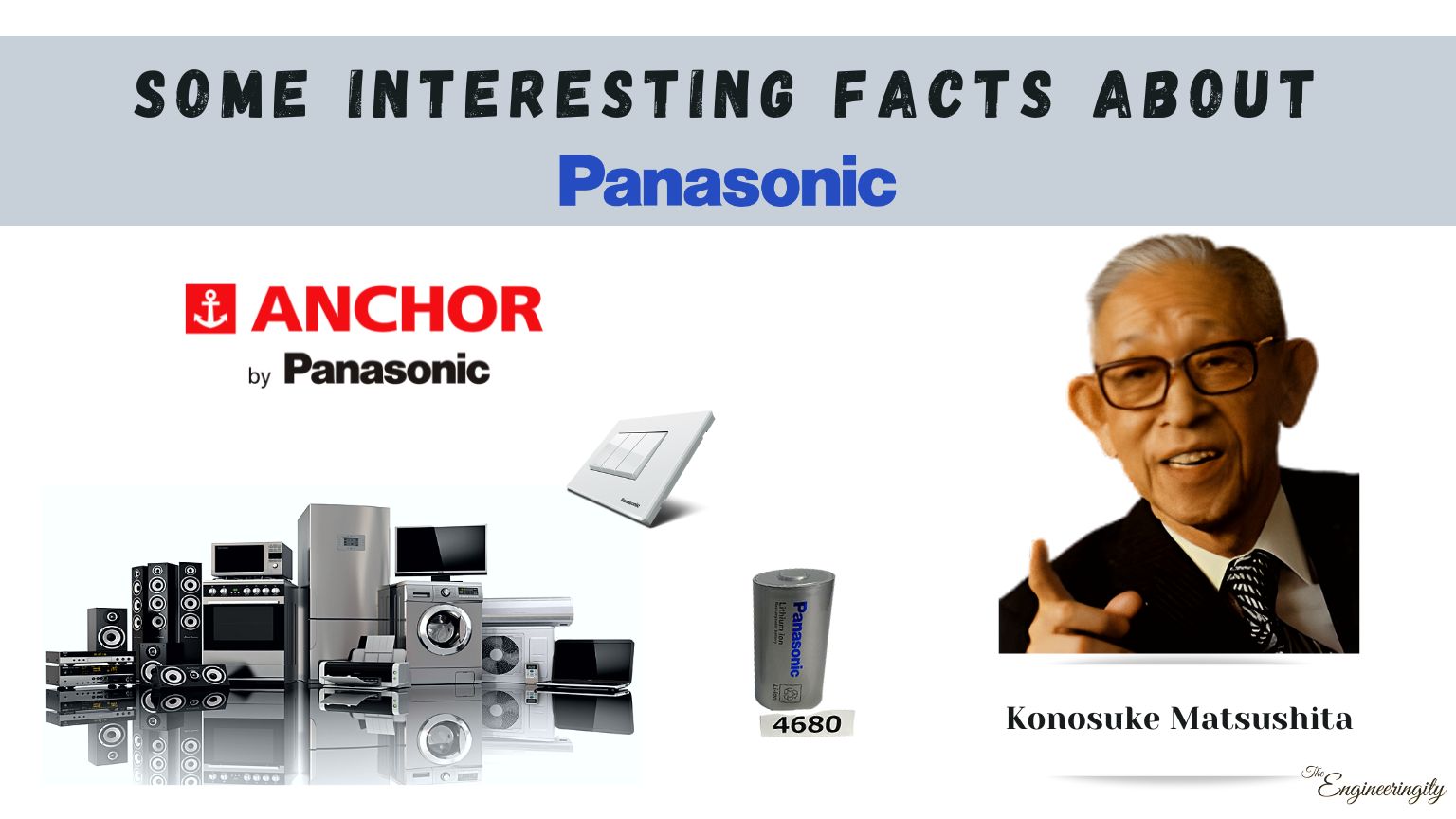
 Some interesting and surprising facts about one of the most successful Japanese electronics companies ever Panasonic.

4680 Battery | Anchor Panasonic | Panasonic Facts | Konosuke Matsushita

Panasonic was founded in 1918 as the Matsushita electrical housewares manufacturing works by Konosuke Matsushita. Matsushita used his innovative spirit to expand the company from offering a straightforward product to producing quality electrical products in a short amount of time although the company was devastated by war Matsushita’s leadership drove the company to rebuild into an even stronger and more successful company. Matsushita’s spirit continues to drive the company as his work ethic dedication to quality and forward-thinking nature are the basis of all their business operations. Now 100 years after its founding Panasonic is a multi-billion dollar company that offers a wide range of electronic goods including cameras televisions, audio equipment, home theatres, phones, and more. Inspired by Panasonic's long history of ability to adapt to incredible success and forward-thinking nature it's time to take a closer look at this multinational electronics corporation with the 15 things you didn't know about Panasonic.

1. History of Panasonic

Panasonic started as a seller of light bulb sockets although today Panasonic is known the world over as a multi-faceted electronics company it had a very simple beginning. In 1918 the company was founded by Konosuke Matsushita and only had two other employees his wife and his brother-in-law Its only ventures at the time were selling light bulb sockets. In 1927 production expanded into bicycle pumps followed by light fixtures motors electric irons and vacuum tubes.

2. Panasonic built ships and Airplanes In WWII

During the Second World War Panasonic switched its focus to supporting the war effort this led to Panasonic setting up shipbuilding and plane-building sectors but it proved to be difficult since nobody at the company had any experience in these areas. However, they did successfully produce 56 wooden ships and 3 wooden aircraft during the war however Panasonic suffered many losses during the war including 32 Factory and office facilities and about 11,000 staff members.

3. The Company was not called Panasonic

2008 Panasonic was called the Matsushita Electrical Industrial Company from 1935 to October 2008. Panasonic was first used as a brand name in 1955 for audio speakers the Panasonic name was created out of a combination of the words pan and Sonic which the company says the meaning of bringing the sound the company makes to the world number.

4. Panasonic and Tesla are business partners

In July 2014 Panasonic announced that it had made an agreement with Tesla to participate in a massive battery plant called the Giga factory that Tesla plans to build in the US by 2020 the plan is estimated to cost 5 billion dollars and it's expected that it will result in reducing Tesla's battery (4680) costs by 30%. Panasonic announced its initial investment in the Tesla Motors battery factory would amount to tens of billions of yen. Panasonic will provide Tesla with 4680 batteries by March 2024. Pansonic is to begin mass production of Tesla's new 4680 batteries by the end of the fiscal year 2024.

5. Universal Studios once belonged to Panasonic

In 1990 Panasonic purchased an American media company called the Music Corporation of America or MCA for 6.59 billion dollars five years later 80 % of MCA was sold to Seagram company for 7 billion dollars and the name was changed to Universal Studios Today Universal Studios is part of NBC Universal which is owned by Comcast.

6. Panasonic is one of the biggest supporters of the Olympic Games 

Panasonic has been one of the top sponsors of the Olympic Games ever since the 1988 Calgary Olympics. In 2008 Panasonic's HD equipment made the first Olympic Games with full HD official coverage possible at the 2016 Rio Games Panasonic provided 115 projectors which were used during the opening ceremony they also provided 10,000 surveillance cameras and various broadcasting equipment for the Sochi 2014 Winter Games these are just tiny samples of everything Panasonic does to support the Olympics.

7. They first expanded to the US market in 1961.

Konosuke Matsushita traveled to the United States for the first time in 1961 and he had a very successful trip where he met with American dealers and established agreements that would allow him to move to the US market the company began producing television sets for the US market shortly after under the brand name Panasonic and later on starting in 1979 Panasonic TVs were sold in Europe as well the company sold products under the national brand outside of North America from the 1950s to the 1970s however federal could not be used to sell products in the US due to the existence of the National Radio Company.

8. The Panasonic Toughbook claims 50 % of the rugged laptop market 

Toughbook is a brand name owned by Panasonic that refers to its line of rugged computers Toughbook is designed to withstand vibration spills drops extreme temperatures and rough handling tough books are widely used in a variety of industries including military construction health care law enforcement manufacturing oil and emergency services. Panasonic claims 50% of the so-called rugged laptop market with this one product alone.

9. Panasonic built the world's giant hi-def LED screen

Panasonic built the largest high-definition television LED screen at the Texas Motor Speedway in Fort Worth Texas in 2014 the world record-breaking screen is 2600 and 14 square feet with display dimensions of 94.5 feet by 218.4 feet the video board nickname is the Big Hoss TV and its consists of nearly 4.8 million pixels and displays 281 trillion colors it's bigger than two jumbo jets put together the screen is used to display live race coverage leaderboard information instant replays and interactive entertainment.

10. Panasonic invented a tomato-harvesting robot

Panasonic's newest robot was introduced in December 2017 at the robot exhibition in Tokyo the robot has been designed to use its camera range image sensor and artificial intelligence to only pick soon-to-be ripe tomatoes that are ready for harvesting this task was previously thought to be too delicate for a robot to handle without damaging the sensitive fruit or picking up undesirable Tomatoes but the Panasonic robot proved it was up to the task.

Panasonic also claims it can match human efficiency by harvesting 10 Tomatoes every minute.

11. Panasonic is the 97th most valuable brand in the world

Panasonic just made it into the top 100 of Forbes's most valuable brands list the company comes in at number 97 between Walgreens and Nivea the Panasonic brand is valued at 6.9 billion dollars.

12. A stone monument marks where Panasonic was founded 

In November 2004 on the 110th observance of the birth of Panasonic founder Konosuke Matsushita, a stone monument was unveiled that marks where the 23-year-old Konosuke founded the Matsushita Electric housewares manufacturing Works which later became Panasonic. The stone monument is located in Okie rocky Japan in Osaka Fukushima the monument is 1.8 meters high and 2 meters wide and is inscribed with the Japanese character for the path as written by Konosuke himself.

13. Panasonic is the title sponsor for the new Jaguar Formula E team

At the beginning of 2016, Jaguar announced that it would be joining the all-electric Formula E racing series, and nine months later it was announced that Panasonic would be their title sponsor the official name for the racing team is Panasonic Jaguar Racing. The team's car is a Jaguar I type 1 and of course, large Panasonic logos can be seen on it from every angle.

14. The founders of Panasonic and Sanyo were brothers-in-law

After World War, II Panasonic founder Konosuke Matsushita set about trying to refocus and rebuild his company meanwhile his brother-in-law Toshio Liu founded Sanyo as a subtractor for components the two companies became competitors in the same market but long after the two founders had passed away the companies merged when Panasonic bought Sanyo in December 2009. Toshio Liu was one of the three original employees of the Panasonic company.

15. Panasonic set a record with their Evolta batteries

In 2015 Panasonic set a Guinness world record for the longest distance traveled by a vehicle on a railway track powered by dry cell batteries in an attempt to demonstrate the strength and durability of their Evolta batteries Panasonic powered a small train solely with 600 of their batteries and it traveled 14.05 miles before running out of power the two-hour 36-minute train ride took place in Akita Japan and the train was built by 13 local high school students.

In 2014 to attract more workers to its Chinese operations Panasonic offered to pay ex-pats hazard pay to compensate for the chronic air pollution they are subjected to as they work in the heavily polluted environment China has the world's worst air pollution with over 3 million deaths per year being attributed to the toxic air.

  • 0 Comments

 We’ve all must have seen well-armed ragamuffins and ne'er-do-wells glorifying their various victories with some good old-fashioned upwards gunfire. After all, nobody says “I ran a 10k” or “We just overthrew the government” quite like pointing your gun to the sky and letting it near rip. But is it possible that this apparently innocent expression of gun-based joy could unsafe?

Can celebratory gunfire kill a person | Can a falling bullet kill a person

So there you are chuffed to bits at the victory of your preferred political candidate and overcome with an irrepressible urge to celebrate in the only way you know how. You grab whatever loaded firearm you have handy, rush outside, and start gleefully firing off, round after round into the air just as nature intended, when suddenly, a chilling thought falls upon you. These bullets have to come back down eventually, right? Unsurprisingly, the answer to this question is emphatic.

Where are the Factors that determine the factor of a bullet's path

When a gun is fired, several different factors determine the bullet’s path through the air on the way to its target. One of the first things to consider is ‘muzzle velocity, which is very simple, the speed at which a bullet is moving the instant it leaves the gun cask, or ‘muzzle’.This can vary considerably relying on the type of gun and round being used. The ever-popular AK-47 for instance is capable of firing bullets at around 715 meters per second, or about 2,350 feet per second, while in modern rifles, some of the speediest high-performance cartridges can achieve muzzle velocities of well over 1,200 meters per second, or about 4,000 feet per second.

Due to the effects of air resistance, bullets slow down pretty quickly after being fired and follow a route determined by various factors, including atmospheric pressure, humidity, and air temperature. However, the thing that pulls a fired bullet downwards is gravity, which assuming those other previous variables aren’t having an overwhelming effect, ensures that bullets travel back to earth in an approximately parabolic path.

Can celebratory gunfire cause injury to a person?

Now, celebratory gunfire differs substantially from regular gunfire in that it is generally not directed at people you want to shoot, but upwards and away from those you’re celebrating with,  who you don’t want to hit  (well, not usually anyway). That way, the bullets just disappear up into space, right? At least, that’s what people used to think. Early, pre-seventeenth-century studies suggested that bullets shot upwards do somehow achieve escape velocity and peace out into space. We now know that all shots shot from the surface of Earth never even leave the troposphere, the lowest layer of our planet’s atmosphere and unless you’re watching this from the  International Space Station,  the one you’re in right now.

What happens when a bullet is fired from a gun?

In reality, when a bullet is fired directly upwards,  the upward force accelerating the bullet drops off entirely the moment it leaves the chamber.  At this point, the bullet is at its maximum velocity and has its maximum kinetic energy. From this point, downward forces from gravity and air resistance begin to slow the bullet's uprise. The bullet reaches its highest point when its kinetic energy has been transferred to heat and gravitational potential energy. Here Its velocity is zero. 

The only force that has now been exerted on the bullet is Gravity, which pulls back the bullet by 9.81m/s2 every second. As the bullet accelerates downward, its velocity increases; as does the air resistance, and when a bullet falls naturally it will often spin and tumble in the air, further increasing the air resistance and slowing its acceleration significantly. When gravity and air resistance balance out, the bullet will hit its terminal velocity, meaning it will no longer go any faster.

Are bullets falling at this speed still dangerous?

Well, the terminal velocity of a falling bullet will obviously alter depending on the kind of bullet, but generally speaking, yes! it does very much so. Before that let's travel back to the 1920s, the U.S. military conducted a series of tests on falling bullets and found that a 30-caliber round can reach terminal velocities of 90 meters per second or just over 200 miles per hour. According to forensic scientist Dr. B.N. Mattoo(Dir. Forensic Science Department Mumbai), a 30 caliber round can break through the skin while traveling at speeds as low as 37 meters per second, or 85  miles per hour. As you can see, falling bullets have more than enough energy to cause you harm, possibly worse. And that’s just regarding falling bullets;  In reality, people celebrating things with gunfire aren’t generally bothered about making sure that their weapon is totally vertical. 

If a gun is fired at a sufficiently shallow inclination, instead of stalling and falling the bullet will often retain its angular ballistic trajectory and will continue on its parabolic path, making it far less likely to begin tumbling in the air. As a result, such bullets will lose much less speed compared to a bullet in freefall and will be traveling much faster when they hit the ground or whatever gets in their way first. But if all that fancy maths and science talk isn’t sufficient to convince you that the threat from falling ammunition is genuine indeed, there are unfortunately numerous real-life examples of this happening. And as it happens, firing off a few rounds with the chaps is not a particularly uncommon phenomenon and is a culturally acceptable way to celebrate in several places around the world.

Some Real-Life deaths from Celebratory gunfire/ Falling bullets

In 2012, a study conducted in the United States (Violence Prevention Research Program University of California) found that a not-insignificant 4.6% of all deaths and injuries from stray bullets occur as a direct result of celebratory gunfire. The list of incidents is sadly not a short one and features examples from all over the world. In 2003, during a traditional Serbian wedding celebration, guests shot down a small plane while firing into the skies, injuring the two men onboard. In 2007, at least four people were killed and many more injured as a result of stray bullets from celebratory gunfire after the Iraqi national football team won the AFC Asian Cup that year. In 2021, militant leaders claimed to take control of part of Afghanistan.  Their resulting celebratory gunfire injured 41  people and led to the deaths of at least 17. Back in 1999, a teenager called Shannon  Smith was killed after being struck in the head by a stray bullet while outside in her backyard in Arizona. This provoked the state to enact ‘Shannon’s Law’,  which made it banned to unleash a gun into the air in Arizona's cities and towns.

Indeed, in some respects, falling bullets may even be considered more dangerous than regular gunfire. Between  1985 and 1992, a group of physicians at the Martin Luther King/Drew medical center (1985-1992) in Los Angeles studied victims of gunshot wounds,  identifying 118 who had been struck by falling bullets. Compared to those hurt in your average, boring, run-of-the-mill shootings, who died at rates of between 2 and 6 % the death rate of those unfortunate enough to be hit by fall bullets was around a third. This is because, despite moving at slower speeds, bullets falling to the ground vertically are far more likely to hit you in the top of the head compared to other less-lethal points of the body. 

As you can imagine celebratory gunfire is not particularly bizarre, and the risk that it poses is very real which is clear. So the next time your football team wins, or you’re just jazzed about it being New Year, it might be a good idea not to randomly pump the sky full of lead but instead stick to confetti cannons(Party poppers).

  • 0 Comments

 Plastics are inexpensive and durable as a result levels of plastic production by humans are high. However the chemical structure of most plastics renders them too resistant to many natural processes of degradation and as a result, they are slow to degrade together these two factors have led to a high prominence of plastic pollution in the environment millions of animals are killed by plastic every year. But there are many ways we can reduce plastic pollution by converting waste plastic into a helpful resource.

Plastic waste | Plastic Pyrolysis


Chemical Conversion of Plastic Waste into Fuel

We are going to see how plastic is turned into fuel. Imagine a world where a Gigantic of plastic waste can be converted into useful resources again and used for other purposes. Chemical recycling is an attractive way to reduce the explosive growth of plastic waste and disposal problems. We know plastic is just crude oil that has been proposed in different ways and with pyrolysis we can reverse this process.

What is Plastic Pyrolysis?

Plastic pyrolysis is a very effective process where plastic is exposed to high temperatures in an oxygen-free environment. Pyro means heat and lysis means breakdown at any given temperature the molecule is in the vibrating stage this is called molecular vibration.

The frequency at which molecules vibrates is directly proportional to the temperature of molecules during pyrolysis the molecules are subjected to very high temperatures leading to very high molecular vibrations at this high molecular vibration every molecule in the object is stretched and shaken to such an extent that molecules start breaking down into smaller molecules this is Pyrolysis. 

Plastic is hard to break down, and we must add a catalyst to help break the chemical bonds. A Catalyst is a substance that speeds up a chemical reaction but is not consumed by the reaction and mostly Fly ashes obtained from coal combustion or zeolite etc is used as the catalyst. 

Finally, waste plastic is converted into approximately 80% oil 15% gas, and 5% carbon black or Ash. Let's have a look into how plastic is actually converted into a useful resource there are many steps involved in the plastic pyrolysis process but we are simply going to see 5 simple steps.

Process of Plastic Pyrolysis

Steps in Plastic Pyrolysis | Fuel

Waste plastic to pretreatment process, spreader, pyrolysis, condensation, and refining. Waste plastic is first sent into a pretreatment process that removes any foreign matter and then sent into a plastic shredder is a machine used to cut the plastic into smaller pieces the smaller pieces of plastic are then sent into a densifier that comprises the smaller plastic pieces into a dense material to facilitate easy and storage or handling then they are sent into what chamber where the pyrolysis of plastic takes place. 

The plastic is heated approve 450-degree centigrade in the presence of the catalyst and in the absence of oxygen. The plastic is slowly melted and converted into a gas-gaseous state then the gas is sent into a condenser then the condensation takes place. 

Condensation means the conversion of a vapor or gas to a liquid then it is sent into an oil refinery chamber. Finally, plastic waste is refined into approximately 80% oil 15% cash 5% carbon black, or Ash. This oil is used as heating material and sold to cement glass-ceramic electric power factories, etc. 

And also used in heavy oil generators for electricity generation and it is a deep process into diesel oil with a distillation plant the final oil can be used in truck tractors and many more. 15% gas is recycled into the furnace to heat the reactor instead of using coal, wood, oil, etc and the remaining carbon black is used as slag for construction and also used as a replacement for coal.

Some drawbacks and advantages of plastic pyrolysis

Drawbacks

Pyrolysis is an energy-consuming process more energy has to be put in to treat the waste that can actually be recovered pyrolysis of plastic can never be sustainable etc.

Advantages of plastic pyrolysis

It reduces the waste going into landfills and greenhouse gases and reduces the risk of water pollution it creates new jobs for lower-income people based on the quantity of waste generated in the region and extra which in town provides public health benefits through waste cleanup and extra and this is how waste plastic is turned into a usable resource by using waste pyrolysis.

  • 0 Comments

 When you think of celebrities and cars who comes to your mind? Some people might think of Shahrukh Khan for his Hyundai Commercial, and Brie Larson for her Nissan commercial. But I have a different name for you Muhammad Ali yeah that is Muhammad Ali! The legendary boxer, the Civil rights activist, and every college freshman dorm had a photo of him standing over Sonny Liston. But did you know that he owned a car company based out of Brazil? Tape up your hands and buckle up because this story will float like a butterfly and sting like a bee!

Muhammad Ali | Ali stinger | Puma GT

First of all, how does somebody like Mohammed Ali and a small Brazilian car company like Puma meet? To find out, we need to do a little bit of backtracking to answer questions like this: what is Puma? what kind of car was it? How did Muhammad Ali get involved?


    Industrialization in Brazil

    Will first need to take a brief look history of the car industry in Brazil. Pre-1956 Brazil was mostly an agricultural Nation whose main export was coffee. The only notable thing related to the car industry was that Ford had been there since 1919 assembling Model T’s in Sao Paulo. However, during the 1950s, the Brazilian government made efforts to industrialize the country, and one of the big steps they took to achieve that was to encourage domestic car production. 

    Brazil applied heavy import taxes on vehicles that were not produced in the country and banned import altogether for a long time, and to be Frank, these import taxes and bans worked!  To avoid these new hurdles, General Motors, Toyota and Volkswagen would all soon build their factories within Brazil, but before the foreign companies set up shop this burgeoning industry also accelerated the creation of local Brazilian automakers and they were a little different as well. These first Brazilian car companies were mostly of the specialty in kit car variety. 

    One of these cars for the DKW Malzoni was built in Sao Paulo and gained popularity rather quickly.

    • 2 Comments

     Today we are revealing some interesting and surprising facts about one of the most dominant and long-lasting brands in the luxury automotive industry for this we are going to focus all of our attention on Mercedes-Benz. 

    Mercedes Benz class


      How Mercedes-Benz was formed?

      Mercedes-Benz was established when two German automobile companies run by Gottlieb Daimler and Karl Benz merged to create the Daimler-Benz patent company in 1926 and soon after it was renamed, Mercedes-Benz. 

      The first Mercedes-Benz owned by Hitler

      The first joint car they produced was the Mercedes 770 model which Hitler was known to drive with a bulletproof windshield over the used. Mercedes-Benz has been a leader in innovation in technology and safety and has developed some of the most popular luxury cars of all time. 

      Mercedes's slogan is the best or nothing and we know this reflects the mindset of many people out there. Mercedes-Benz is an excellent source of inspiration for future billionaires due to their luxury mindset in forward-thinking ways not to mention their longevity and their drive for success.

      Now let's take a look at the facts you didn't know about Mercedes-Benz:

      Karl Benz created the first modern automobile. Karl Benz was actually the first to create and patent the model automobile in 1886 his vehicle was called the patent motorwagen and it was comprised of 3  wheels a Steel Tube frame of wooden panels in a small gasoline-powered engine it only had two-thirds HP. But Karl had to start from somewhere his wife Bertha Benz financed and marketed the invention.

      Story Behind Naming Mercedes

      Mercedes's name came from an 11-year-old girl. The Mercedes brand name came about as a result of Austria diplomat and racing enthusiast Emil Jellinek insisting that the series of 36 sports cars he ordered from the Daimler company be renamed after his 11-year-old daughter Mercedes. 

      The car was completed in 1901 and Jellinek dominated in every racing event entered with them. Daimler decided to stick with the name after quickly developing an impressive reputation and they trademarked the brand in 1902.

      The invention of the Brake pad

      Bertha Benz was the first person to take a road trip in a modern automobile. Bertha Benz the wife of Karl Benz brought National attention to the Benz patent motorwagen when she and her sons drove the car over 130 miles round trip. The first time the automobile had been driven a considerable distance. She took off without telling her husband with her two sons aged 13 and 15 hoping to prove the viability of the invention. 

      But people were not used to seeing cars on the road so many became frightened and some even thought the horseless carriage was to work of the devil she solves several problems with the automobile along the way like cleaning a blocked few lines with her hat pin and having a cobbler install leather when the wooden breaks began to fail to make the world's first pair of the brake pad.

      What does the 3-point logo represent in Mercedes?

      Evolution of Mercedes Benz logo

      The three-pointed logo almost had a fourth point added, the Mercedes-Benz three-point logo represents its domination of the land, air, and water. The Logo has evolved through the years with the first three-point starter being used in 1909, there was discussion about adding the fourth point to represent space as well.

      The First Driver's License

      Karl Benz was given the very first driver's license individual states and countries started exploring the need to issue driver's licenses in the early 1900s but Karl Benz had the distinction of being the first to secure a license to operate a motor vehicle. 

      In 1888 he requested written permission from local authorities after there had been several complaints in his community about the noise and smell of his first modern automobile prototype.

      Now, who owns the Mercedes?

      Daimler Ag | Mercedes | Maybach | AMG

      Daimler AG owns Mercedes. Daimler-Benz was transitioned over a new name Daimler AG in 1998, They own all of Mercedes divisions such as Benz, the AMG, and a Maybach.

      • 2 Comments
      Update: Now you can also enjoy listening to this post, click on the icon on the left below.

       It all starts with the IBM personal computer, the most advanced computer machine ever created. However, this isn't the story of the computer. But a story about when computers stop working. The man who created a way started all over. The man who invented Control-Alt-Del.


        Who created Ctrl-Alt-Del?

        Control-Alt-Delete | David Bradley founder

        He was Dr. David Bradley. Back in 1980, he worked in IBM's personal computer. His particular job was writing basic input outputs in systems. Even with an elite team of engineers and designers, not everything goes smoothly when you build a computer. 

        The programs that ran most of the time got failed the only way to reset the system was to turn the power off and wait a while to turn the power back on it would go through a very long self-test but the system might die every 5 to 10 mins.  It was not easy.

        Where did Ctrl-Alt-Del come from?

        What he needed was away, shortcut to restart the process. One thing that came out after their discussion was to put a Reset Button on it but if a reset button was put on the system board there was a chance that if it could hit by mistake then all the data would get lost.

        Many engineers worked on it but could not find a solution. So after many attempts, the solution they came up with was a three-key sequence that would reset to this computer.

        And a new coding hits by mistake a single Control key a single Alt key, and then all the way over at the right-hand side a single Delete key when you hit Control-Alt-Delete, You're are deleting everything that you're working out right now, and starting new. 

        Wasn't it great at that time to come up with this invention?

        When does it get popular?

        Even though it was built only as a development tool, programmers began incorporating the features in their applications from there it was released into the while but didn't immediately reach pop culture status for years it was no big deal.

        Then suddenly on the 20th anniversary of the IBM PC that's when Ctrl-Alt-Del became a sort of cultural icon the reason behind this was Bill Gates, it was the simplest and easiest way to fix your problem and hit control alt del start all over.

        Now, this is very interesting on asking Dr. David about his invention.

        Interesting answer by Dr. David

        the history of Ctrl-Alt-Del | Meme on Ctrl-Alt-Del

        On asking Dr. David about his invention Cnt-Alt-del, he answered that he got a lot of things with IBM but all everybody remembers is CONTROL-ALT-DELETE. But taking the fame of CONTROL-ALt-DELETE means he worked on a very successful Product.

        The man did this invention when he was in his 40s and now he is 71.

        Things to learn from this invention

        Inventing new things from the existing ones was not an easy task at that time. But what we can learn from this invention is that,

        There is always a solution to a problem trying to solve may find a way.

        There is always a Way you only have to find the Will.

        If you find this post interesting and knowledgeable, please consider commenting your thoughts below in the comment box and share this post.
        • 0 Comments

        Suppose there is a bike which travels a long mile but there is one condition, it must have petrol in it. So from here, we got to know that the working medium required in a bike will be "Petrol". It implies that the bike will not start if there is no petrol in it.

        Hydraulics and Pneumatic

        So the system that works on fluid like oil is called Hydraulics.

        Similarly, any system that works on pressurized air is called Pneumatics.


          Introduction

          In Hydraulics, Pressurized oil is the working medium and in Pneumatic Compressed air is the working medium.

          Hydraulics came from the Greek word "Hydraulikos" which means water pipeline 

          Pneumatics came from the Greek word "Pneomatiks" which means Air Pressure.

          History

          Hero of Alexandria was a Roman engineer and mathematician of the century(A.D) who had a big contribution to Hydraulics and Pneumatics.

          He had written many theories like Maths Physics mechanics pneumatics. So we call him the father of Hydraulics and Pneumatics.

          Construction

          Construction | Stages in Pneumatic

          There are three stages to it 

          Stage 1: Input stage  

          [ In the input stage there are devices like push buttons]

          Stage 2: Control and processing stage  

          [In this stage specialized control valves are used like 5/2,3/2,4/2. So that the fluid (working medium) flow can be controlled]

          Stage 3: Output stage

          [In this cylinders are used as an output]

          All the 3 steps are the same for both systems, the difference is the input supply. In hydraulics working medium is oil whereas in the pneumatic working medium is air.

          Difference

          Hydraulic System

          Pneumatic System

          Liquid as a working medium

          Dry air as a working medium

          Used to lift Heavyweight

          Used to lift Small/medium weight

          Sluggish working speed 

          Rapid working speed

          Expensive

          Inexpensive

          Used for a short distance

          Used for long-distance

          Can affect heat temperature

          Cannot affect heat and temperature

          High maintenance

          Low maintenance

          Applications

          For Hydraulics:

          • In cars, the gearing system is an example of Hydraulics
          • Bulldozers, JCB also work under Hydraulics
          • Crane which is used to lift the weight also works under Hydraulics
          • Lifts, press machines, and Jack for the uplifting of the car also work under Hydraulics.

          For Pneumatics:

          • The pressure gauge and the vacuum cleaner is an examples of pneumatic.
          • The air brakes we use in buses and truck works under pneumatics.
          • Tubeless tires also work under pneumatics.
          • A pump is used to fill the air in bicycles.

          Based on Pressure:

          Hydraulic utilizes around 3000 to 5000 psi(up to 10000 psi)
          Pneumatic utilizes around 100 psi (up to 150 psi)

          Pneumatic and hydraulic systems have many similarities both of them are applications of fluid power.

          So what do you think is the more efficient Hydraulic system or the Pneumatic system?

          Project-based on Hydraulic

          To know how the Hydraulic system works a small model is made on Hydraulic Powered Track to understand the basic concept of it.

          To know more about it[Click Here]

          • 0 Comments

          Over the past few decades, contemporary literature has addressed the emerging factor influencing the new economy of the over-the-top in India. In the last few years, a chunk of the digitally sophisticated audience has shifted its interest to new-age OTT platforms as a source of entertainment. 


            What is OTT?

            OTT platforms


            OTT means over the top it also means that without satellite and cable operators watching movies and television content directly to the audience on high-speed internet.
            It has gained public attention within a short period it has a wide variety of ranging from movies, tv serials, live sports 

            It is one of the fastest-growing networks in India. It has grown its viewership more during April as compared to January. For India, the highest consumed platform is YouTube followed by Hotstar and many other local players like Voot, zee5, Jio tv

            In the line with global trends, Indian consumers are increasingly consuming the content on digital platforms, rather than spending time on television content.

            History Of OTT Platforms:-

            Over the past few years, OTT platforms have been clamoring to get market share in one of the fertile grounds to be in India. Unlike other countries, India is growing with the viewership on the OTT(Over The Top) immensely.

            But it all started with the first dependent Indian OTT platform Big Flix. Big Flix was launched by Reliance in the year 2008 but it was not impactful. After years passed, in 2013 Ditto T.V.(Now known as Zee) and Sony Liv was launched which got a good response. It was a time when data had a high price and there was no subscription to any OTT platforms. Thus many of the audience could not afford to watch online. 

            Many other OTT platforms were also rising like Youtube, Hotstar, Amazon Prime, and many more by the year 2015. By the time people were aware of watching TV serials online. And then there was an entry of Reliance Jio which changed India from a lack of internet usage to most users of the internet in the world.

            The Rise Of OTT Platforms in India:-

            Increasing viewership of OTT


            The rise of Over The Top (OTT) platforms in India like Prime videos, Hotstar, Netflix, and many more have allowed the audience to view the diverse content from all around the world and experience the new genres.

            India has shown a tremendous increase and has seen a significant jump from traditional media to new media. Digital content was considered an abstract idea five or six years ago, it no longer is. 
            For India, the highest consumed platform is Youtube followed by Hotstar and many other local players like Voot, zee5, and Jio tv.

            In the line with global trends, Indian consumers are increasingly consuming content on digital platforms.

            The Indian market has responded to domestic and foreign OTT platforms with open arms, cheap internet connections, and easy access to digital devices.

            The OTT industry in India is open for competition right now. Many local players have established their audience. There are clear front runners who have the money to create quality content and market their platforms to the right audience. While some have a different approach to getting their target audience. 

            The Rising Wave of the Indian OTT Market:-

            The Rise of OTT platforms was when data(internet) was cheap, this was all possible due to Reliance Jio entering the market in the year 2016. Jio gave unlimited data(internet), due to which there was a lot of usage of the internet and due to which OTT platforms were growing.

            People got more attracted towards digital platforms by the year 2016 be it watching cricket on Hotstar or watching movies and web series on various other ott platforms like Netflix, Prime, Hotstar, and many more.

            From the year when data was the cheap rise, OTT platforms were rising tremendously. Ott was also rising because of its original content shows. 

            How do OTT Platforms make money?

            how do ott generate revenue


            OTT has to buy the rights to the movie for release or streaming on their respective platforms. The process is that the respective OTT platform gives a fixed amount to the filmmakers and the producers make the film for less than that and the remaining is the profit of the OTT platform.

            They also generate revenue from subscriptions that they take from their audience, by which they can produce their own shows or movies, or web series and present them on their own platforms.

            Opportunity To Talent (OTT):-

            OTT has given underrated actors unforgettable characters. Standing in support and providing an equal platform and opportunity to showcase the talent irrespective of their background. Letting on work and talent of the actor shine.

            For many well-known actors who didn't have work in past years, OTT has given them chance on their talent. The common man got a job due to these platforms. 

            The emergence of OTT during Covid Pandemic:-

            OTT platforms during covid pandemic


            With Covid-19 in the picture, the OTT platforms have witnessed a massive boost in terms of increased viewership, new subscribers and more audiences are flocking towards on-the-go content, much differently, be it music, video, and podcast consumption. During this pandemic, OTT platforms have gained more subscriptions than in past years. 

            In the extended lockdowns and the current state of the economy, OTT seems to be the next normal for the world of entertainment. The ongoing Covid-19 has impacted several industries across the world however, one of the most hit industries is the film and television industry.

            A good step taken by OTT Platforms for age restrictions:-

            More than 15 OTT streaming and digital content players in India including Netflix, Amazon Prime, Disney plus Hotstar, Zee5, and others have agreed to adopt the Universal Self-Regulation code for online curated content providers in India.

            As a part of the code, each signatory platform will have to set up a framework for age classification and description for each title access control this move will give the users more choice and control over the content they prefer to watch.

            Is one OTT platform enough for the Indian viewers?

            Ott platform | digital platform


            One OTT platform is simply not enough for Indian viewers.
            Because Indians are so hungry for online video content that they are lapping everything available.

            There is various content on each platform. So the viewer will not rely only on one platform.

            For example, Netflix content can't be seen on Hotstar and vice versa.

            Conclusion:-

            The media and entertainment industry witnessed a rapid change in the current year with disruptions due to technological advances and cheap data and mobile penetration. 

            OTT engagement is expected to grow steadily in the years to come. The Indian market has a huge potential to be one of Asia's biggest media and entertainment markets.

            Thus it is safe to say that the OTTs have revolutionized the entertainment industry and with their steadily growing potential they will continue to keep us glued to our screens.

            So to conclude, the Indian OTT industry still holds many opportunities, yet to be explored. With growing access to mobile data and internet-based services in the rural parts of the country, the no of users and subscribers is set to be on the rise.

            • 4 Comments

            The word engineering has been derived from the term engineer and dates back to around 1325 and the word engineer in those times meant or was denoted to someone who was the constructor of engines. Engines come from an old word used in Latin that means Intrinsic quality, particularly cerebral power. The word engineer is also derived from the Latin word ingeniare ("to create, generate, contrive, the device")

            History


              Introduction:-

              Engineering is ancient and was founded. But the only thing was it was not named engineering, later it was. People were inventing new things for their lives. But they never knew that building a house for them which is today known as civil engineering. Gradually people started evolving with modern technology and modern inventions.

              After the bulb's invention, instead of the candle, the bulb was in use, later known as Electrical Engineering.

              For convenience and comfort of an easy living lifestyle, cars were invented which later got known as Mechanical engineering. Every invention is an engineered product.

              In short, the science behind doing everything daily is called Engineering.

              Pyramids invented by engineer

              History Of Engineering:-

              The idea of engineering has been present since past historic times when humans started shaping important creations like the lever, wheel, and pulley. Every invention is reliable with the contemporary explanation of engineering manipulation basic principles to develop useful tools and objects.

              The first architectural engineer in history the first doctor and one of the most famous engineers in ancient Egypt lived under the rule of king "Djoser" the family. He was the one who built the pyramid of Saqqara Amphither's "Pyramid of Djsor" in the 30th century BC. The Greeks called it Amenhotep. He was the first engineer in history.

              The Romans developed a lot of infrastructures like roads and aqueducts to help their cities flourish 
              It was the Romans who brought engineering culture.

              Evolution of Engineering:-

              As time passed more structures like houses, buildings, and bridges required technicalities the term what we know as civil engineering was introduced to differentiate between those who were experts in building military machines and was also called military engineering. 

              The term engineering has much depth and the discipline is extremely broad and comprised a variety of more dedicated types of engineering, each with a more precise prominence on specific parts of technology, applied science, and types of application.

              With the rise of engineering as a profession in the 18 century, the term became more in use in which mathematics and science were applied to the ends.

              Sir Visvesvaraya was the first Indian Engineer and the Father of Engineering. (Read more about him...)

              Invention by engineer | Great invention

              How was Engineering Feilds Invented:-

              The first steam engine was built in 1698 by Mechanical Engineer Thomas Savery. This invention gave rise to the Industrial Revolution in the coming years which changed the entire lifestyle of humans.

              Civil Engineering

              Civil Engineering is the oldest and broadest area of Engineering.
              It all started with the world's first engineer, Impotep designed the pyramid of Djoser in Egypt almost 5,000 years ago.

              The name civil engineering comes from Civilian Engineering.
              John Smeaton was the first engineer to call himself a "Civil Engineer". He founded a society in 1771 that was known to be the Institution of Civil Engineers.

              It deals with the construction of bridges, roads, buildings, dams, towers, waterways, dykes, sewers, and railways.

              Mechanical Engineering

              The invention of Thomas Savery and the Scottish engineer James Watt gave rise to modern Mechanical Engineering. This Industrial Revolution led to the rapid growth of Mechanical Engineering.

              The field of Mechanical engineering was advancing with new inventions as the years were passing as discussed earlier first the steam engine was invented then without using steam another fuel to operate the engine was the petrol engine first invented by Nicholaus August Otto the Otto engine or internal combustion engine was invented.

              After years of working in the same firm Nicholaus Otto, Gottlieb Daimler, and Wilhelm Maybach invented a more efficient Internal combustion engine with more speed and one of the most important installable engines and named it the Grandfather clock. They experimented with it by attaching it to a carriage and thus Motorcycle was born.

              During this era (1900), Mercedes was also born and designed by Wilhelm Maybach.

              During the same era, there was one man who thought outside of the box, he decides to make a horseless carriage with a proper structure of a vehicle that would run on his own design engine and he was successful in making it in 1885. He was Karl Benz. The father of automobiles Karl Benz made the first Motorcar.

              Electrical Engineering

              The experiments of Alessandro Volta in the 19th century, Michael Faraday, Georg Ohm, and others gave rise to Electrical Engineering with the invention of the Electric motor in 1872.

              Electrical engineering became a profession late in the 19th century. Francis Ronald stands ahead of the field, who created the first working telegraph system in 1816 and he also documented his vision of how the world could be transformed by using electricity.

              Electronic Engineering

              James Maxwell and Heinrich Hertz gave rise to the field of Electronics in the late 19th century. The future inventions of the transistor, and vacuum tube accelerated the development of Electronics in the field of Electronics Engineering.

              Aeronautical Engineering

              Aeronautical Engineering is a more modern term that expands to reach the discipline by including spacecraft design. Its origin can be traced to Aviation pioneers around the turn of the 18th century with the work of Sir George Cayley. The Invention of the first airplane was done by an Indian Shivkar Talpade. But he was not having a patent for it.

              Knowledge of aeronautical engineering was largely empirical with some most important skills from other branches of engineering.

              Only after a decade in the 1920s boom in Aeronautical Engineering was when the Wright brothers made a successful attempt to fly the world's first motor-operated airplane.

              This got a great development in Aeronautical Engineering and also during World War 1 military aircraft.

              To know facts about the Indian Airforce and its aircraft. (Read more about it...)

              Computer Engineering

              Computer Engineering began in 1939 when John Vincent and Clifford Berry began developing the world's first electronic digital computer through a combination of Physics, Mathematics, and Electrical Engineering.

              In late 1990, there was a rise in computer technology, the first search engine was built by Computer Engineer Alan Emtage, and thus from then, the computer era started. During this time the most important invention was done of Ctrl-Alt-Del(Read more about it)

              And till now in every field, Computer Technology is used.

              The Core Engineering Fields are Mechanical, Civil, and Electrical Engineering.

              And even today many Engineering fields are coming up and many more are to come.

              Conclusion:-

              The Engineering field is very old and has massive importance in our lives, due to which we can stay and work comfortably. Throughout history, Engineers have solved problems and have figured out how to make things work. 

              In design, and development work today, an advanced understanding of a broad array of scientific disciplines is required, as is the ability to use sophisticated and complicated computer analysis and modeling tools.

              Individuals started to work in a team. Technology advances provide opportunities to improve society as well as risks.

              Engineers must always look toward the development of the country.

              • 4 Comments

              Established on 8th October 1932, the Indian Air force is the air arm of the Indian Armed Forces. The role of the Indian Air Force (IAF) is to keep Indian air space safe from attacks during conflict situations.

              Rafale | Indian Airforce

              Indian Air Force stands at 4th position in the list of the strongest airforce in the world. After India got independence from the United Kingdom in 1947, the name Royal Indian Air Force was kept and served in the early of World War II. With the Transition of government to Republic in 1950, the prefix Royal was removed, and thus from 1950, it was called as Indian Air Force.

              Marshal of Indian Air Force Arjan Singh Aulakh was a senior air officer of IAF. He was the first and so far 5-star rank officer of IAF in 2002 January. 

              Air Chief Marshal Rakesh Kumar Singh is the current Chief of Air Staff in the Indian Air Force.

              The Indian Air force is celebrating its 88th anniversary. The day is marked by the main event comprising a parade and flying in a similar pattern at Hindon Air Force Base. On Indian Air Force Day India showcases its aviation airpower. This year it will feature newly included Rafale fighter aircraft in the parade.

              India's first operational squadron came into being in April 1933.

              • 0 Comments
              Older Posts Home

              Like and Share our Facebook page

              The Engineeringity

              Blog Archive

              • ►  2020 (13)
                • ►  September (3)
                • ►  October (5)
                • ►  November (2)
                • ►  December (3)
              • ►  2021 (32)
                • ►  January (1)
                • ►  February (2)
                • ►  March (3)
                • ►  April (3)
                • ►  May (5)
                • ►  June (2)
                • ►  July (3)
                • ►  August (4)
                • ►  September (2)
                • ►  October (2)
                • ►  November (2)
                • ►  December (3)
              • ►  2022 (21)
                • ►  January (3)
                • ►  February (2)
                • ►  March (2)
                • ►  April (1)
                • ►  May (1)
                • ►  June (2)
                • ►  July (2)
                • ►  August (2)
                • ►  September (1)
                • ►  October (2)
                • ►  November (1)
                • ►  December (2)
              • ►  2023 (16)
                • ►  January (2)
                • ►  February (2)
                • ►  March (2)
                • ►  April (1)
                • ►  May (1)
                • ►  June (2)
                • ►  August (1)
                • ►  September (2)
                • ►  October (1)
                • ►  November (1)
                • ►  December (1)
              • ▼  2024 (3)
                • ►  January (2)
                • ▼  June (1)
                  • Japanese Brands Electric Car Aversion: Decoding Tr...

              Featured post

              Mini Project On "Hydraulic Powered Track".

              What is Hydraulics?  Hydraulics is a technology and applied science using engineering, chemistry, and other sciences involving liquids' ...

              About Blog


              Hi! I'm owner of Engineeringity

              Student by profession, joined blogger as a hobby, and want to explore more about curious things.

              Get latest updates straight to your inbox!

              Enter your email address:

              Delivered by FeedBurner

              Popular posts

              • Mini Project On "Hydraulic Powered Track".
                What is Hydraulics?  Hydraulics is a technology and applied science using engineering, chemistry, and other sciences involving liquids' ...
              • The Inventor of Aeroplane | Story of Shivkar Talpade
                 The whole world knows that the first airplane was flown by Wright Brothers, But what the world doesn't know is that 8 years before the ...
              • The great visionary leader Chhatrapati Shivaji Maharaj
                 Chhatrapati Shivaji Maharaj was a visionary leader and founder of the Maratha Empire in western India during the 17th century. He was born ...
              • Types of Engine placement in car | Front-Rear-Mid Engines
                 Automakers all agree to place the engine in the front of cars, vans, and trucks, after over a century of innovation. Why do we do this? Wha...
              • History of Engineering | Importance of Engineering
                The word engineering has been derived from the term engineer and dates back to around 1325 and the word engineer in those times meant or wa...
              • The Rise and Fall of LML: India's 2nd Scooter Giant Falters
                 You must know about this legend if you were also born in the 90s like me or even earlier than that. This scooter was used to carry both peo...

              Search this blog

              Labels

              automobile (22) Facts (12) Inventions (10) stories (10) 7 lessons (9) automotive-innovators (9) Engineering (7) electric vehicle (7) Hydrogen (6) Aircrafts (5) green-energy (5) Fuel cells (3) Projects (3) Fluid Mechanics (2) Solid State battery (2) festivals (2) drone (1)

              Pages

              • About Us
              • Disclaimer
              • Privacy Policy
              • Terms and Conditions
              • Contact Us
              • Sitemap

              Pages

              • Feedback Form
              • Feedback Survey
              • Complaint Form

              Copyright@2019-2022 Engineeringity All Right Reseved

              Created with by OmTemplates | Distributed By Gooyaabi Templates