• Home
  • Projects
    • Hydraulics
    • Kinematics
  • Automobile
    • Automotive Innovators
    • Electric vehicles
  • Inventions
    • Inventions
    • Intresting Facts
    • Stories
  • Aviation
    • Aircrafts
    • Drones
  • About Us
    • About Us
    • Terms in use
    • Privacy Policy
    • Disclaimer
  • Contact Us
  • Sitemap

The Engineeringity

 A portable power supply has become the lifeline of the modern technological world, especially the Lithium-ion Battery. Imagine a world where all cars are driven by Induction motors and not Internal combustion engines. Induction motors are far superior to IC engines in almost all engineering aspects, additionally being more robust and cheaper. 

Another huge disadvantage of IC engines is that they only produce usable torque in a narrow band of engine RPM. Considering all of these factors, induction motors are definitely the perfect choice for an automobile. 


    What is the difference between an IC engine and an electric engine?

    Internal Combustion Engine (IC)

    Electric Engine (Induction Motor)

    Thousands of moving parts 

    Very few moving parts

    Mechanical balancing Issue

    No balancing issues

    Poor speed control

    Good speed control

    Not self-started

    Self-Started

    Low Acceleration

    High Acceleration

    Low starting torque

    High starting Torque

    Narrow speed range

    Wide speed range

    Why are Electric cars better?

    An electric car is a car that is propelled by one or more electric motors using energy stored in rechargeable batteries. Some diesel models claim beyond 700 miles on one tank, some models up to 1,000, and although very few people will ever have the discomfort of driving that far on one trip, electric vehicle range is still the topic that needs addressing to entice more people to reduce their local emissions. 

    Ev's average is somewhere around 300 miles from one charge, a huge leap forward from a barely triple figure of the past, but a far cry from the modern-day types of diesel that can achieve more than double this. 

    How do Electric cars have a connection with Solid-State Batteries?

    Arrangement of Batteries in series and parallel 

    Taking the example of the Tesla cell, it has a voltage between 3 - and 4.2. These cells are called solid-state batteries and they are having a structure like normal batteries.

    Many such Tesla cells are connected in series and in a parallel fashion to form a model. 16 such models are connected in series to form a battery pack in a Tesla car. Thus it forms a big battery on which the Tesla car runs. To know more about Solid State Batteries[Click Here]

    Who is working on SSB (Solid State Batteries)?

    Another world leader in battery power devices is Dyson famed for its vacuum cleaners and hair products. Dyson is the head of all competition when it comes to consumer electronics. 

    The company had previously announced the plans to build its own electric car testing for 2021 launch the plan was scrapped last, and the company still promises to be working on advancing their batteries technology, but so far its car project is pushed back it is not entirely canceled.

    And many companies are working on it but to the overheating of batteries, they are lagging.

    How do Electric Cars have an advantage?

    We're told that electric cars are the future. Petrol and diesel cars will be banned in the UK by 2030, and many European and American countries are following suit. 

    India also is in the race for electric cars and many automobile companies are on the verge to launch their models. Likewise, Tesla's electric car works on a total electric solid-state battery which is the showstopper in the automobile sector for its different approach to satisfying the need of people and care towards nature. 

    To take human life more towards the future. Tesla always comes up with innovative ideas for electric vehicles. 

    Conclusion

    Compared to Internal combustion engine (ICE) vehicles electric cars are quieter have no exhaust emissions and have lower overall emissions. Many electric car companies want to launch their own electric cars but they are still advancing in their batteries. 

    However, the constant power supply for an induction motor is the real barrier to achieving the induction motor to revolutionize the automation industry.

    The market for electric vehicles will be more significant in India in the future than ever seen before.
    • 0 Comments

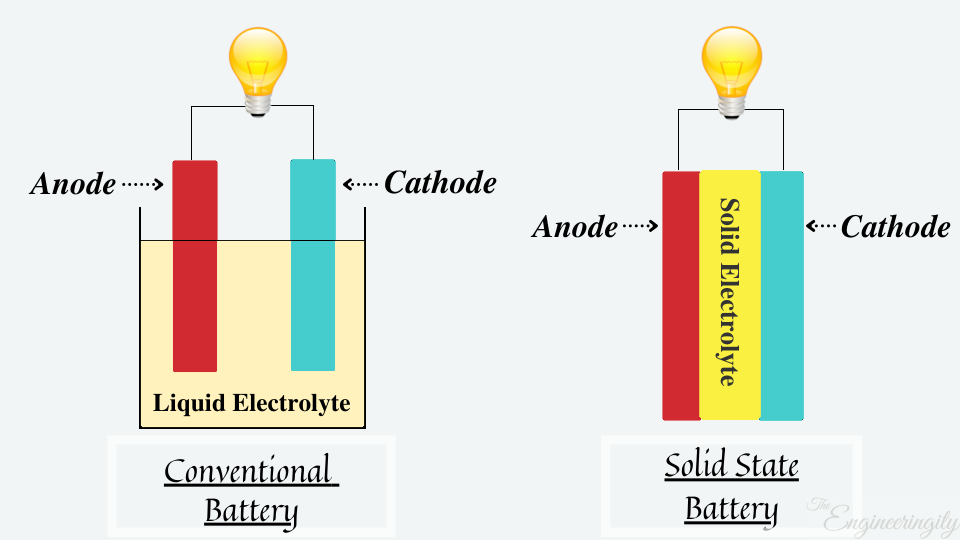
     Have you seen a few pictures of smartphone explosions, if you have noticed them carefully, the reason is the battery behind them? Those batteries use a liquid electrolyte, the liquid electrolyte is flammable and the chances are high for exploding of the battery. 

    But what about pacemakers and RFID readers? Pacemakers and RFID readers use solid-state electrolytes in their volatile batteries, and the chances of exploding are almost negligible. Solid-state batteries are the future of battery technology and consumer electronics and electric vehicles.

    What is solid state battery? | All about solid state battery


      What Solid-state Batteries are?

      • In solid-state batteries, the electrolyte used is solid form. An example of it is Lipon Lithium phosphate glass.
      • Compared to liquid electrolyte batteries(Conventional batteries), solid-state batteries are high in energy density because in liquid electrolytes large separators are used between the liquid cells.
      • Whereas solid-state batteries require a very thin barrier to prevent a short circuit.
      • Solid-state batteries can pack in as much energy as lithium-ion and normal liquid electrolyte battery separators come with 20 to 30 microns thickness. Whereas solid-state batteries can decrease this separated distance down to 3 to 4 microns charging time.
      • Solid-state batteries can charge 6 times faster than liquid-state batteries.

      • 5 Comments
      Older Posts Home

      Like and Share our Facebook page

      The Engineeringity

      Blog Archive

      • ►  2020 (13)
        • ►  September (3)
        • ►  October (5)
        • ►  November (2)
        • ►  December (3)
      • ►  2021 (32)
        • ►  January (1)
        • ►  February (2)
        • ►  March (3)
        • ►  April (3)
        • ►  May (5)
        • ►  June (2)
        • ►  July (3)
        • ►  August (4)
        • ►  September (2)
        • ►  October (2)
        • ►  November (2)
        • ►  December (3)
      • ►  2022 (21)
        • ►  January (3)
        • ►  February (2)
        • ►  March (2)
        • ►  April (1)
        • ►  May (1)
        • ►  June (2)
        • ►  July (2)
        • ►  August (2)
        • ►  September (1)
        • ►  October (2)
        • ►  November (1)
        • ►  December (2)
      • ►  2023 (16)
        • ►  January (2)
        • ►  February (2)
        • ►  March (2)
        • ►  April (1)
        • ►  May (1)
        • ►  June (2)
        • ►  August (1)
        • ►  September (2)
        • ►  October (1)
        • ►  November (1)
        • ►  December (1)
      • ▼  2024 (3)
        • ►  January (2)
        • ▼  June (1)
          • Japanese Brands Electric Car Aversion: Decoding Tr...

      Featured post

      Mini Project On "Hydraulic Powered Track".

      What is Hydraulics?  Hydraulics is a technology and applied science using engineering, chemistry, and other sciences involving liquids' ...

      About Blog


      Hi! I'm owner of Engineeringity

      Student by profession, joined blogger as a hobby, and want to explore more about curious things.

      Get latest updates straight to your inbox!

      Enter your email address:

      Delivered by FeedBurner

      Popular posts

      Search this blog

      Labels

      automobile (22) Facts (12) Inventions (10) stories (10) 7 lessons (9) automotive-innovators (9) Engineering (7) electric vehicle (7) Hydrogen (6) Aircrafts (5) green-energy (5) Fuel cells (3) Projects (3) Fluid Mechanics (2) Solid State battery (2) festivals (2) drone (1)

      Pages

      • About Us
      • Disclaimer
      • Privacy Policy
      • Terms and Conditions
      • Contact Us
      • Sitemap

      Pages

      • Feedback Form
      • Feedback Survey
      • Complaint Form

      Copyright@2019-2022 Engineeringity All Right Reseved

      Created with by OmTemplates | Distributed By Gooyaabi Templates