• Home
  • Projects
    • Hydraulics
    • Kinematics
  • Automobile
    • Automotive Innovators
    • Electric vehicles
  • Inventions
    • Inventions
    • Intresting Facts
    • Stories
  • Aviation
    • Aircrafts
    • Drones
  • About Us
    • About Us
    • Terms in use
    • Privacy Policy
    • Disclaimer
  • Contact Us
  • Sitemap

The Engineeringity

 The modern wiper technology we all have taken for granted was born because of one man's flash of genius, Prof. Robert W. Kearns created the efficient wiper technology and grabbed inspiration from the human eye. The wiper technologies before his were pretty inadequate and obstructed the driver's eyesight, Mr. Kearns's wiper technology was so original and brilliant that the ford company tried to steal it.

Invention of intermittent windshield wiper | Robert Kearns | Flash of genius


Let's analyze the details of his brilliant invention. First, we need to understand professor Kearns's mistakes while developing their wiper technology. Wiper blades achieve an oscillating motion with the help of a four-bar linkage mechanism, a dc motor drives a worm in the worm gear assembly, which is used for torque multiplication. This mechanism gives the continuous movement of the wiper but these continuously moving wipers can block the vision of the driver. The continuously moving wipers will significantly affect your vision even during light rain. Here comes the genius of Mr. Robert Kearns who presented the idea of periodical wiping. He observed that humans blink their eyelids but this blinking never obstructs their vision, the reason we are unconscious of our blinking is that it's intermittent our eyelids take a long rest after each blink. This long rest at the extreme ends is why our eye blinking does not interrupt our eyesight in terms of driving. If we stop the wiper blade for a certain period after each wiping cycle would reduce interference with the driver's vision this moment was professor Kearns's flash of genius.

Cam Arrangement in Bar linkage mechanism

We can achieve this intermittent wiper design using a cam arrangement. The motor's output can be connected to a cam which will move the wiper for only a short period and stop for a dwell period at the bottom of the windshield. we have achieved intermittent wiping or we can see the problem with the design. The reality is that a wiper technology's dwell time or rest time should be differed based on the amount of rainfall. In a low rainfall situation, you need a long dwell time whereas in a heavy rainfall situation, you need a shorter dwell time-varying the dwell time using a purely mechanical arrangement is not practical. In fact, Prof. Kearns was so smart that he realized the issue of intermittent wipers and he didn't even try this design to achieve a varying dwell time wiper design the solution cannot be strictly mechanical it should possess electronics as well.

Adding electronics solutions to it

This realization was Kearn's second flash of genius for this purpose he developed an electronic circuit with all these features embedded in it. To understand the circuit let’s recollect some basic details about transistors. The transistor turns on when its base is forward-biased and it is reverse-biased when turned off.

He introduced a double-throw switch to make the switching of forward and reverse bias states easier when the switch is in this condition the base is forward biased and the circuit is on when the switch is in state b the base goes for reverse biased condition and the current flow stops in the circuit. He used this transistor circuit to power the wiper motor here the wiper mechanism is directly connected to the motor output. This is obviously a continuous wiping interestingly a cam connected to the motor can easily operate the switch and the circuit goes off the wiper is in the dwelling stage now. However, this is an infinite dwell time this circuit won't be able to turn on the motor again. 

Let's go back to the active stage and try to fix this issue this circuit is an active stage now and introduces a capacitor resistor pair in the circuit, the current flow direction in the resistor, due to this resistance there will be a potential difference between the two terminals of the capacitor and this will make the capacitor get charged. When the cam operates the switch the circuit goes off state as we know earlier now the charged capacitor acts as a hero it's ready for release the potential at point B is always fixed, however, the potential at point a will change during the discharge. Let's assume when the capacitor is fully charged the potential at point a is more than at point B the transistor is obviously reverse-biased however as the capacitor starts to discharge the voltage at point drops at some instance voltage at point A becomes less than at the point B and the transistor becomes active the time duration of discharge of the circuit to activation of the base is the dwell time of this wiper.

The interesting thing is that we can easily adjust this dwell time by altering the resistance value. If the resistance is more then dwell time will be more, this way using clever electronics professor Kearns achieved a variable dwell time wiper mechanism. The heart of this invention is a brilliant electronic circuit but it is driven by a mechanical switch absolute genius right. 

However, during heavy rainfall, we need almost zero dwell time it's not practical to achieve zero resistance, and thus zero dwell time during heavy rainfall the friction between the glass and wiper is very low.

During its dwell or non-active stage the circuit is connected but the wipers still have a good momentum they will continue the downward movement since the frictional force is low due to the wiper's high momentum they provide the driving force for the rest of the mechanism in the cam rotates this leads to activation of the motor again, in short, the inertia of the wipers helps to skip the dwell period of the mechanism this is a crude method to get continuous wiping from an intermittent agent in professor Kearn's patent, he has even elaborated more sophisticated circuits to achieve the continuous wiping modern-day wipers consist of relays instead of cams to drive the wiper motor the dwell time can be accurately measured and changed using timer circuits and microcontrollers also these microcontrollers take input from moisture sensors or rain sensors present on the windshield to automatically wipe the windshield if it's wet after developing such a brilliant wiper design.

What happened to professor Kearns was tragic he had to spend a good part of his life in court battles against ford motor company for infringing his patent finally he won the legal battle.

The fact that simple observations can lead to amazing inventions.

  • 0 Comments

 On a December afternoon in Chicago during the epicenter of World War II scientists cracked open the nucleus at the center of the uranium atom and turned nuclear mass into energy over and over again. They did this by creating a chain reaction inside a new engineering marvel the nuclear reactor for the first time. Since then the ability to mind great amounts of energy from uranium nuclei has led some to build nuclear power as a plentiful unrealistic source of electricity.

A modern nuclear reactor generates enough electricity from 1 kilogram of fuel to power an average household for almost 34 years but rather than conquer the international electricity market. Atomic power has declined from an all-time high of 18 % in 1996 to 11 % today and it's envisioned to drop further in the coming decades.

Nuclear Power Plant Working

What happened to the great promise of this technology?

It turns out nuclear power faces many hurdles including high construction costs and public opposition and behind these problems lie a series of unique engineering challenges.

How does nuclear power work?

Nuclear power depends on the fission of uranium nuclei and a controlled chain reaction that multiplies this splitting into numerous more hearts. The atomic nucleus is densely packed with protons and neutrons found by a strong nuclear force. Most uranium atoms have a total of 238 protons and neutrons but roughly 1in every 140 lakhs three neutrons and this lighter isotope is less tightly bound. Compared to its abundant cousin a strike by a neutron can easily split the u-235 nuclei into lighter radioactive elements called fission products. In addition, 2-3 neutrons gamma rays, and a few neutrinos.

During fission some nuclear mass converts into energy a fraction of the newfound energy powers the fast-moving neutrons and if some of them hit uranium nuclei fission results in a second larger generation of neutrons. If this second generation of neutrons strikes more additional uranium nuclei then more fission results in an even larger third generation and the chain goes so on. But inside a nuclear reactor, this spiraling chain reaction is tamed using control rods made of elements that capture excess neutrons and keep their number in check. With a controlled chain reaction a reactor draws power steadily and is stable for years. The neutron lead chain reaction is a potent process driving nuclear power but there's a catch that can result in unique demands on the production of its fuel. It turns out most of the neutrons emitted from fission have too much kinetic energy to be captured by uranium nuclei the fission rate is too low and the chain reaction fizzles out.

Light water reactor

The main nuclear reactor created in Chicago used graphite as a moderator to disperse and slow down neutrons just enough to grow their capture by uranium and boost the rate of fission. Modern reactors commonly use purified water as a moderator but the scattered neutrons are still a little too fast to compensate and keep up the chain reaction the concentration of u-235 is enriched to 4 to 7 times its natural abundance. Today enrichment is often done by passing a gaseous uranium compound through centrifuges to separate lighter u-235 from heavier u-238. But the same process can be resumed to highly enriched u-235 up to 130 times its natural abundance and create an explosive chain reaction in a bomb. Methods like centrifuge processing must be carefully regulated to limit the spread of bomb-grade fuel.

Remember only a fraction of the released fission energy goes into speeding up neutrons most of the nuclear power goes into the kinetic energy of the fission products. Those are captured inside the reactor as heat by a coolant usually purified water. This heat is ultimately utilized to drive an electric turbine generator by steam just outside the reactor. Water flow is critical not only to create electricity but also to guard against the most dreaded type of reactor accident the meltdown. If the water flow stops because a pipe carrying it breaks or the pumps that push it fails the uranium heats up very quickly and melts during a nuclear meltdown radioactive vapors escape into the reactor, and if the reactor fails to hold them a steel and concrete containment building is the last line of defense. But if the radioactive gas pressure is too high containment fails and the gases escape into the air spreading as far and wide as the wind blows. The radioactive fission products in these vapors eventually decay into stable elements while some decay in a few seconds others take hundreds of thousands of years the greatest challenge for a nuclear reactor is to safely hold these products and keep them from damaging humans or the environment.

Storage of Fuel

Containment doesn't stop mattering once the fuel is used up it becomes an even greater storage problem. Every one to two years some spent fuel is removed from reactors and stored in pools of water that cool the waste and block its radioactive emissions. The irradiated fuel is a mixture of uranium that failed to fission products and plutonium a radioactive material that is very rare in nature this mix must be separated from the environment until it has all safely decayed, many countrysides propose deep time storage in tunnels mined far underground, but none have been built and there's great uncertainty about their long-term security.

How can a nation that has lived for only a few hundred years plan to protect plutonium through its radioactive half-life of 24,000 years? today many nuclear power plants sit on their waste instead of storing them indefinitely on-site, Apart from radioactivity, there's an even greater danger with spent fuel. Plutonium can uphold a chain reaction and be excavated from the waste to make bombs storing spent fuel is thus not only a safety hazard for the environment but also a protection risk for nations.

Who should be the watchman to safeguard it? imaginative scientists from the earlier years of the nuclear age pioneered how to reliably tap the enormous amount of energy inside an atom as an explosive bomb and a controlled power source with incredible potential. But their successors have learned humbling insights about the technology's not-so-idealistic industrial limits. Mining the subatomic realm makes for complicated, costly, and risky engineering.

  • 2 Comments

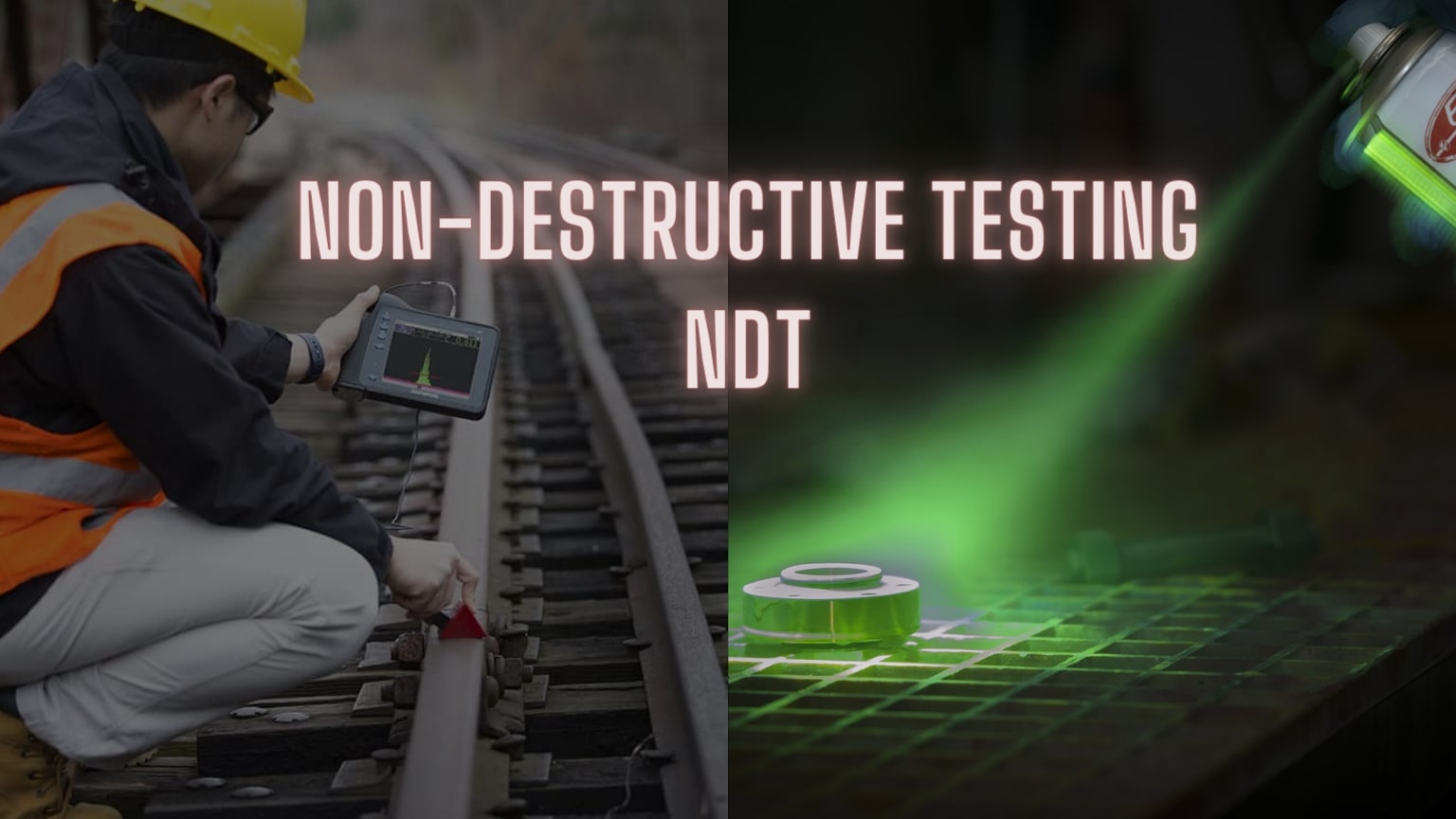
 Millions of people drive over bridges every day. You probably don't give it a second thought when you're commuting to work or traveling for the holidays. Factors like wear, exposure to the elements, and the age of a bridge will cause decay. Without proper maintenance, a bridge's structure can weaken, and the consequences can be dangerous. To keep proper maintenance of the bridge  "Non-destructive testing" helps to detect defects on the bridge before they could become a significant problem.

NDT | Types of NDT | Non Destructive Inspection

In the same way, NDT can be done on the pipelines, the automotive industry which relies regularly upon wear and tear, Railroads, ships, and many more industries.

WHAT IS NDT?

Nondestructive testing (NDT) is the process of inspecting or evaluating materials, components, or assemblies for discontinuities, or differences in characteristics without destroying the serviceability of the part or system. In other words, the amount can be still used when the inspection or test is completed.

Nondestructive testing or non-destructive testing (NDT) is a wide group of analysis techniques used in the science and technology industry to evaluate the properties of a material, component, or system without causing damage.

The representations of nondestructive inspection (NDI), nondestructive examination (NDE), and nondestructive evaluation (NDE) are also normally used to define this technique. 

During the process of casting a metal object, for example, the metal may shrink as it cools and cracks or even introduce voids inside the structure. During their service lives, many industrial components need regular non-destructive tests to detect damage that may be difficult or expensive to find every day.

What are the Types of NDT?

1. Dye Penetration Testing

2. Ultrasonic Testing

3. Magnetic Testing

4. Radiography testing

DYE PENETRANT TESTING

Liquid Penetrant Testing (LPT), also anointed Dye Penetrant Inspection (DPI) and Penetrant Testing (PT), is widely used to detect surface defects in castings, forging, welding, material cracks, porosities, and possible fatigue failure areas.

Dye penetrant inspection can be applied to both ferrous and non-ferrous materials and all non-porous materials (metals, plastics, or ceramics).

Dye Penetrant Inspection | Liquid Penetrant Testing | Steps for Dye Penetrant Testing

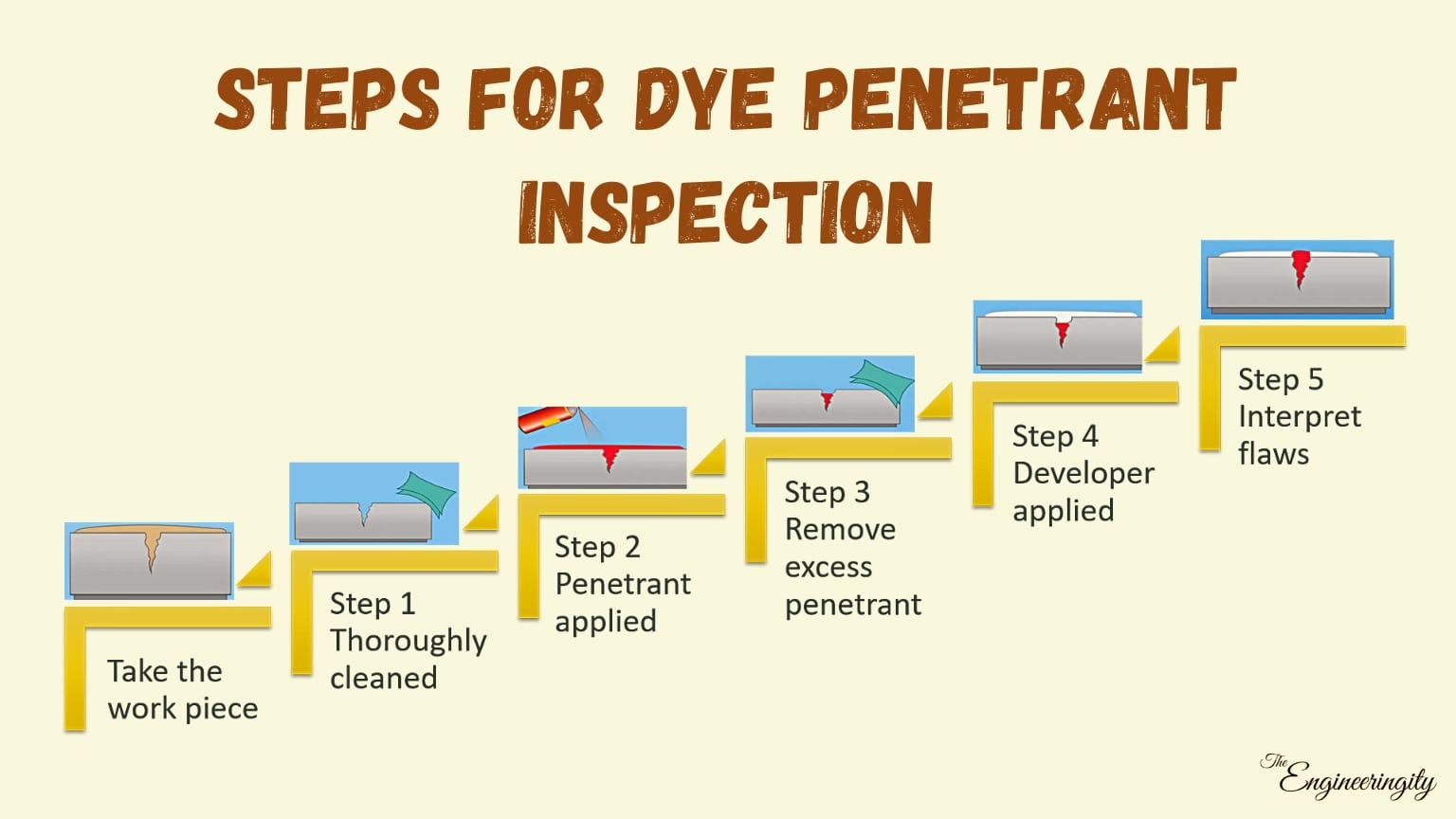
Steps for Dye Penetration:

Take the workpiece

Step 1: Clean it thoroughly.

Step 2: Penetrant applied.

Step 3: Remove excess penetrant.

Step 4: Developer applied.

Step 5: Interpretation of flaws.

Advantage:

  • High sensitivity
  • Rapid inspection
  • Visual inspection
  • Low cost

Disadvantage:

  • Only surface defects
  • Only non-porous required
  • Direct access required
  • Chemical handling and disposal

ULTRASONIC TESTING:

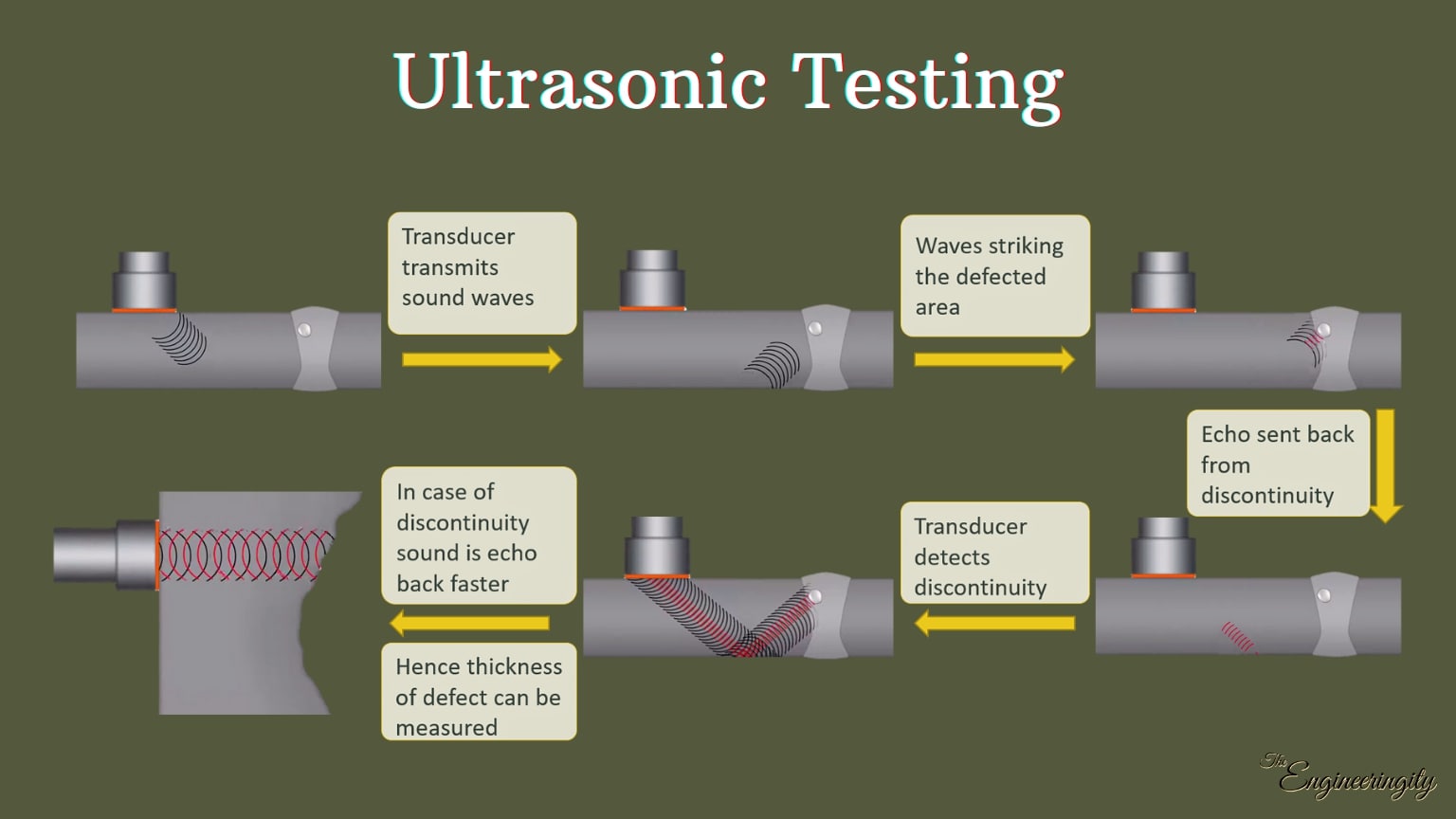
Ultrasonic testing (UT) is a type of non-destructive testing technique based on the propagation of ultrasonic waves in the object or material tested.

Steps for Ultrasonic Testing | How ultrasonic Testing works

In most common UT applications, very short ultrasonic pulse waves with center frequencies ranging from 0.1- 15 MHz, and occasionally up to 50 MHz, are transmitted into materials to detect internal flaws or to characterize materials.

Advantages:

  • Internal defects can be detected
  • Access to only one side of the component is needed
  • There is no radiation hazard
  • Thick specimens can also be examined easily

Disadvantage:

  • A high degree of operator skill is needed
  • More expensive than other methods
  • Needs a relatively smooth surface to couple the transducer
  • Difficult to use on thin materials

MAGNETIC PARTICLE TESTING

Magnetic particle Inspection (MPI) is a non-destructive testing (NDT) process for detecting surface and slightly sub-surface discontinuities in ferromagnetic materials such as iron, nickel, cobalt, and some of their alloys.

The process puts a magnetic field into the part. The piece can be magnetized by direct or indirect magnetization

Also known as Magnaflux. This method is used to detect surface discontinuities in ferromagnetic substances. This is also used for test weld works. It is a simple and easy technique.

Types of Magnetization:

1. The specimen can be magnetized either by direct magnetization or by indirect magnetization.

Direct magnetization occurs when an electric current is passed directly through a specimen to produce a magnetic field.

In Indirect magnetization, the magnetic field is applied by using a strong external magnetic field without passing a current through a specimen.

Whereas indirect magnetization can also be done by using permanent magnets or electromagnets.

Since magnetic fields in permanent magnets cannot be varied, Electromagnets are preferred usually for testing.

Steps for Magnetic Particle Testing | MPT

Procedure for Magnetisation:

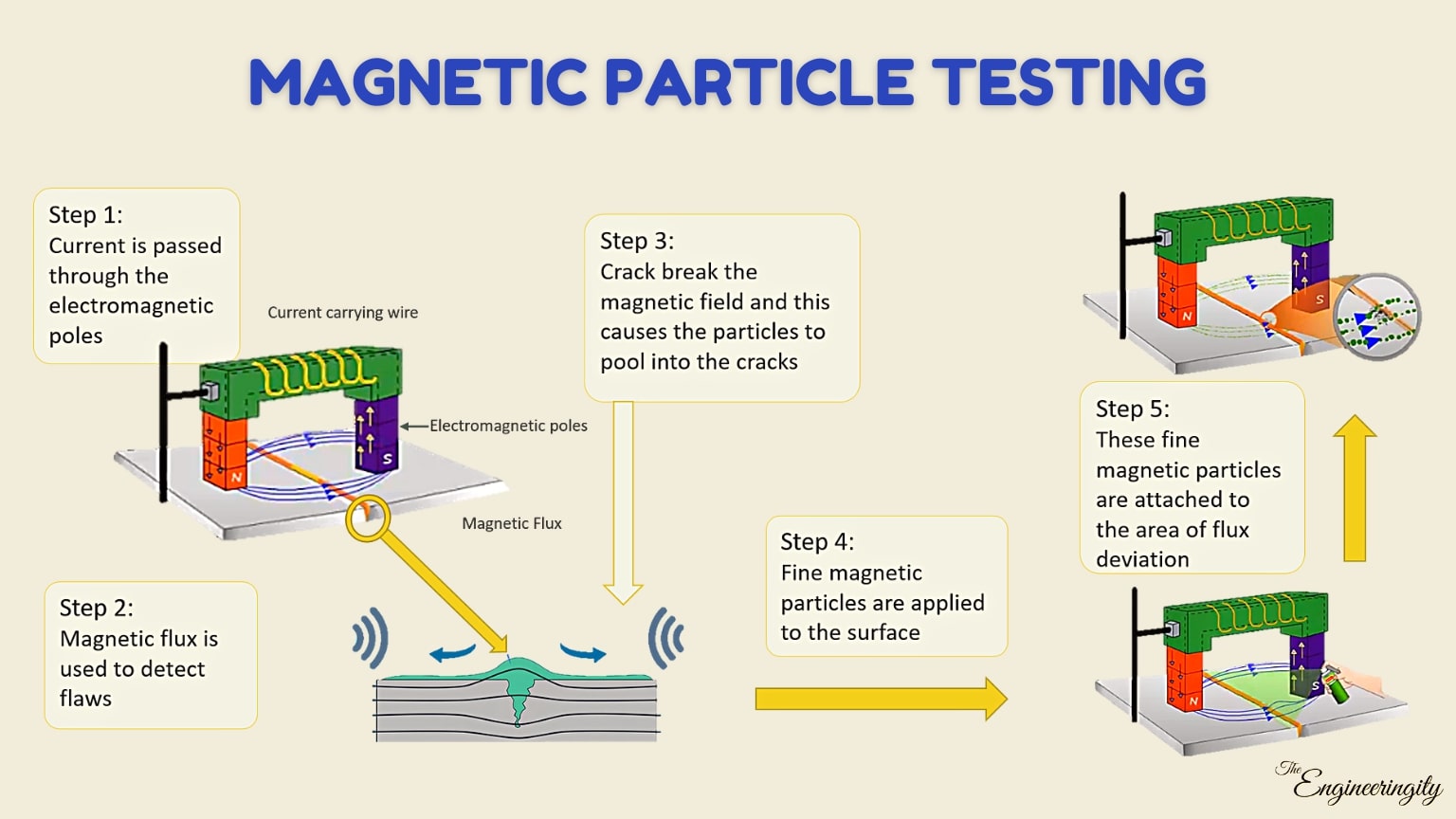
To know how the procedure is done using Electromagnets, let’s take a look at the schematic representation of it.

The component that is to be tested is cleaned first.

Step 1: The electromagnet consists of a coil of wires through which current is supplied to produce the magnetic field.

Step 2:  Magnetic flux is used to detect the flaws in the specimen.

If we elaborate on the welded part of the specimen.

This flux line running along the surface will deviate from the path if it approaches a crack.

Step 3:  Fine magnetic particles are applied to the surface of the specimen for visible indication of cracks.

Step 4:  These fine magnetic particles are attracted to the area of flux deviation. creating a visible indication of flaws.

Advantage:

  • High sensitivity

  • Rapid inspection of large areas and volumes
  • Suitable for parts with complex shapes.
  • Low cost

Disadvantage:

  • Only surface-breaking defects can be detected
  • Restricted to ferromagnetic substances.
  • Direct access to the surface is required.
  • Chemical handling and disposal.

RADIOGRAPHY TESTING

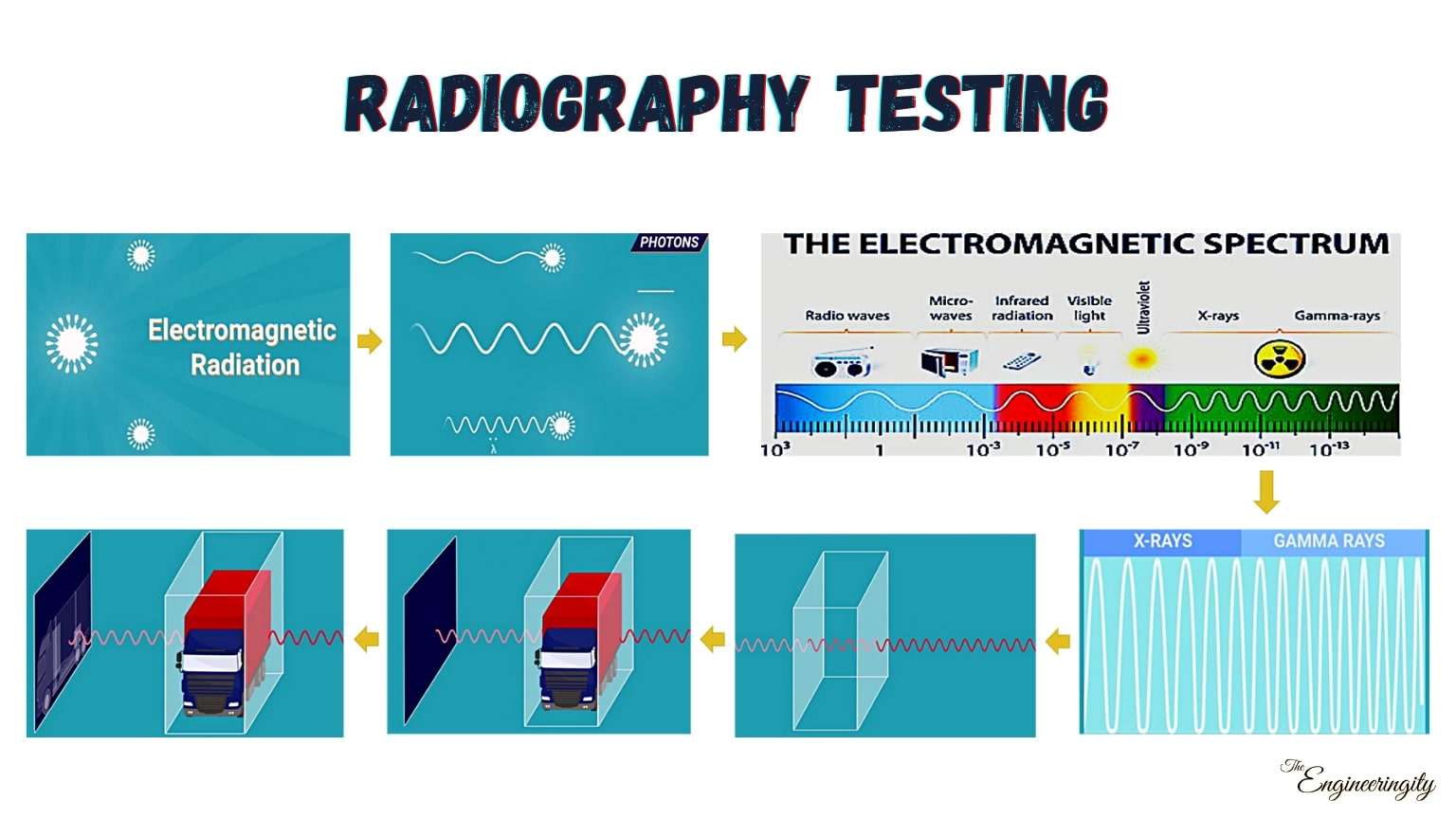
Radiographic Testing (RT), or industrial radiography, is a nondestructive testing (NDT) method of inspecting materials for hidden flaws by using the ability of short wavelength electromagnetic radiation (high energy photons) to penetrate various materials.

Radiographic Testing procedure

Either an X-ray machine or a radioactive source can be used as a source of photons This can see different things from X-rays because neutrons can easily pass through lead and steel but are stopped by plastics, water, and oils.

Advantage:

  • It has very few material limitations.
  • Minimal or no part preparation is required.
  • RT provides images of the object under inspection.
  • Can detect hidden areas.

Disadvantage:

  • Slow process.
  • A few seconds of being exposed to radiation can result in severe injuries.
  • A high degree of skill and experience is required.
  • It is quite an expensive method.

APPLICATION OF NDT

•NDT is commonly used in forensic engineering, mechanical engineering, petroleum engineering, electrical engineering, civil engineering, systems engineering, aeronautical engineering, medicine, and art.

•Non-destructive testing detects defects on bridges before they could become a significant problem.

•NDT ensures that railroads remain operational and flaws are caught well before they could pose a danger.

•Aircraft take a lot of stress from frequent landings and harsh environmental conditions. That is why prevention through regular non-destructive testing on-air and spacecraft is vital.

  • 2 Comments

 Some interesting and surprising facts about one of the most successful Japanese electronics companies ever Panasonic.

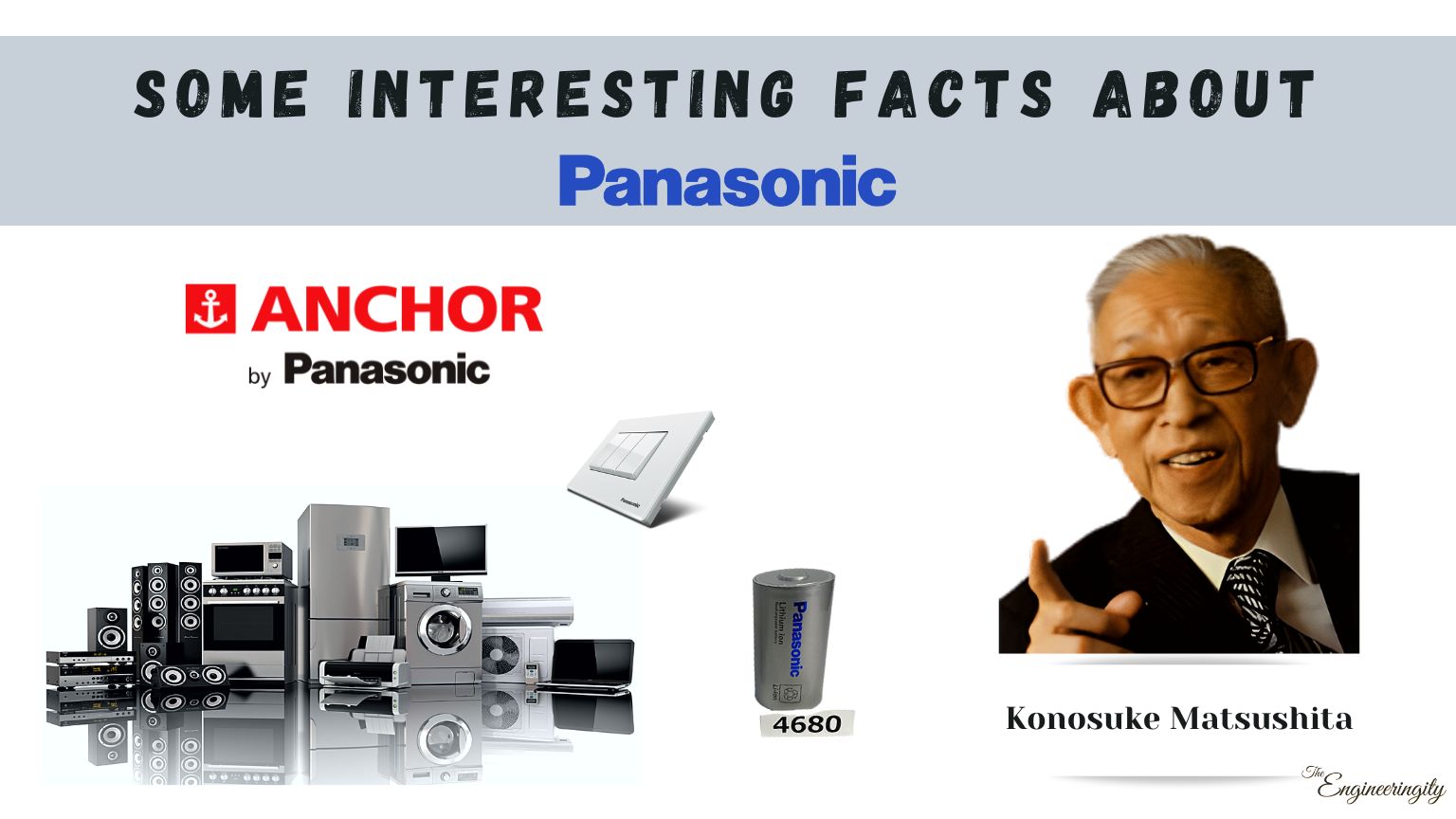
4680 Battery | Anchor Panasonic | Panasonic Facts | Konosuke Matsushita

Panasonic was founded in 1918 as the Matsushita electrical housewares manufacturing works by Konosuke Matsushita. Matsushita used his innovative spirit to expand the company from offering a straightforward product to producing quality electrical products in a short amount of time although the company was devastated by war Matsushita’s leadership drove the company to rebuild into an even stronger and more successful company. Matsushita’s spirit continues to drive the company as his work ethic dedication to quality and forward-thinking nature are the basis of all their business operations. Now 100 years after its founding Panasonic is a multi-billion dollar company that offers a wide range of electronic goods including cameras televisions, audio equipment, home theatres, phones, and more. Inspired by Panasonic's long history of ability to adapt to incredible success and forward-thinking nature it's time to take a closer look at this multinational electronics corporation with the 15 things you didn't know about Panasonic.

1. History of Panasonic

Panasonic started as a seller of light bulb sockets although today Panasonic is known the world over as a multi-faceted electronics company it had a very simple beginning. In 1918 the company was founded by Konosuke Matsushita and only had two other employees his wife and his brother-in-law Its only ventures at the time were selling light bulb sockets. In 1927 production expanded into bicycle pumps followed by light fixtures motors electric irons and vacuum tubes.

2. Panasonic built ships and Airplanes In WWII

During the Second World War Panasonic switched its focus to supporting the war effort this led to Panasonic setting up shipbuilding and plane-building sectors but it proved to be difficult since nobody at the company had any experience in these areas. However, they did successfully produce 56 wooden ships and 3 wooden aircraft during the war however Panasonic suffered many losses during the war including 32 Factory and office facilities and about 11,000 staff members.

3. The Company was not called Panasonic

2008 Panasonic was called the Matsushita Electrical Industrial Company from 1935 to October 2008. Panasonic was first used as a brand name in 1955 for audio speakers the Panasonic name was created out of a combination of the words pan and Sonic which the company says the meaning of bringing the sound the company makes to the world number.

4. Panasonic and Tesla are business partners

In July 2014 Panasonic announced that it had made an agreement with Tesla to participate in a massive battery plant called the Giga factory that Tesla plans to build in the US by 2020 the plan is estimated to cost 5 billion dollars and it's expected that it will result in reducing Tesla's battery (4680) costs by 30%. Panasonic announced its initial investment in the Tesla Motors battery factory would amount to tens of billions of yen. Panasonic will provide Tesla with 4680 batteries by March 2024. Pansonic is to begin mass production of Tesla's new 4680 batteries by the end of the fiscal year 2024.

5. Universal Studios once belonged to Panasonic

In 1990 Panasonic purchased an American media company called the Music Corporation of America or MCA for 6.59 billion dollars five years later 80 % of MCA was sold to Seagram company for 7 billion dollars and the name was changed to Universal Studios Today Universal Studios is part of NBC Universal which is owned by Comcast.

6. Panasonic is one of the biggest supporters of the Olympic Games 

Panasonic has been one of the top sponsors of the Olympic Games ever since the 1988 Calgary Olympics. In 2008 Panasonic's HD equipment made the first Olympic Games with full HD official coverage possible at the 2016 Rio Games Panasonic provided 115 projectors which were used during the opening ceremony they also provided 10,000 surveillance cameras and various broadcasting equipment for the Sochi 2014 Winter Games these are just tiny samples of everything Panasonic does to support the Olympics.

7. They first expanded to the US market in 1961.

Konosuke Matsushita traveled to the United States for the first time in 1961 and he had a very successful trip where he met with American dealers and established agreements that would allow him to move to the US market the company began producing television sets for the US market shortly after under the brand name Panasonic and later on starting in 1979 Panasonic TVs were sold in Europe as well the company sold products under the national brand outside of North America from the 1950s to the 1970s however federal could not be used to sell products in the US due to the existence of the National Radio Company.

8. The Panasonic Toughbook claims 50 % of the rugged laptop market 

Toughbook is a brand name owned by Panasonic that refers to its line of rugged computers Toughbook is designed to withstand vibration spills drops extreme temperatures and rough handling tough books are widely used in a variety of industries including military construction health care law enforcement manufacturing oil and emergency services. Panasonic claims 50% of the so-called rugged laptop market with this one product alone.

9. Panasonic built the world's giant hi-def LED screen

Panasonic built the largest high-definition television LED screen at the Texas Motor Speedway in Fort Worth Texas in 2014 the world record-breaking screen is 2600 and 14 square feet with display dimensions of 94.5 feet by 218.4 feet the video board nickname is the Big Hoss TV and its consists of nearly 4.8 million pixels and displays 281 trillion colors it's bigger than two jumbo jets put together the screen is used to display live race coverage leaderboard information instant replays and interactive entertainment.

10. Panasonic invented a tomato-harvesting robot

Panasonic's newest robot was introduced in December 2017 at the robot exhibition in Tokyo the robot has been designed to use its camera range image sensor and artificial intelligence to only pick soon-to-be ripe tomatoes that are ready for harvesting this task was previously thought to be too delicate for a robot to handle without damaging the sensitive fruit or picking up undesirable Tomatoes but the Panasonic robot proved it was up to the task.

Panasonic also claims it can match human efficiency by harvesting 10 Tomatoes every minute.

11. Panasonic is the 97th most valuable brand in the world

Panasonic just made it into the top 100 of Forbes's most valuable brands list the company comes in at number 97 between Walgreens and Nivea the Panasonic brand is valued at 6.9 billion dollars.

12. A stone monument marks where Panasonic was founded 

In November 2004 on the 110th observance of the birth of Panasonic founder Konosuke Matsushita, a stone monument was unveiled that marks where the 23-year-old Konosuke founded the Matsushita Electric housewares manufacturing Works which later became Panasonic. The stone monument is located in Okie rocky Japan in Osaka Fukushima the monument is 1.8 meters high and 2 meters wide and is inscribed with the Japanese character for the path as written by Konosuke himself.

13. Panasonic is the title sponsor for the new Jaguar Formula E team

At the beginning of 2016, Jaguar announced that it would be joining the all-electric Formula E racing series, and nine months later it was announced that Panasonic would be their title sponsor the official name for the racing team is Panasonic Jaguar Racing. The team's car is a Jaguar I type 1 and of course, large Panasonic logos can be seen on it from every angle.

14. The founders of Panasonic and Sanyo were brothers-in-law

After World War, II Panasonic founder Konosuke Matsushita set about trying to refocus and rebuild his company meanwhile his brother-in-law Toshio Liu founded Sanyo as a subtractor for components the two companies became competitors in the same market but long after the two founders had passed away the companies merged when Panasonic bought Sanyo in December 2009. Toshio Liu was one of the three original employees of the Panasonic company.

15. Panasonic set a record with their Evolta batteries

In 2015 Panasonic set a Guinness world record for the longest distance traveled by a vehicle on a railway track powered by dry cell batteries in an attempt to demonstrate the strength and durability of their Evolta batteries Panasonic powered a small train solely with 600 of their batteries and it traveled 14.05 miles before running out of power the two-hour 36-minute train ride took place in Akita Japan and the train was built by 13 local high school students.

In 2014 to attract more workers to its Chinese operations Panasonic offered to pay ex-pats hazard pay to compensate for the chronic air pollution they are subjected to as they work in the heavily polluted environment China has the world's worst air pollution with over 3 million deaths per year being attributed to the toxic air.

  • 0 Comments

 The man who pioneered the Indian nuclear research program Homi Jehangir Bhabha was a nuclear physicist who laid the foundation for nuclear research in India often called the father of the Indian nuclear program. He established the main two institutions one them is TIFR(Tata Institute of Fundamental Research) and the second AEET(Atomic Energy ) which later after his demise was changed to Bhabha Atomic Research Center(BARC) is located in Trombay.

Father of India's Nuclear power Programme | BARC | TIFR

An institution builder and a visionary scientist Dr. Homi Bhabha was a brilliant and hardworking student since childhood and his parents dreamed of him becoming a mechanical engineer. However young Bhabha's interest fibbed in studying physics and not in becoming an engineer yet he honored his parent's wish and completed his degree in mechanical engineering. His parents appreciated their son's genuine interest and supported him in his pursuit of scientific research. Studying in Europe Bhabha became familiarized with many great physicists of his time and was resolute in contributing to India's scientific research on his return, he had wildly ambitious plans upon returning to his home country. From establishing the Cosmic Rays Research Unit he helped to formulate India's strategy in the field of nuclear power for which he is fondly remembered as the “Father of Indian nuclear power”.

Early life Homi Bhabha's

Dr. Homi J Bhabha was born on 30 October 1909 in Bombay into the home of a well-known Parsi lawyer Jahangir Hormuji Bhabha and his wife Meheren his family was very wealthy and prominent and he was related to the Dorabji Tata after receiving his primary education at Bombay's Cathedral and John Connon school. He took his secondary college at Elphinstone College(located in Mumbai, Fort). Then he studied at the Royal Institute of Science till 1927 his parents and uncle Dorabji Tata who was a big industrialist at that time wanted the brilliant young Homi to study mechanical engineering at Cambridge University so that he could join Tata Steel Mills upon his return to India.

Homi Bhabha Turning point of Life

Going to Cambridge University can also be called his turning point. Because at that time Cambridge University had become the center of the latest innovations. Homi went to Cambridge University where he began studying mechanical engineering but soon he realized that his true potential wasn't engineering but the pursuit of science. He told his parents of his goal his father was a thoughtful person and promised to finance Homi’s further studies in science. He completed his mechanical engineering in first-class passing the mechanical engineering exam in 1930. Keeping up with his promise his father let him continue his studies Homi studied mathematics under Paul Dirac and he was influenced by him very much. Paul Dirac was the one who articulated the existence of 'anti-matter' for the first time. Later for his contribution, he was awarded a Nobel prize.

Development of Nuclear physics

Impressed with his work, Homi J Bhabha started getting interested in nuclear research. Later he worked towards his doctorate in theoretical physics in 1933 he received his doctorate in nuclear physics and published his first scientific paper, “The Absorption of Cosmic Radiation” which helped him win the Isaac Newton studentship in 1934 which he held for the next three years. During the 1930s nuclear physics was an emerging area that usually was in the discussions in the scientific community several transformations were taking place in this field and Homi Bhabha was profoundly attracted to research in this domain.

During his studentship, he also worked with Neil Bohr in Copenhagen along with his research work at Cambridge where he published paper proceedings of the Royal Society Series A in 1935, wherein he gave the calculation to determine the cross-section of electron-positron scattering along with Neil Bohr he published a paper “the passage of fast electrons and the theory of cosmic showers” in 1936, where he explained how primary cosmic rays from outer space interact with the upper atmosphere. For his work, Bhabha was awarded the senior studentship in 1937 which permitted him to continue his work at Cambridge in 1939.

How did Homi Bhabha establish BARC?

Bhabha came to India for a short vacation when World War II broke out and this obstructed him from returning to Cambridge. So he accepted a position at the Indian Institute of Science Bangalore as a reader in the Department of Physics which was headed by the renowned physicist CV Raman.

In 1944 Baba felt that India needed laboratories and facilities to conduct research in nuclear science thus he decided to solicit the support of visionary and industrialist Dorabji Tata the Tata Trust accepted his proposal and the Tata Institute of Fundamental Research (TIFR) was established. In 1945 in Bombay which had the facilities for conducting large-scale research in physics, chemistry, electronics, and mathematics he also played a key role in the formation of the Atomic Energy Commission in 1948.

Then Homi Bhabha felt that atomic research would not be able to completed at TIFR so he requested the government to build a new laboratory government accepted his request and allotted 1200 acres of ground to build the laboratory and the Department of Atomic Energy in 1954 established naming AEET(Atomic Energy Establishment Trombay). Also known as Bhabha Atomic Research Center(BARC). He had acquaintances with other scientists all over the world whom he used to call in India and introduced them to Indian scientists so that Indian scientists could get something to learn and get encouragement.

Bhabha Scattering

He started research on Parmanu weapons. He was appointed as director of the parmanu program after the independence in 1948. And was officially given permission to develop Parmanu. His research on Bhabha scattering is been in the curriculum of nuclear sciences all over the world through nuclear physics. His research on Bhabha Scattering is still widely used today in the field of nuclear physics.

How Homi Bhabha helped Dr. Vikram Sarabhai

A visionary who had realized the importance of nuclear research programs way back in the 1940s when India was still under British rule. Their research has led to the development of nuclear sciences all over the world through nuclear physics. He envisioned a three-stage nuclear program consisting of the utilization of natural uranium, thorium, and plutonium in advanced nuclear reactors with a closed full circle because of this he was called the “father of India's nuclear power program”.

In 1954 he was honored with the Padma Bhushan the third-highest civilian award in India for his invaluable contributions to science and engineering. He also helped Vikram Sarabhai, a renowned scientist of that time, to form a national committee for space research. They were also known as Rocket Boys as they had achieved tremendous success in Rocketry. 

Rocket Boys

Homi Bhabha and Vikram Sarabhai played a significant role in the development of rocketry and space technology in their respective countries.

Homi Bhabha was an Indian nuclear physicist who played a crucial role in the development of India's nuclear program. He was also instrumental in setting up the Tata Institute of Fundamental Research, which played a significant role in India's early rocketry and space exploration efforts.

Vikram Sarabhai was an Indian physicist and astronomer who is often referred to as the father of India's space program. He established the Indian Space Research Organisation (ISRO) in 1969 and oversaw the development of India's first satellite, Aryabhata, which was launched in 1975.

Their contribution towards the Indian Space program and Nuclear energy Programme is tremendous so a web series dedicated to the life of Nuclear Scientist Dr. Homi J. Bhabha and Space Research scientist Dr. Vikram Sarabhai named Rocket Boys is streaming on Sony Liv.

How did Homi Bhabha die?

Homi Bhabha was a bachelor man who fully devoted his life to science he had a hobby of painting and loved classical music and opera. He abhorred the Air India flight 101 which crashed near Mount Blanc in the Alps on January 24th, 1966 and he died in that plane crash. The great scientist's brilliant career was cut short by a plane crash that claimed his life. Later,  AEET was renamed Bhabha Atomic Research Center in memory of Dr. Homi J. Bhabha. He will be always remembered for his tremendous contribution to the area of Parmanu.

  • 0 Comments

 In California, it can be difficult to be a car enthusiast. You've got smog checks(A test for emissions produced by an automobile, required for vehicle registration), and CARB compliance regulations on what modifications you're allowed to execute. It can be rather demoralizing seeing what's allowed in other states, but not mine. But what if you lived in a place where you couldn't make any modifications to your car at all? Not even paint. Well, that's exactly the kind of law that passed in India 2 years ago. Can car enthusiasts enjoy cars if they can't modify them?

Modification of car which are legal in India | Facts about car modification in India | Car modification companies in India

So before we get into India's controversial law banning car modification. Let's set the scene for the Indian automotive world. The whole car scene modification means getting those big cars and sports cars and stuff. It's been a privileged thing. So it has always been limited to people who can afford it and do it. But for a majority of people, there are financial restrictions. Car ownership in India is often a need but also bears a high charge. You need a car to get you to work and back but you are only looking to spend what is required. That sounds like a lot of places, America included but what hits the Indian market the hardest is their essential duty tax.

What is Import duty in India?

To sell a car that was not made in India, the manufacturer must pay up to a 100%  import duty. Now Import duty is a tax gathered on imports and some exports by a country's customs authorities. A good's price will usually dictate the import duty. Depending on the context, import duty may also be known as a tariff, import tax, customs duty, or import tariff.  So immediately the cost of any car not made in India doubles. Because of this, plenty of manufacturers don't even bother shipping their sports cars to India.

India never got the MR2, the S2000, the Sylvia, the Evo, the WRX, the Camaro, the Corvette, or the charger just to name a few. But despite the tax, some global market cars do make it to India. BMW M2s, Porsche's GTRs. Even the 5.0 Mustang is obtainable at a significant premium. These are called CBU cars or complete-built units.

What are CBU or Complete Built Units?

Basically, CBU cars mean the car is completely built outside of India, but there is a different kinds of vehicles. The CKD or complete knockdown unit. Apart from being an awesome name for a hardcore band, the complete knockdown unit is a car that is assembled in India. Even though the components were made elsewhere. CKDs are subject to a lower tax as low as 15%. So if manufacturers have to build an assembly plant in India they can still save money with these market-specific cars to make a CKD car. in India, there are assembly plants for cars like the Jaguar XJ, Renault fluence, and land Rover evoke.

For many automakers, the procedure of getting even one model into the Indian market as a CKD or CBU is a difficulty in itself. And with sporty cars having such consolidated margins already, it took quite a while for some of the faster cars to create in the Indian market. For example, in the 2000s India didn't get the Mitsubishi Lancer Evo but didn't get the Mitsubishi Lancer Sedia, which was a little de-tuned version of a standard Lancer. At first, these Indian market offerings were not at all amazing, but as time went on more and more fun cars started to pop up, especially in the hot hatch segment. 

The Fiat Punto Abarth is one of the hottest cars in the Indian car scene with its 2-ton paint. The scorpion cloud version of the Punto does 0 to 60 in 8.8 secs and is built in Ranjangaon in Maharashtra, India. The Volkswagen polo is another go-to hatch in India and the Skoda Octavia RS 245 is a riotous four-door that's keeping up with the golf GTI and looks awesome. Devoted sports cars, it is tough to find or expensive to import. This sounds like a super ripe atmosphere that would get people modifying their cheaper cars. So in India, there are people who are looking for a regular car to get it modified through a proper modification company. So, they get a regular car maybe say a Volkswagen Polo which is pretty popular in India because it is already handled, much better than most cars, most hatchbacks in India.

Which region of India uses which automotive / India's car Manufacturing development

In a very comparable fashion to the United States, various regions of India develop different automotive selections over the past few decades. 

  • The Northern region with close access to the Himalayas got super into four-by-fours and off-roading out of necessity. Cars like the Toyota Fortuner and SUV built on the highlights podium are extremely widespread for being daily drivers with a bit of four-by-four wheeling ability. 
  • In contrast to that Southern India, often has better roads. The scene curved towards tuning and street racing. Modified Honda city type 2’s, and Skoda Octavias rip around on these super smooth streets. 
  • Then in major metropolia like Mumbai and Delhi where most of India's rich people live, you have the supercar scene and plenty of people with cash to spend on importing a car. Porsche, Ferrari, and Mercedes can be seen cruising around. 

But not just what we in the US think of us Supercars. Importing a car in any country is a lengthy and expensive process. And that's no different in India but apart from the high cost associated with it, import laws are actually pretty chill compared to the US.

In America, we have a 25-year import rule that States, that no vehicle from outside the US domestic market can be imported until the car is 25 years old. This has put a ticking clock on many beloved JDM in Europe cars. But surprisingly India doesn't have such a rule. As long as the vehicle meets emission standards and is right-hand drive, nothing else stops you from importing R34s, Holdens, and JZ X100s. Mostly there are not many importers in India. In India, there is a traditional way of getting vehicles. Wherein you have the manufacturer set up in the shop here you can contact them and they'll facilitate the whole thing. But don't go thinking that India is full of rare imports.

Indian car manufactures

Car nerds are still a very small portion of the 1.3 billion people that live and work in India. We who love cars aren't the majority of consumers in any market. Thus, the most popular cars in India are local offerings. The Indian branch of the Suzuki motor company is Maruti Suzuki. And by 1996, they had a 60% share of the Indian car market. Today cars like the Maruti Swift, Maruti Alto, and Maruti Baleno are the top-selling cars in India. And India's manufacturing is not just an echo chamber of India-only cars. 

In 2008, Indian manufacturer Tata Motors bought Jaguar and land Rover from Ford. And by 2011 India had become the sixth-largest car manufacturer in the world. India's high import duties and large market meant it made sense to build up manufacturing in India. And once a manufacturing plant is established it can be used. Today India makes over $1 billion in revenue from US domestic market in parts and vehicles. Ford's Eco sport is a crossover made in India design based on what the Indian market dictated and is now being sold here in the US. The auto industry in India has been developing more powerfully and stronger. While most performance cars are still expensive. Economy boxes with go-cart handling and four-by-fours with some off-road chops are manageable to find. And if you want a cool car but can't buy one, you can make it yourself.

Road safety and the protection of the environment Law

In January 2019, the Supreme court of India enacted a law ruling that any modification that takes a car out of OEM spec aka stock is regarded as illegal. So not just modifying engine swaps and turbos even wider tires, coil-overs, and plastic dip are banned. A police car can stop you from anything. Even if it's a race trip that you have on your bonnet. It's not permitted because of modifications of any sort, basic customization, or anything it is not allowed.

The Supreme court decided that this law was made in the name of "Road Safety and the Protection of the Environment". With more people buying cars every year in India, Mods could have a huge effect on your quality of life. Suppose 500 million people installed straight exhaust in their motorcars. This no-mods law is pretty harsh on paper, and the actual penalty is enough to get your car's registration taken away. But every major hub of car culture has had an epoch of outrunning the law. 

Car culture has never been slowed by laws. And while not favoring any rule-breaking, it's safe to say that the Indian car scene will succeed even with this delinquency. The more we learn about the automotive world oceans away, the more we get to appreciate how much cars give us so much curiosity. 

Mustang has always had great influence, across the world so as in India. So mustang has been that one car that everybody desires to drive and own. Driving a mustang in a city like Mumbai would get the most amount of attraction or eyeballs than any vehicle has ever received that sort of appreciation or that sort of love. We oftentimes all get snagged up in our own little bubbles of the car rules. So it is okay to reach out and get to chat with people who love the same things we do. 

  • 0 Comments

 The company we know today as Audi could have been named DKW or auto union if not for a decision made by parent company Volkswagen in the 1960s the brand's story begins with automotive pioneer and racing driver August Horsch who formed his first company in 1901 to build passenger cars his name means hark or listen in English, but Horsch was a man of vision as a businessman however horse was kicked out of his own company by the board of management and he went on to establish another firm in his hometown of Zwickau. Horsch established his new company “Audi” which means the Latin form of his name.

Four Rings premium carmaker| August Horch | Audi | Horsch | DKW | Wanderer

Audi was founded in 1909 in Zwickau Germany by August Horch with the purpose of industrial production of luxury cars. His aim was from the start the international market and he achieved this relatively fast. The company slogan is “Progress through technology” It is a top producer well known in the whole world with impressive annual figures and cars. The first Audi was built by hand and very few were sold, Horsch stayed with low volume low-profit production long after Audi's rivals had adopted henry ford's mass production technique within a few years howdy's cars had grown in size and engine displacement. Today the company is almost completely owned by the Volkswagen Group.

How did Audi get its logo?

The logo which proudly represents the prestigious company was created in a relatively tribal way. August Horch simply found inspiration in soap dishes which at the time had a distinct design made out of four class lines thus the distinctive aspect of German cars and logos was born. Audi respects tradition and has not implemented any modern models or lines, unlike other companies. This logo brings together the union of four different companies which created Audi in 1932, the Horsch, the Audi companies decided to establish the auto union with two other German companies DKW and the Wanderer, thus every company will specialize in a specific aspect both hork and Audi will produce luxury cars, wanderer will produce standard cars and DKW will produce small cars and motorcycles.

Audi took the slogan progress through technology very seriously by being the first car manufacturer to ever start a real impact test. The first one took place in 1938 it is important to understand the historical context all these impact tests were done by people it was a time when both the safety of the driver and the pedestrian were not entirely prioritized Audi deserves considerable praise for their safety efforts because their results were implemented by other companies too and they have summarized the safety efficiency that we are kept by and that we enjoy today. It is no surprise that Audi is one of the safest automobiles in the globe obtaining 5 stars reviews for many of their latest models safety also in terms of technology it is the first time when the name cuatro appears precisely in 1980 and was registered by Audi and used to name permanent all-wheel drive technology or system via a central differential on its models. In 1997 Audi was the first European car manufacturer to release a hybrid car in the market it was the a4 Avant.

Audi R8

Audi R8 is undoubtedly an example of high performance perhaps the finest car of the company the 2003 concept has an evaluated value of over 5 million dollars after no more than 3 years in 2006 inspired by the previous concept Audi released the R8 with only the soundest employees of the company had the opportunity and responsibility to operate on this expensive and accurate project for the building of the car more than 5000 parts and more than 70 hours are mandated.

Audi R8 carries a heavy price tag. The cost of the base model starts at approximately $1,43,000 for coupe models and $1,55,000 for convertible models, while the R8 V10 Performance costs about $197,000 for coupe models and $209,000 for convertible models. The Audi r8 v10 price in India is approximately Rs.2.72Cr.

History of Audi and its car racing 

Audi holds second place among car manufacturers at 24 hours le mans Porsche is the first with 18 victories closely followed by Audi with 13. Audi was the first car to have succeeded in the competition with a diesel engine in 2006 and after this accomplishment, Audi defeated the challenger for the first time with a hybrid car in 2012. Audi resumes innovative standing as the first car manufacturer to have ever built cars with a steering wheel on the left side, it happened for the first time in 1921 with a type k model this was legislated 16 years before Germany officially. It was the most evolved car in terms of engineering but it also created a challenging situation because the left-wheel drivers were made to drive on the left side of the road by the time driving was switched to the right side of the road to produce car accidents and to reduce the traffic Audi clever in new concepts the newest cars released on the market have shown impressive aspect for the headlights and tail lights trying to combine visibility importance with the most groundbreaking design in creativity and innovation.

Audi the Swarm lighting concept

Among these, there is the car concept Audi Swarm which materialized this concept with the new design of the model and interactive led lights to bring us closer to the future car. It is Something truly remarkable that stands out from the crowd how Audi invents itself and always brings new projects Audi implements upgrades and new ideas through crowdfunding intern tasks it turns out to be a very productive and ingenious idea. Audi curve fund brings together creative employees from a wide range of fields within internal investors so that the unit formed can execute bold ideas. This visionary working method is used to stimulate the initiative of our employees while boosting the team spirit within the company said the officials.

Audi and Electric cars

The first electric SUV is the Audi e-throne which was presented as a concept car in 2015 but it only reached the market in 2009 due to a long process of construction and adaptation thus Audi implemented a new range of cars among the others a comes from the standard of the luxury cars q comes from SUV models and e for electric vehicles although relatively new on the market each round has made prominent figures in Germany, Norway, Netherlands, Sweden and ranking in a top of electricity SUVs in Austria. Audi has made a good profit in the international market without neglecting exports to any continent in the united states one in three coups eight cars have been sold and is growing annually the biggest sales are in Europe and in China where a new record has been set 69083 cars in 2019.

What kind of features does Audi come with?

Audi is a respectable luxury car this can be seen in the equipment with which the company sells cars the majority of modern features come only with special separate packages, for example, the equipment from Audi q7 for the new dark edition package starts from 3740 euros, s-line exterior package, Audi exclusive aluminum wheels 5 spoke design with titanium optics Audi exclusive black optical package rear tinted windows 7 plus headlights features that bring improvements in appearance and not necessarily in mechanics.

The simplest and the cheapest set of features is the advanced type starting from 500 euros which offers an Audi parking system, heated front seats, cruise control, standing headlights, headlight washer system, front center armrest, and onboard computer therefore in some cases premium package only offers prestige not necessarily comfort. Audi has over 100 years of experience time in which it has revolutionized the audio industry countless times with bold cars project and concepts because it is an indulgence and one of the most well-known cars on the globe we can only anticipate the same efficiency and exceptional product that Audi has delivered so far.

  • 0 Comments

 We’ve all must have seen well-armed ragamuffins and ne'er-do-wells glorifying their various victories with some good old-fashioned upwards gunfire. After all, nobody says “I ran a 10k” or “We just overthrew the government” quite like pointing your gun to the sky and letting it near rip. But is it possible that this apparently innocent expression of gun-based joy could unsafe?

Can celebratory gunfire kill a person | Can a falling bullet kill a person

So there you are chuffed to bits at the victory of your preferred political candidate and overcome with an irrepressible urge to celebrate in the only way you know how. You grab whatever loaded firearm you have handy, rush outside, and start gleefully firing off, round after round into the air just as nature intended, when suddenly, a chilling thought falls upon you. These bullets have to come back down eventually, right? Unsurprisingly, the answer to this question is emphatic.

Where are the Factors that determine the factor of a bullet's path

When a gun is fired, several different factors determine the bullet’s path through the air on the way to its target. One of the first things to consider is ‘muzzle velocity, which is very simple, the speed at which a bullet is moving the instant it leaves the gun cask, or ‘muzzle’.This can vary considerably relying on the type of gun and round being used. The ever-popular AK-47 for instance is capable of firing bullets at around 715 meters per second, or about 2,350 feet per second, while in modern rifles, some of the speediest high-performance cartridges can achieve muzzle velocities of well over 1,200 meters per second, or about 4,000 feet per second.

Due to the effects of air resistance, bullets slow down pretty quickly after being fired and follow a route determined by various factors, including atmospheric pressure, humidity, and air temperature. However, the thing that pulls a fired bullet downwards is gravity, which assuming those other previous variables aren’t having an overwhelming effect, ensures that bullets travel back to earth in an approximately parabolic path.

Can celebratory gunfire cause injury to a person?

Now, celebratory gunfire differs substantially from regular gunfire in that it is generally not directed at people you want to shoot, but upwards and away from those you’re celebrating with,  who you don’t want to hit  (well, not usually anyway). That way, the bullets just disappear up into space, right? At least, that’s what people used to think. Early, pre-seventeenth-century studies suggested that bullets shot upwards do somehow achieve escape velocity and peace out into space. We now know that all shots shot from the surface of Earth never even leave the troposphere, the lowest layer of our planet’s atmosphere and unless you’re watching this from the  International Space Station,  the one you’re in right now.

What happens when a bullet is fired from a gun?

In reality, when a bullet is fired directly upwards,  the upward force accelerating the bullet drops off entirely the moment it leaves the chamber.  At this point, the bullet is at its maximum velocity and has its maximum kinetic energy. From this point, downward forces from gravity and air resistance begin to slow the bullet's uprise. The bullet reaches its highest point when its kinetic energy has been transferred to heat and gravitational potential energy. Here Its velocity is zero. 

The only force that has now been exerted on the bullet is Gravity, which pulls back the bullet by 9.81m/s2 every second. As the bullet accelerates downward, its velocity increases; as does the air resistance, and when a bullet falls naturally it will often spin and tumble in the air, further increasing the air resistance and slowing its acceleration significantly. When gravity and air resistance balance out, the bullet will hit its terminal velocity, meaning it will no longer go any faster.

Are bullets falling at this speed still dangerous?

Well, the terminal velocity of a falling bullet will obviously alter depending on the kind of bullet, but generally speaking, yes! it does very much so. Before that let's travel back to the 1920s, the U.S. military conducted a series of tests on falling bullets and found that a 30-caliber round can reach terminal velocities of 90 meters per second or just over 200 miles per hour. According to forensic scientist Dr. B.N. Mattoo(Dir. Forensic Science Department Mumbai), a 30 caliber round can break through the skin while traveling at speeds as low as 37 meters per second, or 85  miles per hour. As you can see, falling bullets have more than enough energy to cause you harm, possibly worse. And that’s just regarding falling bullets;  In reality, people celebrating things with gunfire aren’t generally bothered about making sure that their weapon is totally vertical. 

If a gun is fired at a sufficiently shallow inclination, instead of stalling and falling the bullet will often retain its angular ballistic trajectory and will continue on its parabolic path, making it far less likely to begin tumbling in the air. As a result, such bullets will lose much less speed compared to a bullet in freefall and will be traveling much faster when they hit the ground or whatever gets in their way first. But if all that fancy maths and science talk isn’t sufficient to convince you that the threat from falling ammunition is genuine indeed, there are unfortunately numerous real-life examples of this happening. And as it happens, firing off a few rounds with the chaps is not a particularly uncommon phenomenon and is a culturally acceptable way to celebrate in several places around the world.

Some Real-Life deaths from Celebratory gunfire/ Falling bullets

In 2012, a study conducted in the United States (Violence Prevention Research Program University of California) found that a not-insignificant 4.6% of all deaths and injuries from stray bullets occur as a direct result of celebratory gunfire. The list of incidents is sadly not a short one and features examples from all over the world. In 2003, during a traditional Serbian wedding celebration, guests shot down a small plane while firing into the skies, injuring the two men onboard. In 2007, at least four people were killed and many more injured as a result of stray bullets from celebratory gunfire after the Iraqi national football team won the AFC Asian Cup that year. In 2021, militant leaders claimed to take control of part of Afghanistan.  Their resulting celebratory gunfire injured 41  people and led to the deaths of at least 17. Back in 1999, a teenager called Shannon  Smith was killed after being struck in the head by a stray bullet while outside in her backyard in Arizona. This provoked the state to enact ‘Shannon’s Law’,  which made it banned to unleash a gun into the air in Arizona's cities and towns.

Indeed, in some respects, falling bullets may even be considered more dangerous than regular gunfire. Between  1985 and 1992, a group of physicians at the Martin Luther King/Drew medical center (1985-1992) in Los Angeles studied victims of gunshot wounds,  identifying 118 who had been struck by falling bullets. Compared to those hurt in your average, boring, run-of-the-mill shootings, who died at rates of between 2 and 6 % the death rate of those unfortunate enough to be hit by fall bullets was around a third. This is because, despite moving at slower speeds, bullets falling to the ground vertically are far more likely to hit you in the top of the head compared to other less-lethal points of the body. 

As you can imagine celebratory gunfire is not particularly bizarre, and the risk that it poses is very real which is clear. So the next time your football team wins, or you’re just jazzed about it being New Year, it might be a good idea not to randomly pump the sky full of lead but instead stick to confetti cannons(Party poppers).

  • 0 Comments

 Rudolph Christian Carl Diesel was a German inventor and Mechanical Engineer famous for the invention of the Diesel Engine and his suspicious death at Sea. Diesel was born in Paris France in 1858. He was the second of three children of Elyse and Teodor diesel his parents were Bavarian immigrants living in Paris. Theodore Diesel a bookbinder by trade left his hometown of Augsburg Bavaria in 1848. He saw his wife, a daughter of a Nuremberg merchant in Paris in 1855 and evolved as a leather goods manufacturer there.

Invention of Diesel Engine | First successful Diesel Engine | Death of Rudolf Diesel

Only a few weeks after his birth diesel was given away to vincent's farmer family where he spent his first nine months when he was returned to his family. They moved into flat 49 in the Ruta la Fontaine ROI at the time, the diesel family suffered from financial difficulties thus young Rudolph diesel had to operate his father's workshop and supply leather goods to customers using Ibero. He attended a protest in french school and soon became interested in social questions and technology being a very good student at the age of 12 diesel received the sauce tape or lon struccione la montaire bronze medal and had plans to enter a cold premier superhero in 1870.

At the outbreak of the Franco-Prussian War the same year his family was forced to leave as were many other Germans. They decided to stay in London where diesel attended an English school before the war stopped regardless diesel's mother sent 12-year-old Rudolph to Augsburg to stay with his aunt and uncle Barbara and Christophe Barnicle to become formal in German and to visit the koniglichi christ cure Betul, where his uncle taught him math at the age of 14.

Rudolf Diesel's interest in engineering

Diesel wrote a note to his parents expressing that he desired to become an engineer. After completing his primary education and being excellent in his class in 1873. He registered at the newly established industrial school of Augsburg two years later he obtained a merit scholarship from the royal bavarian polytechnic of Munich which he accepted against the desires of his parents who would preferably have witnessed him start to work, one of the diesel's professors in Munich was Carl von land diesel was unable to graduate with his class.

In July 1879 because he was suffering from typhoid fever while postponing the next examination date he gained practical engineering experience at the Salzer brother's machine works in Winterthur Switzerland. Diesel graduated in January 1880 with the highest academic honors and returned to Paris where he helped his former Munich professor carl von land with the layout and construction of a modern refrigeration and ice plant diesel became the director of the plant one year later. In 1883 diesel tied the knot with Martha flasch and continued to work for Varl von land achieving multiple patents in Germany and France.

An Engine that can fulfill Carnot cycle efficiency

In early 1890 diesel moved to Berlin with his wife and children Rudolf jr, Hedy, and Eugene to consider management of lin's corporate research and development department and to merge several other corporate boards there as he was not permitted to use the patents he developed while an employee of Linz for his purposes he extended beyond the field of refrigeration. Before that Karl Benz had created the first car by making history. He foremost worked with steam his research into thermal efficiency and fuel efficiency led him to construct a steam engine using ammonia vapor, during tests however the engine blasted and almost killed him.

His research into high compression cylinder pressures experimented with the strength of iron and steel cylinder heads one blasted during a run-in he spent many months in a hospital followed by health and eyesight problems ever since attending lectures of carl von land. Diesel planned to design an internal combustion engine that could cover the maximum theoretical thermal efficiency of the Carnot cycle, he also worked on this idea for several years and in 1892 he considered his theory to be finished the same year diesel was awarded the German patent drp 67207.

Innovation of Diesel Engine

In 1893 he issued a treatise entitled theory and construction of an analytical heat engine to substitute the steam engine and the combustion engines known today that he had been functioning since before 1892, this treat has developed based on his work on the innovation of the diesel engine by summer 1893 diesel had recognized that his initial thesis was incorrect which led him to file another patent application for the updated theory in 1893. Rudolf learned thermodynamics and the hypothetical and functional constraints on fuel efficiency he understood that as much as 90% of the energy left in the fuel is wasted in a steam engine. His work in engine design was operated with the goal of much higher efficiency ratios in his engine. Fuel was injected at the end of the compression stroke and was ignited by the high temperature resulting from the compression from 1893 to 1897 Heinrich von buzz director of manusc in Augsburg permitted Rudolph diesel to test and materialize his ideas.

When did the first diesel Engine Run?

The first successful Diesel Engine ran in 1897 and it has been displayed at the German Technical Museum in Munich. Rudolph Diesel received patents for his design in Germany and different countries including the U.S. he was also inaugurated into the automotive hall of fame in 1978.

The Tragic Death Of Rudolf Diesel

On the nightfall of September 29, 1913, Rudolf diesel boarded the GER Steamer SS Dresden in Antwerp (City in Belgium) on his way to a conference of the compressed diesel manufacturing company in London  He had dinner on board the ship and then headed to his cabinet about 10 p.m departing word to be called the next morning at 6:15 a.m but he was never seen alive again. In the morning his cabin was vacant and his bed had not been slept in although his nightdress was neatly spread down and his watch had been left where it could be seen from the bed. His hat and neatly folded overcoat were found beneath the after-deck railing.

10 days later the crew of the Dutch boat compelled and came upon the carcass of a man floating in the north sea near Norway. The body was in such an advanced state of decomposition that it was unrecognizable and they did not carry it aboard instead the crew retrieved personal items from the clothing of the dead man and returned the body to the sea on the 13th of October. These items were identified by Rudolph's son Eugene diesel as belonging to his father on the 14th of October 1913 it was reported that diesel's body was found at the mouth of the scalp by a boatman but he was forced to throw it overboard because of heavy climate there are different theories to describe diesel's death certain people such as his biographer Grosser and Hans Alcitauer argue that Rudolph diesel committed suicide. Another line of thought suggests that he was murdered, given his refusal to grant the german forces the exclusive rights to use his invention.

Indeed diesel boarded the SS Dresden with the intent of meeting with representatives of the British royal navy to discuss the potential of powering British submarines with diesel engines he never made it ashore. Yet the proof is limited for all explanations and his disappearance and death remain unsolved. Shortly after diesel's disappearance, his wife Martha opened a bag that her husband had given to her just before his ill-fated voyage with hints that it should not be opened until the following week. She discovered 2,00,000 german marks in cash and several economic statements hinting that their bank accounts were almost empty.

In a diary diesel carried with him on the ship for the day, the 29th of September 1913 was sketched possibly predicting death.

When did the Automotive sector adopt Diesel Engine

Development of Diesel Engine

After diesel's death, his engine experienced much development and became a very crucial alternative for the steam piston engine in many applications. The diesel engine required a fattier more powerful structure than a gasoline engine it saw restricted use in aviation. Nevertheless, the diesel engine became across-the-board in many other applications such as stationary engines agricultural machines, off-highway machinery in general submarines, ships, and much later locomotive trucks, and modern automobiles.

The diesel engine has the benefit of running more fuel-efficient than gasoline engines due to much higher compression ratios and longer duration of combustion which means the temperature rises more slowly allowing more heat to be converted to mechanical work diesel was interested in using cold dust or vegetable oil as fuel and in fact, his engine was running on peanut oil. Although these fuels were not immediately popular during the 2008 uprising fuel prices coupled with troubles about oil reserves have led to the more widespread use of vegetable oil and biodiesel the primary fuel used in diesel engines is the eponymous diesel fuel derived from the refinement of crude oil diesel is securer to store than gasoline because its flash point is roughly 175 degrees Fahrenheit higher and it will not burst.

What else did Rudolf Diesel Invent?

One more interesting thing is that Rudolph Diesel’s interests went beyond motors and fuels. He even acquired a patent on a solar-powered air engine, which makes him a more interesting pioneer of energy and technology than we may ever have known, a man before his time. He was also known as the Father of Compression Ignition.

The Automobile Engine will come and then I will assume my life's work is complete.

- Rudolph Diesel
  • 0 Comments

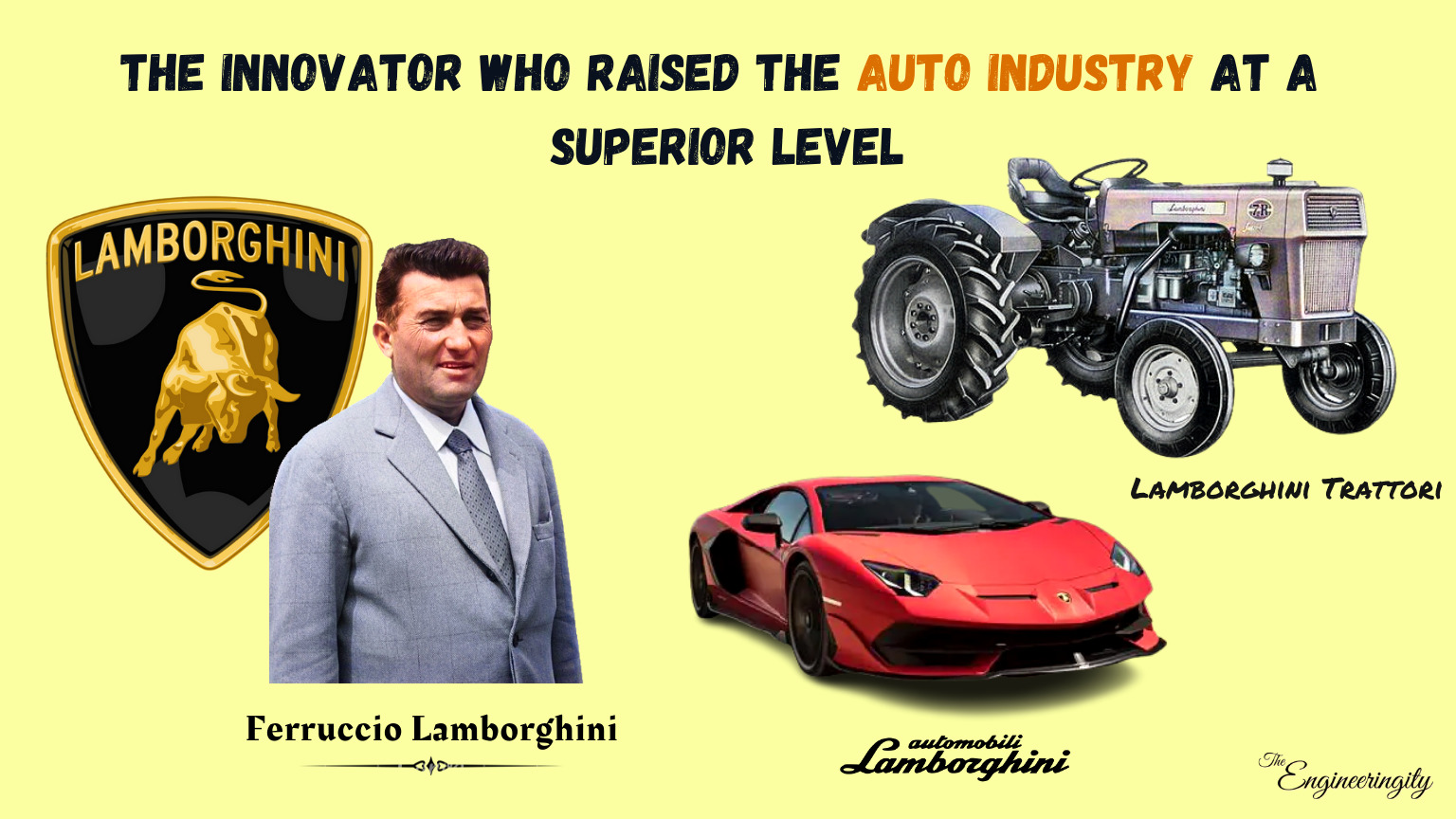
 The anecdote of Lamborghini takes us to the northern Italian province of Emilia-Romagna in a peaceful township of Renazzo di Cento(A place in Italy). Where poor grape farmers Antonio and Evelina Lamborghini raised their son Ferruccio in their family's vineyards. Young Ferruccio was born a Taurus (“Bull” Sign of astrology) though you'll know why it has a significant impact further. More significantly, he was born in 1916 smack dab in the middle of World War I.

How was Automobili Lamborghini founded | Lamborghini story with Ferrari car maker | Lamborghini Bull Logo | Lamborghini Trattori

Despite Ferruccio growing up to be hopeful and enterprising like most wretched Italians, during the early 20th century he had to face one crucial decision. He could either stick with his traditional occupation as a farmer or he could try to stay ahead of the curve and risk-taking up factories and industrial work. For Ferruccio however, the option was obvious he was obsessed with applications of machines and could hardly be kept out of his dad's garage. This eventually led him to study mechanics and in 1935 he felt confident enough to start his own workshop. 5 years later, Ferruccio was pulled from his civilian life thanks to World War II.

How did Ferruccio acquire Experience? 

He was recruited by the Royal Italian Air Force in 1940 and was allotted as a mechanic to the Garrison on the Greek island of Rhode. In the span of his duties, Ferruccio acquired valuable experience with scrapping and repurposing old machinery. In 1943 however, after Italy surrendered, a German formation forcibly took over the Garrison and expelled their former allies. 

Ferruccio could have fled but he decided to stay on as a civilian and with the authorization of the Germans, he started operating his own workshop. As much as the Germans loved Ferruccio’s technical mastery, 1945 came around, and with it arrived the Allied forces. They seized everyone in the Garrison prisoner, but after they noticed what Ferruccio could do, they got him to work fixing their vehicles for a year until they sent him home in 1946.

An opportunity turned into an Idea

Upon reaching back to Italy, Ferruccio started another short-lived workshop, but soon behind he was struck by a brilliant idea. His experience with both allied and axis vehicles gave him an advantage over most other mechanics. He knew that post-war Italy would need to increase its agricultural production to heal the damages of war, and where better to get the machinery to do so than from the extensive reserves of military equipment Mussolini's government head commission.

How did Ferruccio established Lamborgini Trattori 

Ferruccio’s ambitious plan was fixed in motion around the end of 1947 when he founded his first company. With just three other mechanics and ₺2000 (lira currency) in initial capital. Ferruccio took the large-scale production of affordable tractors into his hands. His main supplier was an ARAR(Azienda Rilievo Alienazione Residuati), a government-owned company responsible for selling all the extra military equipment left behind in the war. By taking an old British Morris engine and modifying it to run on cheap diesel instead of costly petrol Ferruccio created a groundbreakingly reasonable-priced tractor that could trade all across Italy. This was to be the foremost of his 'Carioca' unveiled on February 3rd, 1948 and Italy went nuts over them.

The design was so successful that Ferruccio started a second company Lamborghini Trattori(Tractor company), where he hired 4 new workers, purchased a factory in Cento(Place in Italy), and borrowed ₺10 million(lira currency), backed by his family's grapes farm to purchase hundreds of Morris, Perkins, and dodge engines from ARAR. He also arranged to enter of prestigious endurance race called Mille Miglia, he drove his rebuilt Flat Topolino, but he collided beside a restaurant and gave up racing for the rest of his entire life. Despite his company doing excellent, by 1950 Trattori had a workforce of 30 people and could produce upwards of 200 tractors per year. Demand was rising rapidly and so in 1951, Ferruccio acquired 1000 M2(Meter square) of land upon which he built a new factory. 

1951 saw the introduction of the L33 tractors whose rage would greatly satisfy the government allowance to farmers who used domestically built machinery. After assigning a deal with Motorenwerken Mannheim for their diesel engines, Lamborghini could now create tractors completely on their own. Ferruccio's new factory produced its first tractor in 1956 and by that point, he could simplify his engine design around three tiers of HorsePower. Ferruccio even traveled across the Atlantic to purchase heating and air conditioning technologies from the US. By the early 1960s, Lamborghini’s tractor factory had 400 employees stirring out as many as 30 tractors a day. Some of their most prominent developments during the time were a series of air-cooled tractor engines and even helicopter concepts though the government never supported them. In 1961 Ferruccio disclosed an independent oil heater factory and by that point, he was so wealthy that he decided to satisfy his love of sports cars.

How Enzo Ferrari's Insult led Ferrucio to create a car that was better than Ferrari

Being a learned mechanic himself, Ferruccio was imperative to any engineering faults he found in any cars he owned. Among them are two Alfa Romeos, two Maseratis, a Jaguar E-type, a Mercedes Benz, and of course several Ferraris. The Ferraris most appealed to Ferruccio whereas he found them to be needlessly noisy and thought they had a scanty interior. He was largely aggravated by the bizarre tendency of the Ferraris to constantly have a clutch breakdown. 

After finally getting unhappy with all these restoration bills Ferruccio took the problematic vehicle directly to Modena, where he personally confronted Enzo Ferrari regarding the clutches. According to Ferruccio, Enzo basically brushed him off and told him to stick to driving tractors. That's not terribly surprising coming from the guy who fired most of his senior staff when they grumbled about his wife but Ferruccio saw it as a challenge.

How was Automobili Lamborghini founded?

He was well familiar with the returns to be had in the grand tourism industry so in 1963 the tractor tycoon launched an automobile factory near Sant’Agata(Place in Italy). Thus, out of the primordial urge to give Enzo a reply. Ferruccio created a car named Automobili Lamborghini. For the brand's logo, he chose a bull, after all, it was his own astrological sign, and also had a deep infatuation with bullfighting. This preferably fearsome creature proved to be a proper representation of Lamborghini’s company as a head through milestone year after year.

Which was the first Lamborghini?

The first functional Lamborghini GT350 was built in 1964 with the support of young engineer Paolo Stanzani. It integrated some extremely amazing technology including a v12 engine, 5-speed transmission, 4-wheel disc brakes, and four-wheel independent suspension. Creating the GT 350 was complicated and its prototype suffered from some serious design flaws that were made very apparent during its streamed entry into the 1963 auto show in Turin. The most considerable issue was the fact that the engine itself would not even accommodate within the car's body panel. Ferruccio’s solution was to seal the compartment with bricks and to keep the cover shut at all times. After all the show was all about glimpsing at cars, not driving them.

In the end, the GT 350 was a technical masterwork and was complimented by critics and customers alike. 1966 got the 400 GT and Miura P 400. The Miura was especially renowned for setting the Rear mid-engine layout as the benchmark for all high-performance cars of the era, a standard that is still beneficial today.  It was initially developed as a street racing vehicle by a team of fierce engineers directed by Marcello Gandini they kept this project mysterious from Ferruccio since he was against creating race cars due to his own racing incident in 1948. When Ferruccio understood the new design, he was fascinated enough not to discard it but he folded down his no-racing policy. 1968 Saudi Espada established itself as one of Lamborghini's most eminent classics along with the Libero 400 GT. The company continued its successful Spot, debuting renowned models like the Countach LP 500, the Urraco P250, and the Jaramaa 480 GTS.

Evolution of Lamborghini from Fall to Rise

Crisis on Lamborghini

The 1970s however would be a problematic time for Lamborghini. In 1970 two years after the abolition of the Bretton Woods system, the global stock market underwent a dramatic crash with the dove erasing nearly half of its value. And the same time OPAEC(Organization of Arab Petroleum Exporting Countries) started an oil embargo, which greatly lifted the price of fuel and brought the automotive world into its own emergency. As if all of that wasn't enough Lamborghini Trattori was also hurt when a deal to provide Bolivia with 5000 tractors was canceled after the 1971 coup by Hugo Banzer. Ferruccio did his best to keep his various enterprises alive. He eventually found buyers for the unsold tractors and he also relocated his oil heater factory to Dosso in Nigeria in the end though he was forced to sell shares of Lamborghini to outside investors to outlast his business from bankruptcy. The crisis broke Ferruccio and although he managed to save Lamborghini he retired in the face of across-the-board strikes and unionization that had spread across Italy.

In 1973 he sold the Trattori company to another Italian tractor manufacturer. A year later he sold his remaining 49% stake in Automobili Lamborghini to a Swiss businessman named Rene Leimer. A friend of Rene had previously bought the remaining 51% and together they hope to revive the brand. Despite their tries, they failed, and ultimately, Automobili Lamborghini was forced into liquidation. In 1980 Italian government sold Lamborghini for $3 million to the Mimran brothers to French entrepreneurs who owned immense sugarcane farms and Flour Mills in Africa. The brothers had ambitions to renovate all Lamborghini facilities and form a new team of engineers, but they soon ran over funding and ended up selling the company.

Lamborghini into the hands of Chrysler and then Volkswagen

In 1987, Lamborghini went into the hands of Chrysler who wanted to import the luxury car brand into the United States. Less than 5 years later Lamborghini still hadn't gained profits so Chrysler sold it to Indonesian Conglomerate. The Indonesian actually managed to restore the brand moderately and in 1996 Lamborghini made a modest profit of $120000, As luck would have it in 1998 an economic crisis knocked Asia, and Lamborghini was sold again. 

This time the buyer was Ferdinand Piech of Volkswagen who had bought a Bentley and Bugatti the same year. Under the paternal care of Volkswagen Lamborghini found its structure heavily streamlined. This allowed it to finally regain its place in the luxury sports car market. 

To fulfill the challenges of the 21st century Lamborgini started aggressively marketing its brand name while all the same time funding heavily into material research and development. They have diversified their cars to demand a broader range of budgets even though their most subordinate price is still prohibitively costly to the average. The Pinnacle of victory for the modern Lamborghini is undoubtedly the Gallardo which has throughout its 10-year production runs sold barely over 14,000 units thus evolving Lamborginis’s most popular design ever.

Rise of Lamborgini

2015 marked the most profitable year of the company's history as the sales jumped from over 2500 to 3000 cars. They've already manufactured other heavy hitters such as the Urus SUV concept of the Huracan, inheritor of Gallardo. So far it seems that Lamborghini’s game of corporate hot potato has finally reached an end, at least for the time being. It's safe to articulate that if Ferruccio could witness his company now, he would be satisfied that Lamborghini is once again recreating the red flag to Ferrari’s Bulls.

As the cars will be electric in the coming years, Lamborghini is planning to launch its first-ever electric supercar in the coming year 2027.

  • 0 Comments
Newer Posts Older Posts Home

Like and Share our Facebook page

The Engineeringity

Blog Archive

  • ►  2020 (13)
    • ►  September (3)
    • ►  October (5)
    • ►  November (2)
    • ►  December (3)
  • ►  2021 (32)
    • ►  January (1)
    • ►  February (2)
    • ►  March (3)
    • ►  April (3)
    • ►  May (5)
    • ►  June (2)
    • ►  July (3)
    • ►  August (4)
    • ►  September (2)
    • ►  October (2)
    • ►  November (2)
    • ►  December (3)
  • ►  2022 (21)
    • ►  January (3)
    • ►  February (2)
    • ►  March (2)
    • ►  April (1)
    • ►  May (1)
    • ►  June (2)
    • ►  July (2)
    • ►  August (2)
    • ►  September (1)
    • ►  October (2)
    • ►  November (1)
    • ►  December (2)
  • ►  2023 (16)
    • ►  January (2)
    • ►  February (2)
    • ►  March (2)
    • ►  April (1)
    • ►  May (1)
    • ►  June (2)
    • ►  August (1)
    • ►  September (2)
    • ►  October (1)
    • ►  November (1)
    • ►  December (1)
  • ▼  2024 (3)
    • ►  January (2)
    • ▼  June (1)
      • Japanese Brands Electric Car Aversion: Decoding Tr...

Featured post

Mini Project On "Hydraulic Powered Track".

What is Hydraulics?  Hydraulics is a technology and applied science using engineering, chemistry, and other sciences involving liquids' ...

About Blog


Hi! I'm owner of Engineeringity

Student by profession, joined blogger as a hobby, and want to explore more about curious things.

Get latest updates straight to your inbox!

Enter your email address:

Delivered by FeedBurner

Popular posts

  • Mini Project On "Hydraulic Powered Track".
    What is Hydraulics?  Hydraulics is a technology and applied science using engineering, chemistry, and other sciences involving liquids' ...
  • The Inventor of Aeroplane | Story of Shivkar Talpade
     The whole world knows that the first airplane was flown by Wright Brothers, But what the world doesn't know is that 8 years before the ...
  • The great visionary leader Chhatrapati Shivaji Maharaj
     Chhatrapati Shivaji Maharaj was a visionary leader and founder of the Maratha Empire in western India during the 17th century. He was born ...
  • Types of Engine placement in car | Front-Rear-Mid Engines
     Automakers all agree to place the engine in the front of cars, vans, and trucks, after over a century of innovation. Why do we do this? Wha...
  • History of Engineering | Importance of Engineering
    The word engineering has been derived from the term engineer and dates back to around 1325 and the word engineer in those times meant or wa...
  • The Rise and Fall of LML: India's 2nd Scooter Giant Falters
     You must know about this legend if you were also born in the 90s like me or even earlier than that. This scooter was used to carry both peo...

Search this blog

Labels

automobile (22) Facts (12) Inventions (10) stories (10) 7 lessons (9) automotive-innovators (9) Engineering (7) electric vehicle (7) Hydrogen (6) Aircrafts (5) green-energy (5) Fuel cells (3) Projects (3) Fluid Mechanics (2) Solid State battery (2) festivals (2) drone (1)

Pages

  • About Us
  • Disclaimer
  • Privacy Policy
  • Terms and Conditions
  • Contact Us
  • Sitemap

Pages

  • Feedback Form
  • Feedback Survey
  • Complaint Form

Copyright@2019-2022 Engineeringity All Right Reseved

Created with by OmTemplates | Distributed By Gooyaabi Templates