• Home
  • Projects
    • Hydraulics
    • Kinematics
  • Automobile
    • Automotive Innovators
    • Electric vehicles
  • Inventions
    • Inventions
    • Intresting Facts
    • Stories
  • Aviation
    • Aircrafts
    • Drones
  • About Us
    • About Us
    • Terms in use
    • Privacy Policy
    • Disclaimer
  • Contact Us
  • Sitemap

The Engineeringity

 Most of the mishaps with vehicles take place because the driver is unable to see objects around a vehicle in the blind spot zone. Any vehicle traveling in the blind spot is under serious threat as its presence is entirely unknown to the driver. Road collision deaths of pedestrians, cyclists, and bikers are intolerably high and amount to most deaths globally.

Introduction

With the rapid development of vehicle technology and more attention to driving safety, driver assistance systems are making driving easy and safe. With traffic accidents occurring frequently in recent years, safe driving assistance systems have become one of the hottest and most critical technologies. It can improve road transportation efficiency and decrease accidents. Blind Spot Detection Warning (BSDW) is one of the methods through which we can solve the issue.
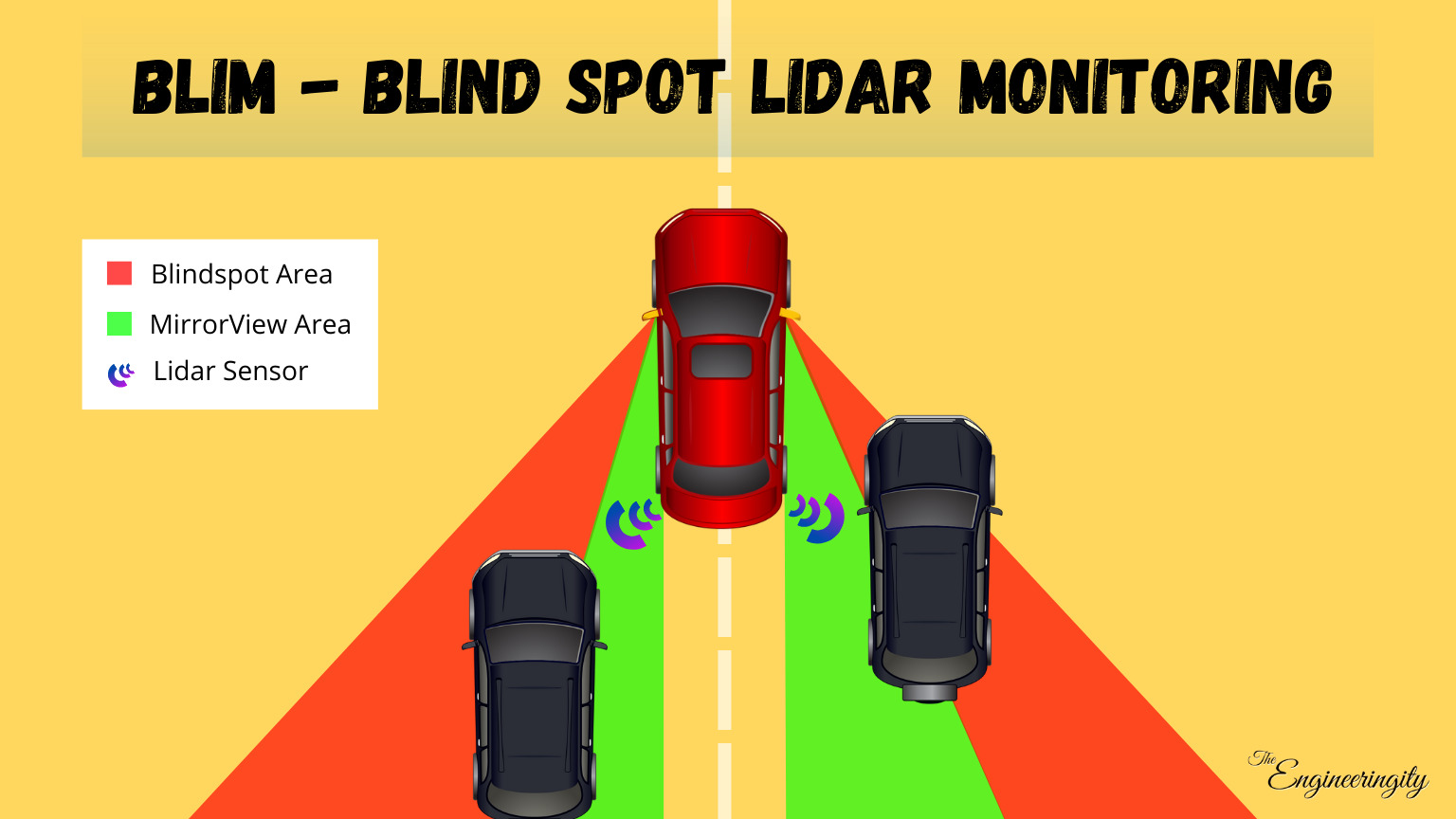
Blind spot monitoring | Lidar technology

Recently, car manufacturers have started designing blind-spot monitoring systems to avoid collisions due to blind spots. There are many blind spot systems, like radar-based, ultrasonic-based, and camera-based detection systems.

Presently in the Indian auto market, blind spot detection technology is only present in extravagance automobiles with narrow features. Yet, the majority of Indian roads consist of mid-range cars which do not have this technology. As 10-20% of the total road accidents happen due to blind spot crashes, devising a reliable system that prevents collisions and warns the driver is a necessity of time. Here's where the proposed model solves this problem.

What is a Blind Spot in a vehicle?

A blind spot in a vehicle is an area around the vehicle that cannot be directly observed by the driver while at the controls, under existing circumstances.

Because of the vehicle's blind spot area, especially the rear spot area, and the driver's weak vision, traffic collision accidents easily occur when the driver changes lanes.

What is Blind Spot Lidar Monitoring(BLiM)?

The Blind Spot Monitor using Lidar alerts drivers of vehicles in their blind spot and the rear cross-traffic alert warns drivers of approaching vehicles when backing up. The Blind Spot Monitor enables alerting the driver to the presence of a car that might evade detection in side-view mirrors, improving conviction and helping to optimize safe operation.

Blind-Spot Lidar Monitoring and alert system that is devised to provide an early warning about the proximity of surrounding vehicles to the driver using the Lidar technology.

The presented system is highly accurate and most importantly cost-effective. Such systems are only available in the higher segment vehicles. Most mid-range cars that comprise a central component of vehicular traffic ignore these systems. Thus the system is a solution for the mid-range segment.

The objective of the project

The focus of this project is to identify the causes of automobile collisions, notably the side collision impact caused by the blind spot.

To develop a system that can accurately monitor the rear blind-spot area of the vehicle which is also affordable for normal car users.

So with this system, accidents can be avoided.

System Components

The system mainly consists of 2 parts 

1. Hardware 2. Software,

The hardware component consists of the Lidar sensor, the microcontroller & the Bluetooth module.

A lidar sensor is a light-emitting sensor. That calculates distance using Time of Flight(ToF). So here in this project, the TF Luna Lidar sensor is used which can travel distances up to 8m. It can perform steady, accurate, sensitive, and high-frequency range detection.

The second component is Arduino Uno is a microcontroller Other variants of microcontroller Arduino Uno, Arduino Mega, and Arduino Nano can be used and can work perfectly having no issue with latency. But used for single-operator use.

HC-05 Bluetooth Module is an easy-to-use Bluetooth. Enabling the Arduino to exchange data with other Bluetooth devices. It works between the baud rate of 9600-115000.

The software component consists of an application (BLiM) on which the data collected from the Lidar sensor (Distance) will be displayed and seen by the driver.

What is Lidar? How does Lidar work?

Lidar Sensor (Light + Radar) stands for Light Detection and Ranging. It means a sensor that works on the principle of light. Here we have used the TF Luna Lidar sensor which is a single-point ranging sensor that has having FOV of 3 degrees. TF Luna Sensor emits infrared waves for detecting objects. It uses the Time of Flight Principle. It calculates time by measuring the phase difference between the original and reflected pulse and using that time to get the relative distance.

𝑫 = 𝒄/𝟐  ∗  𝜟𝝋/𝟐𝝅𝒇 


where,

c = Speed of Light

f = Signal Frequency

Δφ = Phase Difference.

The detection range of TF Luna is up to 8m.


Now, why didn't we use an ultrasonic sensor over lidar in this project because,

Ultrasonic-based systems are relatively inexpensive, while their detection range tends to be fairly short, and they take more time to detect cars when in use, their resolution is also quite low.

Speed of Light = c = 3x10⁸ m/s

Speed of Sound = 343.2 m/s

Disadvantages of Ultrasonic sensor:

  • Air temperature has the greatest impact on the measuring accuracy of an ultrasonic sensor.
  • Noise can also affect the performance
  • Dust rain snow

Overall Look of the System:

TF Luna | Arduino Uno | HC-05 | Power bank

The hardware devices are on the left with a wired connection and on the right is the software BLiM opened in Mobile which is connected wirelessly. 

On the left In the hardware section. There is a box containing Arduino and HC-05. Beside it is the Lidar(TF Luna) sensor and connecting to it there is a power source.

All this hardware has having wired connection. But the BliM app connects it wirelessly via Bluetooth and the output can be displayed.

Working on the system

If we go in-depth into the topic then thought must have appeared in the mind How will this system work?

Blind spot monitoring kit | Lidar sensor

The system starts when the car runs above 20 kph with the detection of the vehicle in the blind spot zone by a LIDAR sensor, detecting the car sends the signal to the microcontroller. Further, this data is sent from the Arduino microcontroller wirelessly to the application (BLiM) on which the alert is shown via the HC-05 Bluetooth module.

The data is then processed and displayed on the BLiM App and displayed in front of the driver. If the approaching is at a critical distance then the driver will get an alert sound will be activated and the distance will be shown in red on the distance dial.

Working on App BLiM

The App comes into the picture when data is received. The App is named BliM(Blindspot Lidar monitoring). Having a clean user interface. When we enter the Application We come across the Start interface where user can set their minimum, moderate, and maximum values as per their convenience. Where the minimum distance is critical and the rest is safe.

Then connection Bluetooth is done connecting with the hardware so that we can receive the data.  Then we land on the main interface. Here there are two main components the color dial which has red, green, and blue, and the other is the real-time distance.  The red color is for minimum distance blue is moderate and green is for maximum safety.

Now whenever the car is approaching our car the Lidar sensor will detect the range of the approaching car. And send it to the App. Then the App segregates whether the distance is in minimum moderate or maximum If it is minimum then it is considered as a critical range and in that case, the color dial will be red with the distance highlighted in red and a chime will sound (beeping) will be activated and as the projected car goes far away (outside the blindspot area) then the color on the dial will be green or blue and the buzzer will stop Beeping.

What if the car is in the critical range (Red) for a long time?

If the car is in the critical range (Red) for a long time then there is an off button on the header of the app. By pressing it in the Red area, the buzzer will stop for an instant and it will automatically turn ‘ON’ when the distance is i.e. when it reaches the green and blue areas. The buzzer sound stops and the driver will be less irritated.

The reason behind making the app was to show the output wirelessly to the driver. Instead of having the LED display with the tangled wire.

Advantages of the System

Of all the existing research covered, many systems using the Ultrasonic sensor were found to be less accurate during bad weather conditions. It also has a lower detection range (2-4m) & is not good at detecting fast-moving objects.

A lot of existing systems warned the driver through audio (buzzer) & a very basic visual aid (LED) which failed to provide the driver with sufficient information.

System installation on car

Lidar sensor application | Blindspot Monitoring App

The sensor was placed above the fuel tank lid of the car (Wagon-R). The horizontal viewing angle of the sensor as noticed from the top was about 45°. The sensor’s detection zone is 8m to 9m. The flat distance from the bottom to the sensor was 104 cm. The absolute arrangement of the LIDAR sensor and the screen on which the warning would be displayed i.e., the BLiM Application in the mobile placed on the dashboard is pictured in the above image. 

Conclusion

The proposed system is highly accurate and most importantly cost-effective. Such systems are only available in the higher segment vehicles. However, most mid-range cars that form a major component of vehicular traffic skip these systems. Thus the system is a solution for this segment.

This project model is Patented under Indian Patent and has a Research Paper published in the Journal of the Institution of Engineers, Series C [Springer Journal] (Scopus Index) (UGC approved)

To read more details about this system the entire Research Paper is available on the Springer website [Click Here]

This was our Final year Project model of Engineering. Please let me know about it in the comments below.

  • 0 Comments

 Hydrogen has been praised as a fuel of the future that could enable the end of the world’s reliance on fossil fuels and benefit change to net-zero emissions. But for this hydrogen revolution to take place, some big barriers need to be overcome. So is the hype about hydrogen justified?

Hydrogen Fuel | Hydrogen cars | Sustainable Energy

The most plentiful element in the universe is Hydrogen. It’s necessary for life, the sun is specially made of it and it’s present in almost all alive things. But on earth pure hydrogen is very inadequate. Instead, it mainly exists integrated with oxygen in the form of water. So how does this ample element get turned into a fuel that could help preserve the planet?

Advantages of using hydrogen fuel

One of the advantages of hydrogen in a hydrogen vehicle is the only emission that comes out of the tailpipe is undiluted, drinkable water. In contrast, the internal-combustion engine puts out loads of harmful chemicals and carcinogens. This signifies that as long as the energy used to produce it is sustainable hydrogen can be a certainly green fuel.

How hydrogen fuel is Generated?

Generation of Hydrogen fuel | Hydrogen Molecules

The first hydrogen needs to be obtained. This is done by splitting molecules. Hydrogen is a power carrier unlike, petroleum which is a primary power source. To make hydrogen from something requires an input of energy. Methane can be used via a process called steam reforming or a source of electricity through electrolysis. Once you have some hydrogen you can either burn it directly or mix it with oxygen in a fuel cell, which is somewhat like a battery. The reaction in the fuel cell creates electricity and heat. And the mere waste is water.

How hydrogen fuel could be used?

NASA began using hydrogen fuel cells to develop electricity in its space capsules in the 1960s. Today it’s not only considered rocket fuel in space but also for planes, trains, and automobiles. As well as the industrial sector. The most potential early applications are going to be in heavy industry, for example, steel- and cement-making. These are heavy, heavy greenhouse-gas polluters and they ingest tons of energy, a lot of coal in respect. And it’s very challenging to substitute that with electricity which is probably how most of the decarbonization of the global economy will occur.

Why hasn't hydrogen fuel been accepted in past?

This isn’t the foremost time hydrogen has been called the energy of the future. So the question is why has it never taken off? Until renewables existed at scale producing hydrogen required extensive quantities of fossil fuel, or nuclear energy which caused hydrogen both more expensive and less efficient than other ways of storing and delivering energy until climate change moved up the political agenda. Hydrogen simply wasn’t worth it. The existing fossil-fuel infrastructure has been in place for decades. It’s trillions of dollars of invested legacy equipment and the companies that built it defend their assets. And so it makes it very difficult for governments to force that legacy equipment to be pushed aside in favor of radically new rival equipment like hydrogen infrastructure or for that matter, renewable energy.

Is hydrogen fuel safe?

The passengers look down to see the east coast of America gliding by beneath them. There has also been a battle against public perception of hydrogen safety sparked by the Hindenburg disaster in 1937. Within moments there was a tremendous outburst and sharp orange flames formed the backdrop for a tableau of death. Hydrogen gas is very combustible and does need to be stored in a precise way. But fears about its protection are overblown. The Hindenburg did not burst because of the hydrogen it's been authenticated. That’s a misperception and what’s more, the industry has shown that hydrogen vehicles can be safer than internal-combustion vehicle cars that use gasoline which, of course, is an explosive product. Every day hydrogen across the world is used by industry quite safely. 

Advantages of Hydrogen over batteries

One advantage hydrogen has over batteries is that it’s much more energy-dense which means that with a very high-pressure storage system it takes much less space to make a vehicle go any distance. If you have a hydrogen tank on board you can refuel a vehicle quickly compared to batteries and electric cars. But we do have issues with the cost we have issues with refueling stations and fuelling infrastructure that has to be built out. So that’s another obstacle that stands in the way of hydrogen.

Is hydrogen sustainable?

There’s also a question over how sustainable hydrogen is despite some advances in the technology to generate it still requires energy-intensive processes that are fuelled largely by fossil fuels or lots of electricity. The only method to make truly green hydrogen is to produce it using sustainable energy. At the moment, a lot of the hydrogen that’s used in the world is made from natural gas but that does produce some greenhouse-gas emissions. Some people see this as terrible. And other people say this could be a bridge. It can help build a market until there’s enough renewable energy and electrolyzers become more efficient and more cost-effective.

But even if renewable energy is used in the electrolysis process the energy content that comes out is less than what goes in. Which leads some to argue that hydrogen is just a waste of renewable energy. They have a point that there are a bunch of applications in which electricity is the most promising thing to use and more efficient. Whereas there are other applications in the hefty industry especially long-distance transportation, for example where hydrogen could find a niche quite a big niche.

Unlike earlier waves of enthusiasm, hydrogen fuel could be here to stay this time. Technological advancements are causing hydrogen production more efficient and cheaper and this along with the government’s affirmation of decarbonizing is helping push a new hydrogen economy. We see huge improvements in the vehicles or the processes that use hydrogen and we see much more sophistication among the companies that are using it 

According to a study by McKinsey, there are more than 350 large-scale global projects underway right now. The whole investment projected in the hydrogen sector amounts to an evaluated $500billon. Scientific advancements, driving from the laboratories to pilot plants and eventually fetching towards a marketplace because they know a market that will pay for low-carbon techniques or green hydrogen is arriving. 

Germany has declared a €7billon program and the Chinese government wants to include 1 million fuel-cell-powered vehicles on its roadways by 2030.

Will there be a hydrogen revolution in the future years?

When we think about the tools that are needed to get to a net-zero carbon world There’s no doubt that hydrogen will play a role. In the short term, electrification is going to lead to the decarbonization charge. Still longer-term, I think there is great potential for a real hydrogen revolution that would play a big role in a decarbonized society.

Are hydrogen cars possible?

As of 2022, there exist two models of hydrogen cars publicly available in select markets: the Toyota Mirai (2014), which is the world's foremost mass-produced reliable fuel cell electric vehicle (FCEV), and the Hyundai Nexo (2018).

  • 0 Comments

 Automakers all agree to place the engine in the front of cars, vans, and trucks, after over a century of innovation. Why do we do this? What about cars where you pop the box? Porches, Volkswagens. What about those cars with the engines in the middle? What about supercars? Rear-engine vehicles represent some of the best-selling and best-performing cars out there.

Front Wheel Drive | Rear Wheel Drive | Mid Engine

There exist all kinds of cars in the world. They have various types of engines, characteristics, transmissions,  features, and much more. A lot of people do not know that cars are also segregated based on the placement of their engines. There are mainly 3 types of positioning dynamics. They are Front, Rear, and mid-mounted engines. Let’s see how they stand apart from each other.

Front Engine

Front-engine front-wheel drive vehicles are more tolerant than the steering since the engine's weight is over the front wheels. That gives them more traction. That means it's easier for your less proficient drivers to not spin out on icy roads. It's also more thrifty to cool the engine if it's in the front. So, it's cheaper to fabricate.

Why are most car engines in the front?

Let's go back to the time when in the 19th century, most horseless carriages had rear-mounted engines with rear-wheel drive. In 1895, French automaker Panhard created the foremost front-mounted engine with rear-wheel drive. To execute this, they invented the modern transmission. This design was outstanding compared to the rear-mounted designs at the time because it circulated the weight evenly between the front and rear wheels, which enhanced the handling and gave the front wheels more traction. Front engine rear-wheel-drive evolved to the pinnacle with Ford cranking out 16,500,000 Model T's from 1908 to 1927, and all other car makers obeyed lawsuit.

Rear engine

In 1934, Mercedes Benz looked at engine placement and asked a very German question: "Why don't we try it in the trunk ya?" This rear-end freak fest, produced the model 130h. Czech manufacturer Tatra followed suit and started producing rear-engine cars. The rear-engine design race peaked in 1938 when Volkswagen released the Beetle, designed by Ferdinand Porsche. Yeah, that Porsche. Tatra immediately sued VW, due to the Beetle's similarity to Tatra's rear-engine V570 and 97. 

Volkswagen was able to avoid a lawsuit by Germany that invaded Czechoslovakia. They did wind up paying a settlement after the war though, remember guys, war can't solve all your problems. The VW Beetle was cheap and economical. The original Beetles got 32 miles to the gallon and sold like Animal Crossing in a pandemic. After the victory of the Beetle, Everybody was dabbling with back-row bangers. Rear-engine and rear-wheel-drive cars were great for acceleration since the engine weight was right on the rear tires.

Problems in Rear Engine wheel drive

The main problem though is oversteering. Since all the weight is in the back, tight turns tend to make the rear of the car swing around in a fashion. Many attempted, but few achieved making a rear-engine, rear-wheel-drive vehicle that was handled pleasingly. They rev like a dragster and kind of handle like a dragster. The first real success in that department was the Porsche 911. Yes, that Porsche. The 911 came out in 1964 with a balanced 16-pack. They got around the oversteer problem by keeping the car downward and the wheelbase shorter than the Beetle. 

Some other popular rear-engine vehicles include the DeLorean DMC 12 and the Alpine a110. Not surprisingly, these cars are two-door coupes. Rear-engine, rear-wheel-drive cars, pretty much had to be until the Corvair. It's the only American car with an air-cooled rear engine. An engine that sat behind the rear tires meant no floor bump to get in the way of your feet. The only problem though, is they've had a pretty long wheelbase for rear engine parts. 108 inches, 20 inches longer than the 911. Nevertheless, they sold like beefcakes laced with gravy.

A book that Investigated the entire automotive industry

One buyer was a young politician by the name of Ralph Nader. After driving the car, he became concerned about the car's handling ability. He published the book "Unsafe at any speed" in 1965. The book investigated the entire automotive industry, but was especially critical of the Corvair, calling it, I quote, a "one-car accident". According to the book, The Corvair's swing axle rear suspension would cause the rear tires to quote, and tuck under around turns, which would cause the car to drift. And since the front suspension had no anti-roll bar, the Corvair would be prone to rollovers, a sedan with rollovers. That's insane. By the time the book came out, Chevy had already redesigned the Corvair with a four-wheel independent suspension, but it was too late. "Unsafe at any speed" was a bombshell and people took notice. Corvair sales were cut in half, in 1966. People were afraid to buy rear-engine cars that were Unsafe at any speed. I don't blame them. Chevy decided to move on and produce after the 1969 model year.

And Ralph Nader went on to head for president like a million times. In the meantime, automakers kept messing with front-engine structures. The British Motor Corporation asked a very British question. "Why don't we make our cars as undersized as possible? "So we stay out of other people's away because we're courteous and unassuming and love to prompt." That's my British accent, I'm sorry. That's right. I'm talking about the mini designer Alec Issigonis, who had the bright idea of engineering the transmission into the oil sump, flipping the engine around to minimize the engine footprint, so you could squeeze it under a hood, that was a little over four feet wide. The engine could only make 33 horsepower, but it was enough to power the Brits since the car was so tiny and light.

Rear Mid-Engine transversely-mounted

Transverse engines permitted the hood to be compressed and per passenger space to be maximized inside. Plenty of companies from Fiat, Volvo to even Land Rover use transverse engines, but none as awesomely as a 1965 Lamborghini Miura, which uses a B12 transverse engine mid-mounted behind the two seats. That's right. The transverse engine transformed in six years. Anyway, back in Detroit, the big three we're concentrating on are the front-engine, rear-wheel-drive layout, producing some cars, you might have heard them around like the Mustang, Camaro, Firebird, the Charger, etc. With the engine in the front, there was no danger of oversteering unless you pushed that gas. They have a bit of understeer, but the engine weight improves the front tire traction so it's easier for your average driver to corner.

It's also cheaper and easier to put a radiator in the front of the car, and running hoses to the back sucks from a design efficiency and maintenance standpoint. It makes sense to have your radiator engine in the same place.

Muscle car Era

Thus began the muscle car era, with the big three and AMC trying to cram as much horsepower as possible into a car. But when you want more horsies that usually means a bigger, heavier engine. As engines got beefier. You got a little more power a more torque, yeah.  But less weight on the back wheels decreases rear-wheel traction and acceleration. To keep some weight on the back tires, you have to move the engine further back and push the passengers back towards the rear axle and you're left with an enormous hood. I'm talking 80s Camaro, 70s Firebird, 70s Chargers, and pretty much every muscle car ever. If you push the engine far enough back, you get a front-mid engine car.

Mid Engine

If the engine is between the front axle and the passenger compartment, it's technically mid-engine, but front mid-engine. If you're already sacrificing passenger area and want to maximize power and handling, you have to rethink engine placement. Take the Corvette, for instance, the C7 Corvette was the best front-engine rear-wheel-drive car that Chevy could design. But they're ultimately delivering the mid-engine Corvette. It's called the CA. Not only does it offer up to 700 horsepower.

Why does moving the Corvette's engine back, improve handling? 

With the engine behind the two front seats, but in front of the rear axle, the Corvette's center of gravity is in the middle of the car, which means a lower polar moment of inertia. Alright, the polar moment of inertia. Think about a figure skater spinning. When they pull their arms in, they spin more quickly. Think about you sitting in an office chair revolving around, when you pull your arms in you communicate faster, and if you can put your arms and legs out you spin slower. Why is that? The same principle applies to cars. If your car's center of mass is centrally located, it can change direction fast and with less struggle. The engine layout also improves braking. With the weight of the engine spread evenly across all four tires, all four brakes help equally. That's why mid-engine vehicles are the best-handling, most costly two-seat vehicles on the planet. You've BMW IA's, your Audi R8's, a Porsche Cayman's, most Ferraris and Lamborghinis, McLaren's lotus, or is it low tide? 

Summary

To sum it up, let's run down the pros and cons of each engine location. The rear engine has great acceleration, but there's less weight on the front tires. You're more likely to Tokyo Drift if you don't know what you're doing. Mid-engine, awesome handling, and braking but no room for extra passengers or luggage. And generally, they're expensive to ship.

Front-engine, they're prone to a bit of understeer, but maximum traction on the front tires. They're spacious and they're cheap to build. Automakers have verified that they can create rear and mid-engine designs that work pretty well. But most consumers want an entire second row of seats and they typically don't need all that performance for driving the children to Chilies. They offer a cheaper, more spacious front-engine car that's good enough. The front-engine cars have one, at least for now.

Some other popular:

Front-engine vehicles include Toyota, TATA, Maruti Suzuki, Hyundai, etc.

Rear-engine vehicles include: Porsche

Mid-engine vehicles include: Ferrari, Lamborgini

Reference: Donut Media

What are your experiences with steering rear-engine cars?

Do you have an engine placement preference?

  • 0 Comments

 After Ford Motors stopped manufacturing in India. There was news from the last 3-4 months that TATA Motors are about to acquire the Sanand Plant of Ford. TATA Motors will buy the Ford plant to increase business in the EVs segment. The question is that what is the use of this deal, and what kind of benefits will get both parties?

Tata motors | Tata EV's | Ford Motor Company | Sanand Plant

So to understand this deal, we have to peek into the sales of TATA motors in the passenger vehicle segment in India. It is divided into two different segments. First is passenger vehicle IC in which petrol, diesel, and CNG cars belong in this segment and the second is the passenger vehicle EV which belongs to all the electric cars for example - Nexon Ev, Tigor Ev, Tigor express T. If you see the passenger department of this brand. Then in 2019, its total sales were around 202000 cars and this brand used to under-utilize its factory. This brand had more capacity to manufacture the cars but it had low demand to sell the cars due to this, it had to manufacture fewer cars. But In FY 2021, it sold around 37 million cars. So sales have increased by almost 60% in this brand that's why this brand has to increase the utilization of the factories which means they manufactured more cars in their factory and it is good for their business. Everything is going well.

Tata Motors Facing Problems to manufacture cars

At the start of 2021, this brand had around 30k cars manufacturing capacity every month. and from the second quarter of 2021, the demand for this brand increased that's why the production capacity of this brand increased from 30K to 35K then the demand increased a little more, and again this brand increased the production capacity from 35K to 40 K. But now the problem is if it is manufacturing 40K cars in a month. So it becomes 48 million cars a year and its capacity has almost reached In this 40K capacity, I haven't included the electric cars but I'm including the engines cars of this brand only.

Pre-Booking of Tata Cars

But now the craze for this brand has increased very high among the people and its business is going well. So now this brand has around 50K demand for the passenger vehicle for a month but it has only 40K capacity to manufacture the cars. Now, this brand doesn't have much margin to increase the capacity in their factories, and because TATA Motors is not able to fulfill this demand this brand has around 100K pre-ordered cars which they've to deliver whose booking has been done but it has not been delivered yet and now the backlogs of EVs have increased very much in this brand and EVs demand is increasing because the petrol price has hiked so much and price of the CNG cars has also increased and our government is also increasing the price of CNG fuel constantly that's why consumers are not finding extra benefits in purchasing CNG cars. The running of EVs is very efficient that's why customers are opting to purchase EVs TATA Motors has a huge stake in the EV department and If 10 electric cars are being sold in a month then nine are from TATA that's why TATA Motors is facing problems to manufacture EVs. 

This brand had 600 car capacity per month but the demand was for 1500 cars to come. Then this brand increased their capacity. and when they took the capacity of 1500 then they start getting orders for around 3K cars then again this brand increase their capacity to 3K cars but now this brand is getting orders for around 6k cars per month. But the delivery output of this brand is only 3500 cars per month. So the estimate of the EVs segment of this brand is increasing to around 2K cars per month. So its demand is increasing but cars are not able to be manufactured. If we see according to the 6K units, this brand has around 70K EVs demand. But its production capacity is around only 30K and now the problem is that it is difficult to increase production capacity because this brand's EVs are manufactured in two different factories.

Where are Tata EVs manufactured?

One is in Sanand, In which this brand has around 10K capacity to manufacture the cars per year which is very less. 

And 2nd is in Pune which has a little additional capacity and almost fulfills its requirement. For example, A student has to top the paper but can't do self-study for more than 2 hr so how will he top, it doesn't mean that you can't study.

A Great deal for TATA Motors and Ford Motors

Now TATA Motors is facing challenges for this capacity issue and they are trying to get rid of this now they can implement 2 to 3 things. 1st thing is that they can make a new factory where they'll manufacture the cars and they've to spend some time buying land for the factory. Then they've to set up the factory and also they've to hire employees but it is very long and time-consuming 2nd is that they can increase the capacity of the existing factory but it has a limit that has already been reached. So they need a solution where they can get pre-made factories and manufacture the cars in a very short time then good news came out that Ford had exited from India and this brand has two different factories in India.

In which the 1st is in Sanand and 2nd is in Chennai and because this brand has gone. So this brand needs a buyer for its factories. So that their debt gets decreased a little bit. So, Ford started a factory in Chennai in the early 20s in India. This brand had manufactured a good amount of cars but the problem is that it is a very old factory and it has very less automation as well as you can manufacture only two models at a time in this factory. Whereas, in the Sanand factory everything is in good condition and it has 90% of automation. Ford inaugurated this factory in the year 2015 Ford made this factory with very good automation and they spent Rs. 45 billion you'll find big robots in this factory that do 90% of the work. So this would increase the speed of making vehicles and manufacturing very good cars which will benefit TATA's Sanand Factory and brand manufacturers Tiago, Tigor, and electric cars as well and there is only 4.6 Km of the distance between TATA's factory and Ford's Sanand factory. So, there is very less distance between these factories. So you can take your forgotten things from another factory or it will help the company while transportation. for example, if the car's roof is being made in the 1st factory and through transportation, they've to take it to the 2nd factory. so it will become very easy for them. I am just giving an example. and there is a 24 million per year car manufacturing capacity in this Ford's Sanand factory.

How will the workers be benefitted if Tata acquires the Ford factory?

If TATA Motors purchase this factory because Ford has left India. TATA Motors will be of benefit. That is why Tata Motors is taking over this factory In this deal, they are getting one more benefit is that there are 23K workers in Ford's Sananda factory and when Ford announced to leave India then their workers started protesting because they will lose their job if this factory will close and also appealed to the Gujrat Gov. If this factory will be in working condition then their jobs will be stay secured. So in this TATA Motors has claimed to the Gujrat Gov that they will reappoint all the 24K workers and no layoff will be done. So every worker will get their job back and there will be no protest. So this deal is beneficial for both parties. Ford will get the money for their factory and TATA Motors will get a factory to manufacture more cars they will get 23K well-trained employees and employees will get their job back. that's why It's a great deal.

Tata Investments to Boom the Ev Sector India

And there is one more reason behind this deal. If you've remembered recently Tata Motors took a 1 billion $ investment from an investment firm TGP Rise for their EV arms with a valuation of around 700 billion. In which a target has been given to this firm by Tata Motors that this year, they’ll manufacture or sell this many cars and market cap which will increase our EV firm and they will get a better return on your investment and capacity will also boost.

Tata EV’s new launches

Also, Tata Motors has claimed that it will launch 10 EVs in India by 2026. and they will invest around Rs.150 billion in their EV firm. So to manufacture 10 different EVs, this brand needs factories, and to acquire this deal, Tata Motors has been showing more EV concepts in the last 2 weeks. For example - the concepts of Curvv and Avinya. and on May 11, Tata Motors is going to launch a long-range version of the Nexon EV. That is why a factory is needed to manufacture the cars and Ford's factory will be better for them. In which the experts are saying that this brand is about to invest around 20 billion in this factory and the manufacturing capacity of this factory will become around 200K by 2026 which is a very good thing. 

Therein Tata Motors will be able to manufacture IC engine cars in their other factories and in this factory, they will be able to make EVs solely. So that's why Tata Motors will be in benefit if they purchase Ford's factory because it is very close and as well as the factory is in very good condition and as well as they'll get 90% automation with a good amount of workers. So in recent months, Tata Motors will launch a lot of EVs if you don't know, then EV cars will be launched in the size of Harrier and Safari in India till 2025 and Tata Motors has started working on this project. 

So, let's see how this car will be. Please let me know what you think about this.

  • 0 Comments

 The modern wiper technology we all have taken for granted was born because of one man's flash of genius, Prof. Robert W. Kearns created the efficient wiper technology and grabbed inspiration from the human eye. The wiper technologies before his were pretty inadequate and obstructed the driver's eyesight, Mr. Kearns's wiper technology was so original and brilliant that the ford company tried to steal it.

Invention of intermittent windshield wiper | Robert Kearns | Flash of genius


Let's analyze the details of his brilliant invention. First, we need to understand professor Kearns's mistakes while developing their wiper technology. Wiper blades achieve an oscillating motion with the help of a four-bar linkage mechanism, a dc motor drives a worm in the worm gear assembly, which is used for torque multiplication. This mechanism gives the continuous movement of the wiper but these continuously moving wipers can block the vision of the driver. The continuously moving wipers will significantly affect your vision even during light rain. Here comes the genius of Mr. Robert Kearns who presented the idea of periodical wiping. He observed that humans blink their eyelids but this blinking never obstructs their vision, the reason we are unconscious of our blinking is that it's intermittent our eyelids take a long rest after each blink. This long rest at the extreme ends is why our eye blinking does not interrupt our eyesight in terms of driving. If we stop the wiper blade for a certain period after each wiping cycle would reduce interference with the driver's vision this moment was professor Kearns's flash of genius.

Cam Arrangement in Bar linkage mechanism

We can achieve this intermittent wiper design using a cam arrangement. The motor's output can be connected to a cam which will move the wiper for only a short period and stop for a dwell period at the bottom of the windshield. we have achieved intermittent wiping or we can see the problem with the design. The reality is that a wiper technology's dwell time or rest time should be differed based on the amount of rainfall. In a low rainfall situation, you need a long dwell time whereas in a heavy rainfall situation, you need a shorter dwell time-varying the dwell time using a purely mechanical arrangement is not practical. In fact, Prof. Kearns was so smart that he realized the issue of intermittent wipers and he didn't even try this design to achieve a varying dwell time wiper design the solution cannot be strictly mechanical it should possess electronics as well.

Adding electronics solutions to it

This realization was Kearn's second flash of genius for this purpose he developed an electronic circuit with all these features embedded in it. To understand the circuit let’s recollect some basic details about transistors. The transistor turns on when its base is forward-biased and it is reverse-biased when turned off.

He introduced a double-throw switch to make the switching of forward and reverse bias states easier when the switch is in this condition the base is forward biased and the circuit is on when the switch is in state b the base goes for reverse biased condition and the current flow stops in the circuit. He used this transistor circuit to power the wiper motor here the wiper mechanism is directly connected to the motor output. This is obviously a continuous wiping interestingly a cam connected to the motor can easily operate the switch and the circuit goes off the wiper is in the dwelling stage now. However, this is an infinite dwell time this circuit won't be able to turn on the motor again. 

Let's go back to the active stage and try to fix this issue this circuit is an active stage now and introduces a capacitor resistor pair in the circuit, the current flow direction in the resistor, due to this resistance there will be a potential difference between the two terminals of the capacitor and this will make the capacitor get charged. When the cam operates the switch the circuit goes off state as we know earlier now the charged capacitor acts as a hero it's ready for release the potential at point B is always fixed, however, the potential at point a will change during the discharge. Let's assume when the capacitor is fully charged the potential at point a is more than at point B the transistor is obviously reverse-biased however as the capacitor starts to discharge the voltage at point drops at some instance voltage at point A becomes less than at the point B and the transistor becomes active the time duration of discharge of the circuit to activation of the base is the dwell time of this wiper.

The interesting thing is that we can easily adjust this dwell time by altering the resistance value. If the resistance is more then dwell time will be more, this way using clever electronics professor Kearns achieved a variable dwell time wiper mechanism. The heart of this invention is a brilliant electronic circuit but it is driven by a mechanical switch absolute genius right. 

However, during heavy rainfall, we need almost zero dwell time it's not practical to achieve zero resistance, and thus zero dwell time during heavy rainfall the friction between the glass and wiper is very low.

During its dwell or non-active stage the circuit is connected but the wipers still have a good momentum they will continue the downward movement since the frictional force is low due to the wiper's high momentum they provide the driving force for the rest of the mechanism in the cam rotates this leads to activation of the motor again, in short, the inertia of the wipers helps to skip the dwell period of the mechanism this is a crude method to get continuous wiping from an intermittent agent in professor Kearn's patent, he has even elaborated more sophisticated circuits to achieve the continuous wiping modern-day wipers consist of relays instead of cams to drive the wiper motor the dwell time can be accurately measured and changed using timer circuits and microcontrollers also these microcontrollers take input from moisture sensors or rain sensors present on the windshield to automatically wipe the windshield if it's wet after developing such a brilliant wiper design.

What happened to professor Kearns was tragic he had to spend a good part of his life in court battles against ford motor company for infringing his patent finally he won the legal battle.

The fact that simple observations can lead to amazing inventions.

  • 0 Comments

 On a December afternoon in Chicago during the epicenter of World War II scientists cracked open the nucleus at the center of the uranium atom and turned nuclear mass into energy over and over again. They did this by creating a chain reaction inside a new engineering marvel the nuclear reactor for the first time. Since then the ability to mind great amounts of energy from uranium nuclei has led some to build nuclear power as a plentiful unrealistic source of electricity.

A modern nuclear reactor generates enough electricity from 1 kilogram of fuel to power an average household for almost 34 years but rather than conquer the international electricity market. Atomic power has declined from an all-time high of 18 % in 1996 to 11 % today and it's envisioned to drop further in the coming decades.

Nuclear Power Plant Working

What happened to the great promise of this technology?

It turns out nuclear power faces many hurdles including high construction costs and public opposition and behind these problems lie a series of unique engineering challenges.

How does nuclear power work?

Nuclear power depends on the fission of uranium nuclei and a controlled chain reaction that multiplies this splitting into numerous more hearts. The atomic nucleus is densely packed with protons and neutrons found by a strong nuclear force. Most uranium atoms have a total of 238 protons and neutrons but roughly 1in every 140 lakhs three neutrons and this lighter isotope is less tightly bound. Compared to its abundant cousin a strike by a neutron can easily split the u-235 nuclei into lighter radioactive elements called fission products. In addition, 2-3 neutrons gamma rays, and a few neutrinos.

During fission some nuclear mass converts into energy a fraction of the newfound energy powers the fast-moving neutrons and if some of them hit uranium nuclei fission results in a second larger generation of neutrons. If this second generation of neutrons strikes more additional uranium nuclei then more fission results in an even larger third generation and the chain goes so on. But inside a nuclear reactor, this spiraling chain reaction is tamed using control rods made of elements that capture excess neutrons and keep their number in check. With a controlled chain reaction a reactor draws power steadily and is stable for years. The neutron lead chain reaction is a potent process driving nuclear power but there's a catch that can result in unique demands on the production of its fuel. It turns out most of the neutrons emitted from fission have too much kinetic energy to be captured by uranium nuclei the fission rate is too low and the chain reaction fizzles out.

Light water reactor

The main nuclear reactor created in Chicago used graphite as a moderator to disperse and slow down neutrons just enough to grow their capture by uranium and boost the rate of fission. Modern reactors commonly use purified water as a moderator but the scattered neutrons are still a little too fast to compensate and keep up the chain reaction the concentration of u-235 is enriched to 4 to 7 times its natural abundance. Today enrichment is often done by passing a gaseous uranium compound through centrifuges to separate lighter u-235 from heavier u-238. But the same process can be resumed to highly enriched u-235 up to 130 times its natural abundance and create an explosive chain reaction in a bomb. Methods like centrifuge processing must be carefully regulated to limit the spread of bomb-grade fuel.

Remember only a fraction of the released fission energy goes into speeding up neutrons most of the nuclear power goes into the kinetic energy of the fission products. Those are captured inside the reactor as heat by a coolant usually purified water. This heat is ultimately utilized to drive an electric turbine generator by steam just outside the reactor. Water flow is critical not only to create electricity but also to guard against the most dreaded type of reactor accident the meltdown. If the water flow stops because a pipe carrying it breaks or the pumps that push it fails the uranium heats up very quickly and melts during a nuclear meltdown radioactive vapors escape into the reactor, and if the reactor fails to hold them a steel and concrete containment building is the last line of defense. But if the radioactive gas pressure is too high containment fails and the gases escape into the air spreading as far and wide as the wind blows. The radioactive fission products in these vapors eventually decay into stable elements while some decay in a few seconds others take hundreds of thousands of years the greatest challenge for a nuclear reactor is to safely hold these products and keep them from damaging humans or the environment.

Storage of Fuel

Containment doesn't stop mattering once the fuel is used up it becomes an even greater storage problem. Every one to two years some spent fuel is removed from reactors and stored in pools of water that cool the waste and block its radioactive emissions. The irradiated fuel is a mixture of uranium that failed to fission products and plutonium a radioactive material that is very rare in nature this mix must be separated from the environment until it has all safely decayed, many countrysides propose deep time storage in tunnels mined far underground, but none have been built and there's great uncertainty about their long-term security.

How can a nation that has lived for only a few hundred years plan to protect plutonium through its radioactive half-life of 24,000 years? today many nuclear power plants sit on their waste instead of storing them indefinitely on-site, Apart from radioactivity, there's an even greater danger with spent fuel. Plutonium can uphold a chain reaction and be excavated from the waste to make bombs storing spent fuel is thus not only a safety hazard for the environment but also a protection risk for nations.

Who should be the watchman to safeguard it? imaginative scientists from the earlier years of the nuclear age pioneered how to reliably tap the enormous amount of energy inside an atom as an explosive bomb and a controlled power source with incredible potential. But their successors have learned humbling insights about the technology's not-so-idealistic industrial limits. Mining the subatomic realm makes for complicated, costly, and risky engineering.

  • 2 Comments

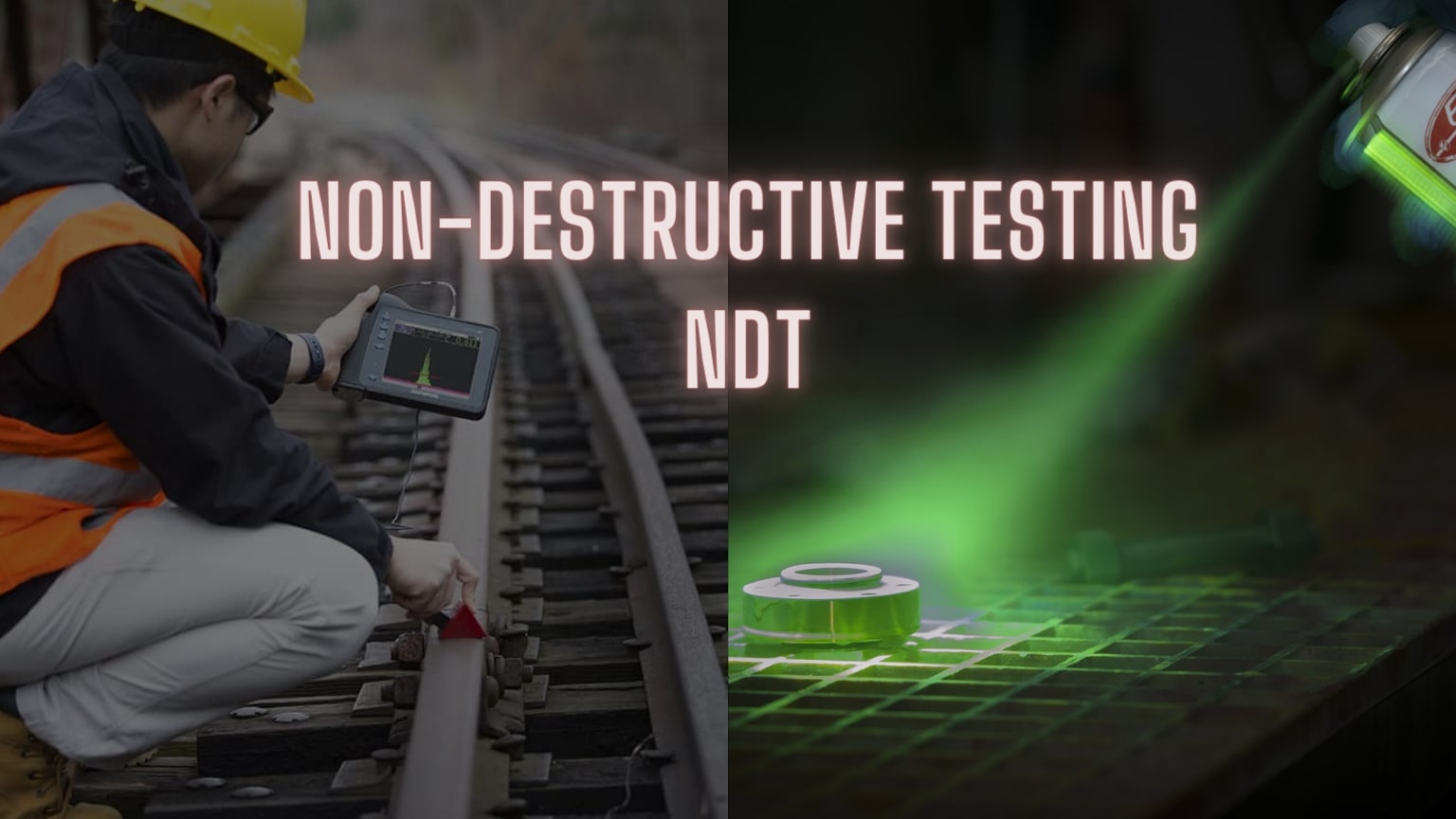
 Millions of people drive over bridges every day. You probably don't give it a second thought when you're commuting to work or traveling for the holidays. Factors like wear, exposure to the elements, and the age of a bridge will cause decay. Without proper maintenance, a bridge's structure can weaken, and the consequences can be dangerous. To keep proper maintenance of the bridge  "Non-destructive testing" helps to detect defects on the bridge before they could become a significant problem.

NDT | Types of NDT | Non Destructive Inspection

In the same way, NDT can be done on the pipelines, the automotive industry which relies regularly upon wear and tear, Railroads, ships, and many more industries.

WHAT IS NDT?

Nondestructive testing (NDT) is the process of inspecting or evaluating materials, components, or assemblies for discontinuities, or differences in characteristics without destroying the serviceability of the part or system. In other words, the amount can be still used when the inspection or test is completed.

Nondestructive testing or non-destructive testing (NDT) is a wide group of analysis techniques used in the science and technology industry to evaluate the properties of a material, component, or system without causing damage.

The representations of nondestructive inspection (NDI), nondestructive examination (NDE), and nondestructive evaluation (NDE) are also normally used to define this technique. 

During the process of casting a metal object, for example, the metal may shrink as it cools and cracks or even introduce voids inside the structure. During their service lives, many industrial components need regular non-destructive tests to detect damage that may be difficult or expensive to find every day.

What are the Types of NDT?

1. Dye Penetration Testing

2. Ultrasonic Testing

3. Magnetic Testing

4. Radiography testing

DYE PENETRANT TESTING

Liquid Penetrant Testing (LPT), also anointed Dye Penetrant Inspection (DPI) and Penetrant Testing (PT), is widely used to detect surface defects in castings, forging, welding, material cracks, porosities, and possible fatigue failure areas.

Dye penetrant inspection can be applied to both ferrous and non-ferrous materials and all non-porous materials (metals, plastics, or ceramics).

Dye Penetrant Inspection | Liquid Penetrant Testing | Steps for Dye Penetrant Testing

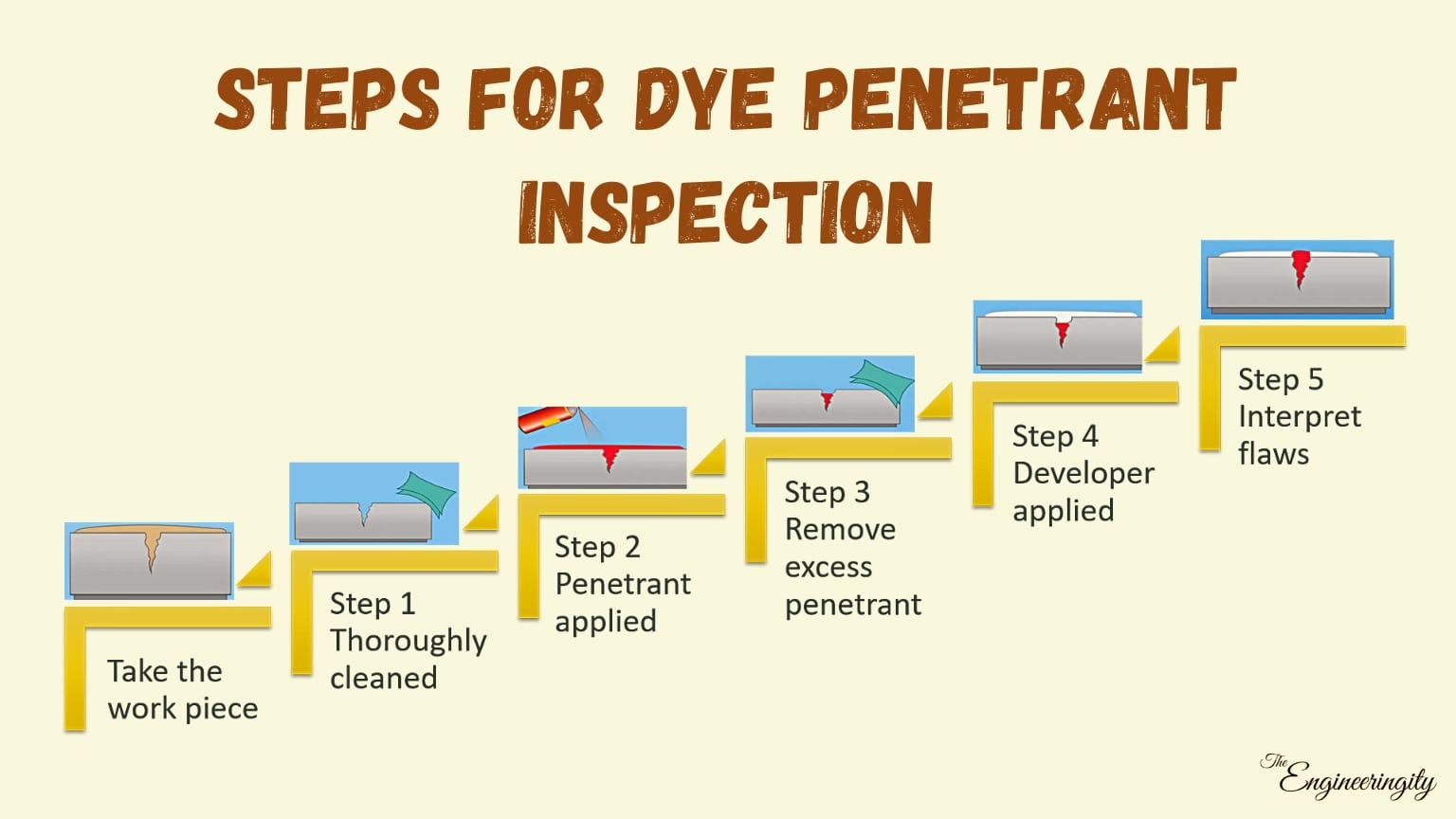
Steps for Dye Penetration:

Take the workpiece

Step 1: Clean it thoroughly.

Step 2: Penetrant applied.

Step 3: Remove excess penetrant.

Step 4: Developer applied.

Step 5: Interpretation of flaws.

Advantage:

  • High sensitivity
  • Rapid inspection
  • Visual inspection
  • Low cost

Disadvantage:

  • Only surface defects
  • Only non-porous required
  • Direct access required
  • Chemical handling and disposal

ULTRASONIC TESTING:

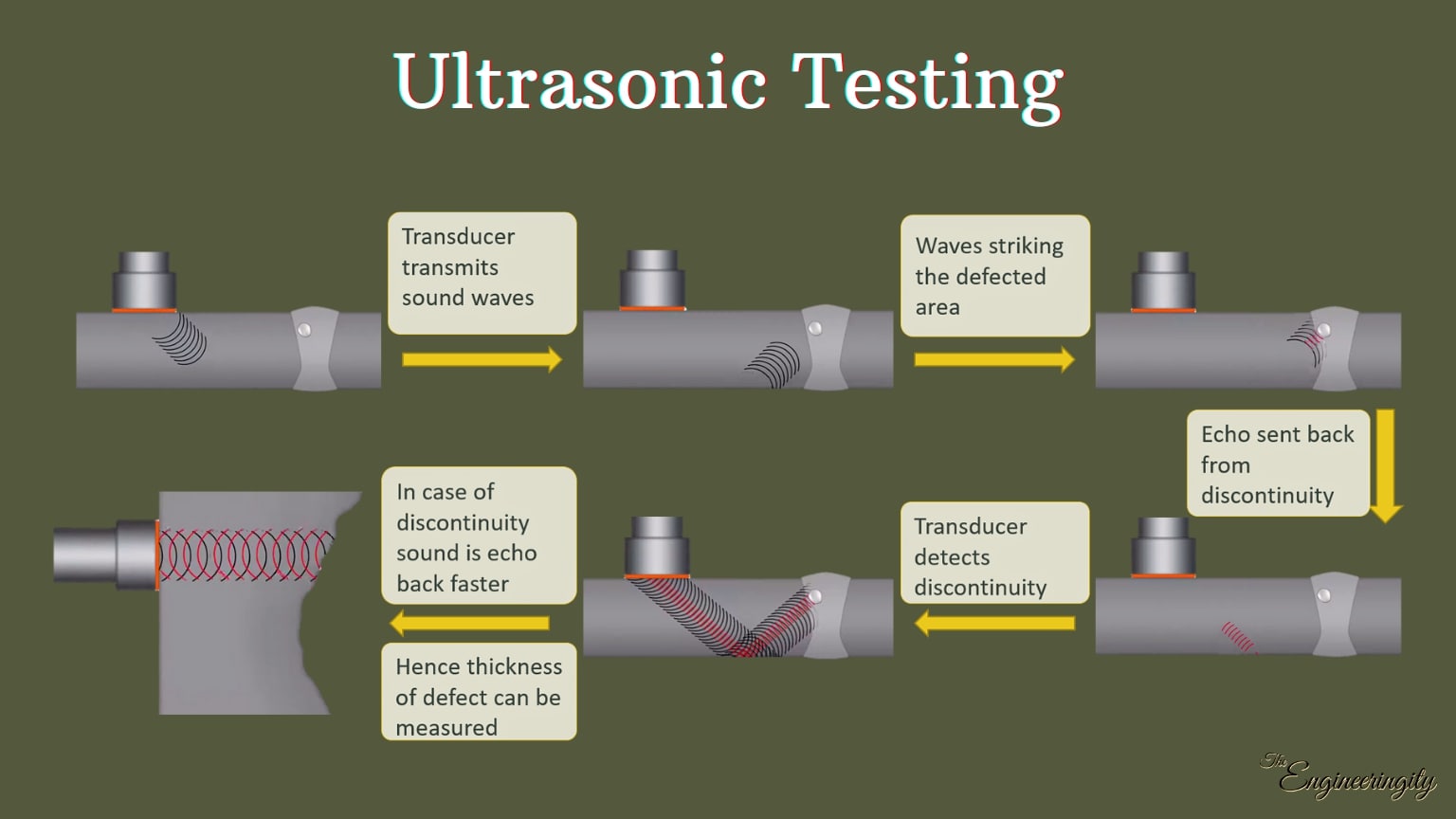
Ultrasonic testing (UT) is a type of non-destructive testing technique based on the propagation of ultrasonic waves in the object or material tested.

Steps for Ultrasonic Testing | How ultrasonic Testing works

In most common UT applications, very short ultrasonic pulse waves with center frequencies ranging from 0.1- 15 MHz, and occasionally up to 50 MHz, are transmitted into materials to detect internal flaws or to characterize materials.

Advantages:

  • Internal defects can be detected
  • Access to only one side of the component is needed
  • There is no radiation hazard
  • Thick specimens can also be examined easily

Disadvantage:

  • A high degree of operator skill is needed
  • More expensive than other methods
  • Needs a relatively smooth surface to couple the transducer
  • Difficult to use on thin materials

MAGNETIC PARTICLE TESTING

Magnetic particle Inspection (MPI) is a non-destructive testing (NDT) process for detecting surface and slightly sub-surface discontinuities in ferromagnetic materials such as iron, nickel, cobalt, and some of their alloys.

The process puts a magnetic field into the part. The piece can be magnetized by direct or indirect magnetization

Also known as Magnaflux. This method is used to detect surface discontinuities in ferromagnetic substances. This is also used for test weld works. It is a simple and easy technique.

Types of Magnetization:

1. The specimen can be magnetized either by direct magnetization or by indirect magnetization.

Direct magnetization occurs when an electric current is passed directly through a specimen to produce a magnetic field.

In Indirect magnetization, the magnetic field is applied by using a strong external magnetic field without passing a current through a specimen.

Whereas indirect magnetization can also be done by using permanent magnets or electromagnets.

Since magnetic fields in permanent magnets cannot be varied, Electromagnets are preferred usually for testing.

Steps for Magnetic Particle Testing | MPT

Procedure for Magnetisation:

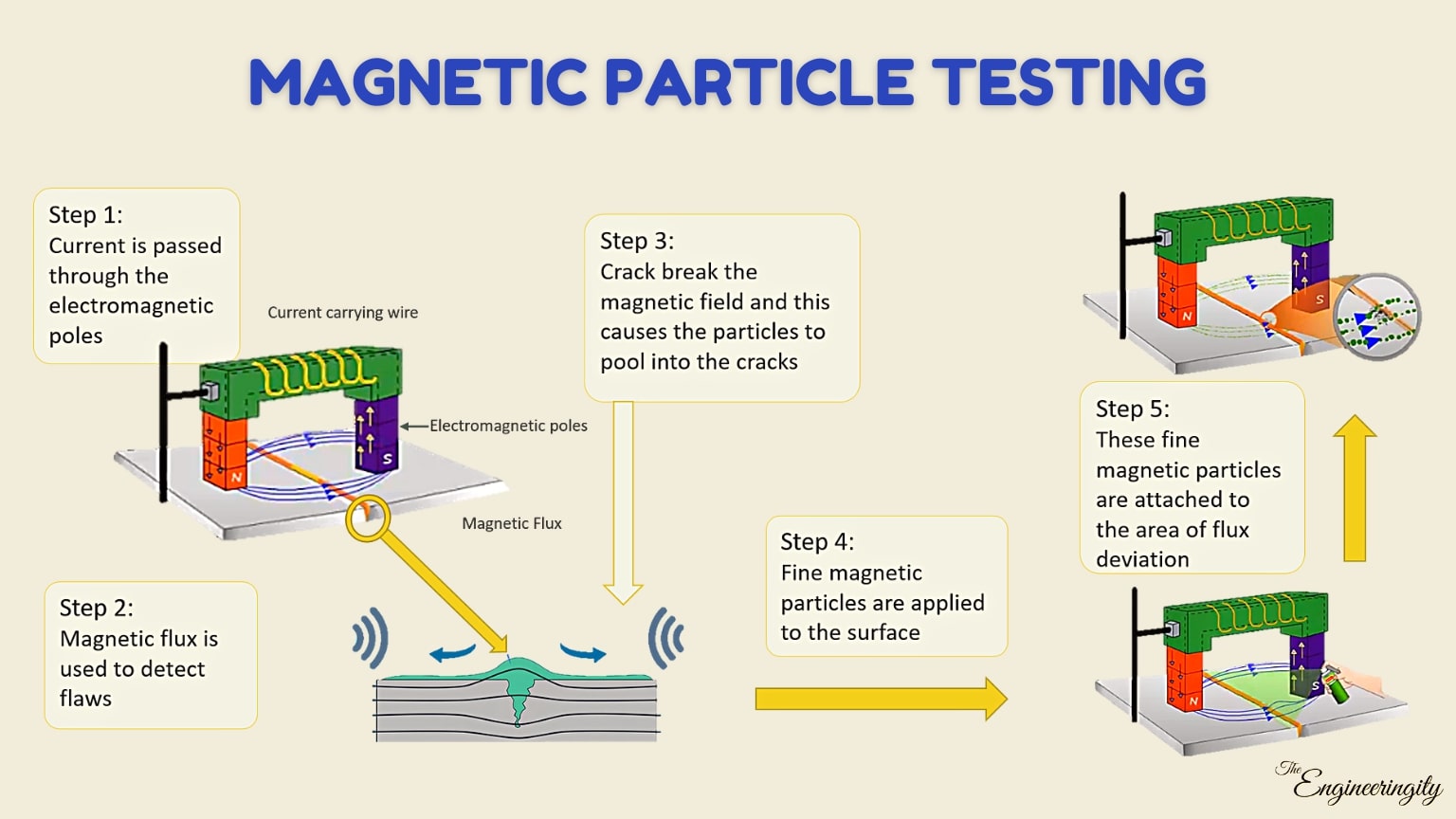
To know how the procedure is done using Electromagnets, let’s take a look at the schematic representation of it.

The component that is to be tested is cleaned first.

Step 1: The electromagnet consists of a coil of wires through which current is supplied to produce the magnetic field.

Step 2:  Magnetic flux is used to detect the flaws in the specimen.

If we elaborate on the welded part of the specimen.

This flux line running along the surface will deviate from the path if it approaches a crack.

Step 3:  Fine magnetic particles are applied to the surface of the specimen for visible indication of cracks.

Step 4:  These fine magnetic particles are attracted to the area of flux deviation. creating a visible indication of flaws.

Advantage:

  • High sensitivity

  • Rapid inspection of large areas and volumes
  • Suitable for parts with complex shapes.
  • Low cost

Disadvantage:

  • Only surface-breaking defects can be detected
  • Restricted to ferromagnetic substances.
  • Direct access to the surface is required.
  • Chemical handling and disposal.

RADIOGRAPHY TESTING

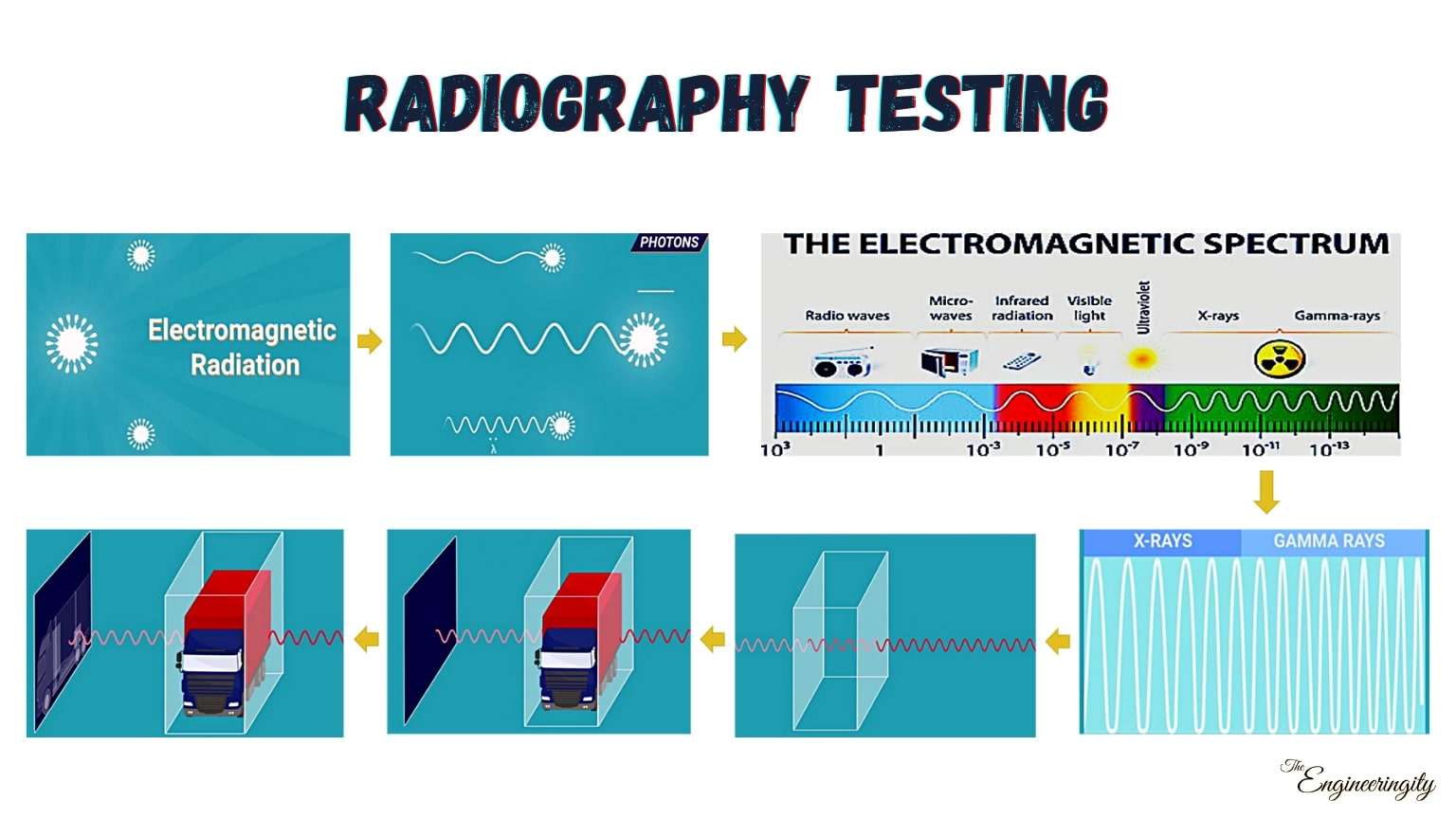
Radiographic Testing (RT), or industrial radiography, is a nondestructive testing (NDT) method of inspecting materials for hidden flaws by using the ability of short wavelength electromagnetic radiation (high energy photons) to penetrate various materials.

Radiographic Testing procedure

Either an X-ray machine or a radioactive source can be used as a source of photons This can see different things from X-rays because neutrons can easily pass through lead and steel but are stopped by plastics, water, and oils.

Advantage:

  • It has very few material limitations.
  • Minimal or no part preparation is required.
  • RT provides images of the object under inspection.
  • Can detect hidden areas.

Disadvantage:

  • Slow process.
  • A few seconds of being exposed to radiation can result in severe injuries.
  • A high degree of skill and experience is required.
  • It is quite an expensive method.

APPLICATION OF NDT

•NDT is commonly used in forensic engineering, mechanical engineering, petroleum engineering, electrical engineering, civil engineering, systems engineering, aeronautical engineering, medicine, and art.

•Non-destructive testing detects defects on bridges before they could become a significant problem.

•NDT ensures that railroads remain operational and flaws are caught well before they could pose a danger.

•Aircraft take a lot of stress from frequent landings and harsh environmental conditions. That is why prevention through regular non-destructive testing on-air and spacecraft is vital.

  • 2 Comments

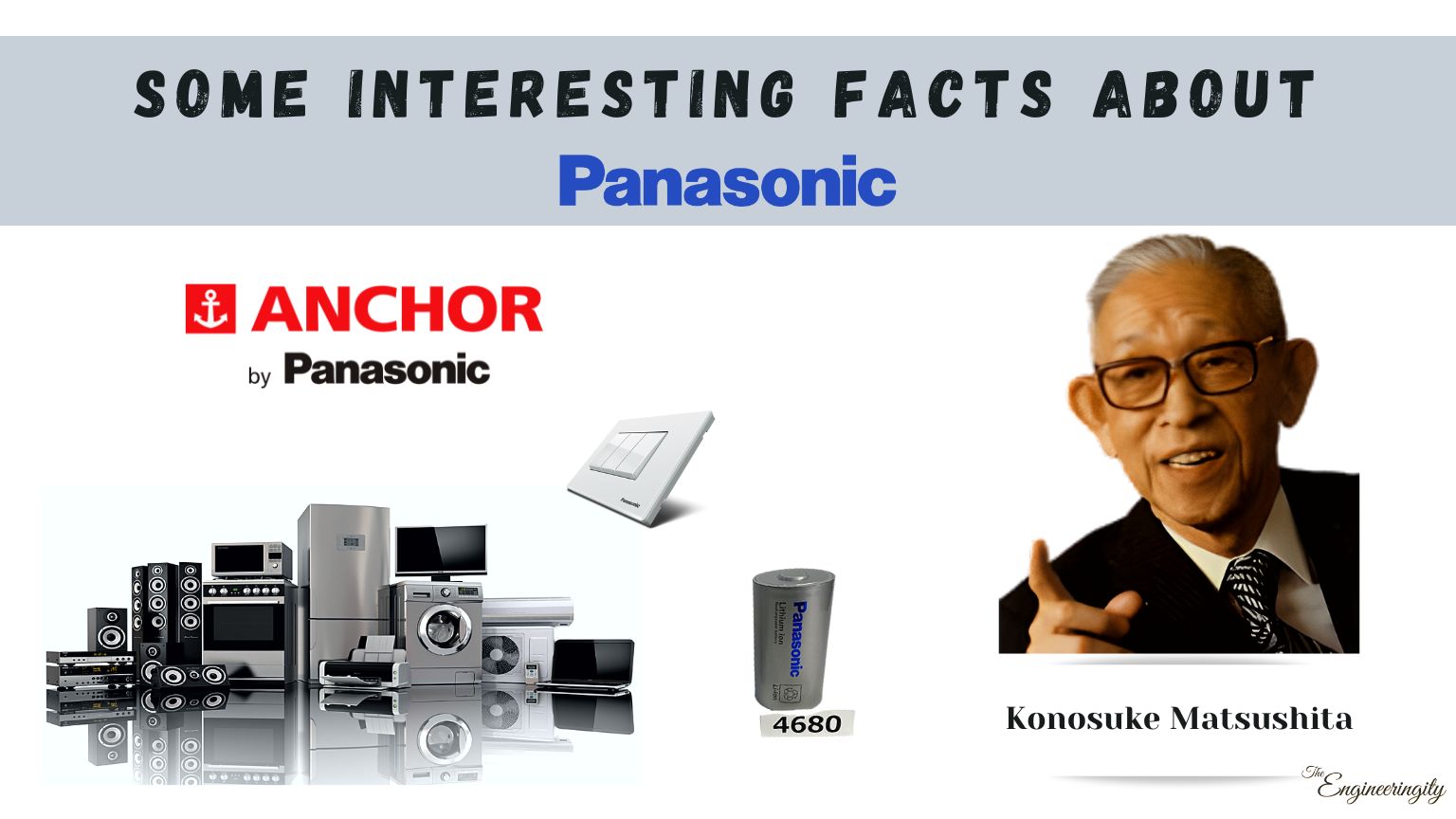
 Some interesting and surprising facts about one of the most successful Japanese electronics companies ever Panasonic.

4680 Battery | Anchor Panasonic | Panasonic Facts | Konosuke Matsushita

Panasonic was founded in 1918 as the Matsushita electrical housewares manufacturing works by Konosuke Matsushita. Matsushita used his innovative spirit to expand the company from offering a straightforward product to producing quality electrical products in a short amount of time although the company was devastated by war Matsushita’s leadership drove the company to rebuild into an even stronger and more successful company. Matsushita’s spirit continues to drive the company as his work ethic dedication to quality and forward-thinking nature are the basis of all their business operations. Now 100 years after its founding Panasonic is a multi-billion dollar company that offers a wide range of electronic goods including cameras televisions, audio equipment, home theatres, phones, and more. Inspired by Panasonic's long history of ability to adapt to incredible success and forward-thinking nature it's time to take a closer look at this multinational electronics corporation with the 15 things you didn't know about Panasonic.

1. History of Panasonic

Panasonic started as a seller of light bulb sockets although today Panasonic is known the world over as a multi-faceted electronics company it had a very simple beginning. In 1918 the company was founded by Konosuke Matsushita and only had two other employees his wife and his brother-in-law Its only ventures at the time were selling light bulb sockets. In 1927 production expanded into bicycle pumps followed by light fixtures motors electric irons and vacuum tubes.

2. Panasonic built ships and Airplanes In WWII

During the Second World War Panasonic switched its focus to supporting the war effort this led to Panasonic setting up shipbuilding and plane-building sectors but it proved to be difficult since nobody at the company had any experience in these areas. However, they did successfully produce 56 wooden ships and 3 wooden aircraft during the war however Panasonic suffered many losses during the war including 32 Factory and office facilities and about 11,000 staff members.

3. The Company was not called Panasonic

2008 Panasonic was called the Matsushita Electrical Industrial Company from 1935 to October 2008. Panasonic was first used as a brand name in 1955 for audio speakers the Panasonic name was created out of a combination of the words pan and Sonic which the company says the meaning of bringing the sound the company makes to the world number.

4. Panasonic and Tesla are business partners

In July 2014 Panasonic announced that it had made an agreement with Tesla to participate in a massive battery plant called the Giga factory that Tesla plans to build in the US by 2020 the plan is estimated to cost 5 billion dollars and it's expected that it will result in reducing Tesla's battery (4680) costs by 30%. Panasonic announced its initial investment in the Tesla Motors battery factory would amount to tens of billions of yen. Panasonic will provide Tesla with 4680 batteries by March 2024. Pansonic is to begin mass production of Tesla's new 4680 batteries by the end of the fiscal year 2024.

5. Universal Studios once belonged to Panasonic

In 1990 Panasonic purchased an American media company called the Music Corporation of America or MCA for 6.59 billion dollars five years later 80 % of MCA was sold to Seagram company for 7 billion dollars and the name was changed to Universal Studios Today Universal Studios is part of NBC Universal which is owned by Comcast.

6. Panasonic is one of the biggest supporters of the Olympic Games 

Panasonic has been one of the top sponsors of the Olympic Games ever since the 1988 Calgary Olympics. In 2008 Panasonic's HD equipment made the first Olympic Games with full HD official coverage possible at the 2016 Rio Games Panasonic provided 115 projectors which were used during the opening ceremony they also provided 10,000 surveillance cameras and various broadcasting equipment for the Sochi 2014 Winter Games these are just tiny samples of everything Panasonic does to support the Olympics.

7. They first expanded to the US market in 1961.

Konosuke Matsushita traveled to the United States for the first time in 1961 and he had a very successful trip where he met with American dealers and established agreements that would allow him to move to the US market the company began producing television sets for the US market shortly after under the brand name Panasonic and later on starting in 1979 Panasonic TVs were sold in Europe as well the company sold products under the national brand outside of North America from the 1950s to the 1970s however federal could not be used to sell products in the US due to the existence of the National Radio Company.

8. The Panasonic Toughbook claims 50 % of the rugged laptop market 

Toughbook is a brand name owned by Panasonic that refers to its line of rugged computers Toughbook is designed to withstand vibration spills drops extreme temperatures and rough handling tough books are widely used in a variety of industries including military construction health care law enforcement manufacturing oil and emergency services. Panasonic claims 50% of the so-called rugged laptop market with this one product alone.

9. Panasonic built the world's giant hi-def LED screen

Panasonic built the largest high-definition television LED screen at the Texas Motor Speedway in Fort Worth Texas in 2014 the world record-breaking screen is 2600 and 14 square feet with display dimensions of 94.5 feet by 218.4 feet the video board nickname is the Big Hoss TV and its consists of nearly 4.8 million pixels and displays 281 trillion colors it's bigger than two jumbo jets put together the screen is used to display live race coverage leaderboard information instant replays and interactive entertainment.

10. Panasonic invented a tomato-harvesting robot

Panasonic's newest robot was introduced in December 2017 at the robot exhibition in Tokyo the robot has been designed to use its camera range image sensor and artificial intelligence to only pick soon-to-be ripe tomatoes that are ready for harvesting this task was previously thought to be too delicate for a robot to handle without damaging the sensitive fruit or picking up undesirable Tomatoes but the Panasonic robot proved it was up to the task.

Panasonic also claims it can match human efficiency by harvesting 10 Tomatoes every minute.

11. Panasonic is the 97th most valuable brand in the world

Panasonic just made it into the top 100 of Forbes's most valuable brands list the company comes in at number 97 between Walgreens and Nivea the Panasonic brand is valued at 6.9 billion dollars.

12. A stone monument marks where Panasonic was founded 

In November 2004 on the 110th observance of the birth of Panasonic founder Konosuke Matsushita, a stone monument was unveiled that marks where the 23-year-old Konosuke founded the Matsushita Electric housewares manufacturing Works which later became Panasonic. The stone monument is located in Okie rocky Japan in Osaka Fukushima the monument is 1.8 meters high and 2 meters wide and is inscribed with the Japanese character for the path as written by Konosuke himself.

13. Panasonic is the title sponsor for the new Jaguar Formula E team

At the beginning of 2016, Jaguar announced that it would be joining the all-electric Formula E racing series, and nine months later it was announced that Panasonic would be their title sponsor the official name for the racing team is Panasonic Jaguar Racing. The team's car is a Jaguar I type 1 and of course, large Panasonic logos can be seen on it from every angle.

14. The founders of Panasonic and Sanyo were brothers-in-law

After World War, II Panasonic founder Konosuke Matsushita set about trying to refocus and rebuild his company meanwhile his brother-in-law Toshio Liu founded Sanyo as a subtractor for components the two companies became competitors in the same market but long after the two founders had passed away the companies merged when Panasonic bought Sanyo in December 2009. Toshio Liu was one of the three original employees of the Panasonic company.

15. Panasonic set a record with their Evolta batteries

In 2015 Panasonic set a Guinness world record for the longest distance traveled by a vehicle on a railway track powered by dry cell batteries in an attempt to demonstrate the strength and durability of their Evolta batteries Panasonic powered a small train solely with 600 of their batteries and it traveled 14.05 miles before running out of power the two-hour 36-minute train ride took place in Akita Japan and the train was built by 13 local high school students.

In 2014 to attract more workers to its Chinese operations Panasonic offered to pay ex-pats hazard pay to compensate for the chronic air pollution they are subjected to as they work in the heavily polluted environment China has the world's worst air pollution with over 3 million deaths per year being attributed to the toxic air.

  • 0 Comments

 The man who pioneered the Indian nuclear research program Homi Jehangir Bhabha was a nuclear physicist who laid the foundation for nuclear research in India often called the father of the Indian nuclear program. He established the main two institutions one them is TIFR(Tata Institute of Fundamental Research) and the second AEET(Atomic Energy ) which later after his demise was changed to Bhabha Atomic Research Center(BARC) is located in Trombay.

Father of India's Nuclear power Programme | BARC | TIFR

An institution builder and a visionary scientist Dr. Homi Bhabha was a brilliant and hardworking student since childhood and his parents dreamed of him becoming a mechanical engineer. However young Bhabha's interest fibbed in studying physics and not in becoming an engineer yet he honored his parent's wish and completed his degree in mechanical engineering. His parents appreciated their son's genuine interest and supported him in his pursuit of scientific research. Studying in Europe Bhabha became familiarized with many great physicists of his time and was resolute in contributing to India's scientific research on his return, he had wildly ambitious plans upon returning to his home country. From establishing the Cosmic Rays Research Unit he helped to formulate India's strategy in the field of nuclear power for which he is fondly remembered as the “Father of Indian nuclear power”.

Early life Homi Bhabha's

Dr. Homi J Bhabha was born on 30 October 1909 in Bombay into the home of a well-known Parsi lawyer Jahangir Hormuji Bhabha and his wife Meheren his family was very wealthy and prominent and he was related to the Dorabji Tata after receiving his primary education at Bombay's Cathedral and John Connon school. He took his secondary college at Elphinstone College(located in Mumbai, Fort). Then he studied at the Royal Institute of Science till 1927 his parents and uncle Dorabji Tata who was a big industrialist at that time wanted the brilliant young Homi to study mechanical engineering at Cambridge University so that he could join Tata Steel Mills upon his return to India.

Homi Bhabha Turning point of Life

Going to Cambridge University can also be called his turning point. Because at that time Cambridge University had become the center of the latest innovations. Homi went to Cambridge University where he began studying mechanical engineering but soon he realized that his true potential wasn't engineering but the pursuit of science. He told his parents of his goal his father was a thoughtful person and promised to finance Homi’s further studies in science. He completed his mechanical engineering in first-class passing the mechanical engineering exam in 1930. Keeping up with his promise his father let him continue his studies Homi studied mathematics under Paul Dirac and he was influenced by him very much. Paul Dirac was the one who articulated the existence of 'anti-matter' for the first time. Later for his contribution, he was awarded a Nobel prize.

Development of Nuclear physics

Impressed with his work, Homi J Bhabha started getting interested in nuclear research. Later he worked towards his doctorate in theoretical physics in 1933 he received his doctorate in nuclear physics and published his first scientific paper, “The Absorption of Cosmic Radiation” which helped him win the Isaac Newton studentship in 1934 which he held for the next three years. During the 1930s nuclear physics was an emerging area that usually was in the discussions in the scientific community several transformations were taking place in this field and Homi Bhabha was profoundly attracted to research in this domain.

During his studentship, he also worked with Neil Bohr in Copenhagen along with his research work at Cambridge where he published paper proceedings of the Royal Society Series A in 1935, wherein he gave the calculation to determine the cross-section of electron-positron scattering along with Neil Bohr he published a paper “the passage of fast electrons and the theory of cosmic showers” in 1936, where he explained how primary cosmic rays from outer space interact with the upper atmosphere. For his work, Bhabha was awarded the senior studentship in 1937 which permitted him to continue his work at Cambridge in 1939.

How did Homi Bhabha establish BARC?

Bhabha came to India for a short vacation when World War II broke out and this obstructed him from returning to Cambridge. So he accepted a position at the Indian Institute of Science Bangalore as a reader in the Department of Physics which was headed by the renowned physicist CV Raman.

In 1944 Baba felt that India needed laboratories and facilities to conduct research in nuclear science thus he decided to solicit the support of visionary and industrialist Dorabji Tata the Tata Trust accepted his proposal and the Tata Institute of Fundamental Research (TIFR) was established. In 1945 in Bombay which had the facilities for conducting large-scale research in physics, chemistry, electronics, and mathematics he also played a key role in the formation of the Atomic Energy Commission in 1948.

Then Homi Bhabha felt that atomic research would not be able to completed at TIFR so he requested the government to build a new laboratory government accepted his request and allotted 1200 acres of ground to build the laboratory and the Department of Atomic Energy in 1954 established naming AEET(Atomic Energy Establishment Trombay). Also known as Bhabha Atomic Research Center(BARC). He had acquaintances with other scientists all over the world whom he used to call in India and introduced them to Indian scientists so that Indian scientists could get something to learn and get encouragement.

Bhabha Scattering

He started research on Parmanu weapons. He was appointed as director of the parmanu program after the independence in 1948. And was officially given permission to develop Parmanu. His research on Bhabha scattering is been in the curriculum of nuclear sciences all over the world through nuclear physics. His research on Bhabha Scattering is still widely used today in the field of nuclear physics.

How Homi Bhabha helped Dr. Vikram Sarabhai

A visionary who had realized the importance of nuclear research programs way back in the 1940s when India was still under British rule. Their research has led to the development of nuclear sciences all over the world through nuclear physics. He envisioned a three-stage nuclear program consisting of the utilization of natural uranium, thorium, and plutonium in advanced nuclear reactors with a closed full circle because of this he was called the “father of India's nuclear power program”.

In 1954 he was honored with the Padma Bhushan the third-highest civilian award in India for his invaluable contributions to science and engineering. He also helped Vikram Sarabhai, a renowned scientist of that time, to form a national committee for space research. They were also known as Rocket Boys as they had achieved tremendous success in Rocketry. 

Rocket Boys

Homi Bhabha and Vikram Sarabhai played a significant role in the development of rocketry and space technology in their respective countries.

Homi Bhabha was an Indian nuclear physicist who played a crucial role in the development of India's nuclear program. He was also instrumental in setting up the Tata Institute of Fundamental Research, which played a significant role in India's early rocketry and space exploration efforts.

Vikram Sarabhai was an Indian physicist and astronomer who is often referred to as the father of India's space program. He established the Indian Space Research Organisation (ISRO) in 1969 and oversaw the development of India's first satellite, Aryabhata, which was launched in 1975.

Their contribution towards the Indian Space program and Nuclear energy Programme is tremendous so a web series dedicated to the life of Nuclear Scientist Dr. Homi J. Bhabha and Space Research scientist Dr. Vikram Sarabhai named Rocket Boys is streaming on Sony Liv.

How did Homi Bhabha die?

Homi Bhabha was a bachelor man who fully devoted his life to science he had a hobby of painting and loved classical music and opera. He abhorred the Air India flight 101 which crashed near Mount Blanc in the Alps on January 24th, 1966 and he died in that plane crash. The great scientist's brilliant career was cut short by a plane crash that claimed his life. Later,  AEET was renamed Bhabha Atomic Research Center in memory of Dr. Homi J. Bhabha. He will be always remembered for his tremendous contribution to the area of Parmanu.

  • 0 Comments

 In California, it can be difficult to be a car enthusiast. You've got smog checks(A test for emissions produced by an automobile, required for vehicle registration), and CARB compliance regulations on what modifications you're allowed to execute. It can be rather demoralizing seeing what's allowed in other states, but not mine. But what if you lived in a place where you couldn't make any modifications to your car at all? Not even paint. Well, that's exactly the kind of law that passed in India 2 years ago. Can car enthusiasts enjoy cars if they can't modify them?

Modification of car which are legal in India | Facts about car modification in India | Car modification companies in India

So before we get into India's controversial law banning car modification. Let's set the scene for the Indian automotive world. The whole car scene modification means getting those big cars and sports cars and stuff. It's been a privileged thing. So it has always been limited to people who can afford it and do it. But for a majority of people, there are financial restrictions. Car ownership in India is often a need but also bears a high charge. You need a car to get you to work and back but you are only looking to spend what is required. That sounds like a lot of places, America included but what hits the Indian market the hardest is their essential duty tax.

What is Import duty in India?

To sell a car that was not made in India, the manufacturer must pay up to a 100%  import duty. Now Import duty is a tax gathered on imports and some exports by a country's customs authorities. A good's price will usually dictate the import duty. Depending on the context, import duty may also be known as a tariff, import tax, customs duty, or import tariff.  So immediately the cost of any car not made in India doubles. Because of this, plenty of manufacturers don't even bother shipping their sports cars to India.

India never got the MR2, the S2000, the Sylvia, the Evo, the WRX, the Camaro, the Corvette, or the charger just to name a few. But despite the tax, some global market cars do make it to India. BMW M2s, Porsche's GTRs. Even the 5.0 Mustang is obtainable at a significant premium. These are called CBU cars or complete-built units.

What are CBU or Complete Built Units?

Basically, CBU cars mean the car is completely built outside of India, but there is a different kinds of vehicles. The CKD or complete knockdown unit. Apart from being an awesome name for a hardcore band, the complete knockdown unit is a car that is assembled in India. Even though the components were made elsewhere. CKDs are subject to a lower tax as low as 15%. So if manufacturers have to build an assembly plant in India they can still save money with these market-specific cars to make a CKD car. in India, there are assembly plants for cars like the Jaguar XJ, Renault fluence, and land Rover evoke.

For many automakers, the procedure of getting even one model into the Indian market as a CKD or CBU is a difficulty in itself. And with sporty cars having such consolidated margins already, it took quite a while for some of the faster cars to create in the Indian market. For example, in the 2000s India didn't get the Mitsubishi Lancer Evo but didn't get the Mitsubishi Lancer Sedia, which was a little de-tuned version of a standard Lancer. At first, these Indian market offerings were not at all amazing, but as time went on more and more fun cars started to pop up, especially in the hot hatch segment. 

The Fiat Punto Abarth is one of the hottest cars in the Indian car scene with its 2-ton paint. The scorpion cloud version of the Punto does 0 to 60 in 8.8 secs and is built in Ranjangaon in Maharashtra, India. The Volkswagen polo is another go-to hatch in India and the Skoda Octavia RS 245 is a riotous four-door that's keeping up with the golf GTI and looks awesome. Devoted sports cars, it is tough to find or expensive to import. This sounds like a super ripe atmosphere that would get people modifying their cheaper cars. So in India, there are people who are looking for a regular car to get it modified through a proper modification company. So, they get a regular car maybe say a Volkswagen Polo which is pretty popular in India because it is already handled, much better than most cars, most hatchbacks in India.

Which region of India uses which automotive / India's car Manufacturing development

In a very comparable fashion to the United States, various regions of India develop different automotive selections over the past few decades. 

  • The Northern region with close access to the Himalayas got super into four-by-fours and off-roading out of necessity. Cars like the Toyota Fortuner and SUV built on the highlights podium are extremely widespread for being daily drivers with a bit of four-by-four wheeling ability. 
  • In contrast to that Southern India, often has better roads. The scene curved towards tuning and street racing. Modified Honda city type 2’s, and Skoda Octavias rip around on these super smooth streets. 
  • Then in major metropolia like Mumbai and Delhi where most of India's rich people live, you have the supercar scene and plenty of people with cash to spend on importing a car. Porsche, Ferrari, and Mercedes can be seen cruising around. 

But not just what we in the US think of us Supercars. Importing a car in any country is a lengthy and expensive process. And that's no different in India but apart from the high cost associated with it, import laws are actually pretty chill compared to the US.

In America, we have a 25-year import rule that States, that no vehicle from outside the US domestic market can be imported until the car is 25 years old. This has put a ticking clock on many beloved JDM in Europe cars. But surprisingly India doesn't have such a rule. As long as the vehicle meets emission standards and is right-hand drive, nothing else stops you from importing R34s, Holdens, and JZ X100s. Mostly there are not many importers in India. In India, there is a traditional way of getting vehicles. Wherein you have the manufacturer set up in the shop here you can contact them and they'll facilitate the whole thing. But don't go thinking that India is full of rare imports.

Indian car manufactures

Car nerds are still a very small portion of the 1.3 billion people that live and work in India. We who love cars aren't the majority of consumers in any market. Thus, the most popular cars in India are local offerings. The Indian branch of the Suzuki motor company is Maruti Suzuki. And by 1996, they had a 60% share of the Indian car market. Today cars like the Maruti Swift, Maruti Alto, and Maruti Baleno are the top-selling cars in India. And India's manufacturing is not just an echo chamber of India-only cars. 

In 2008, Indian manufacturer Tata Motors bought Jaguar and land Rover from Ford. And by 2011 India had become the sixth-largest car manufacturer in the world. India's high import duties and large market meant it made sense to build up manufacturing in India. And once a manufacturing plant is established it can be used. Today India makes over $1 billion in revenue from US domestic market in parts and vehicles. Ford's Eco sport is a crossover made in India design based on what the Indian market dictated and is now being sold here in the US. The auto industry in India has been developing more powerfully and stronger. While most performance cars are still expensive. Economy boxes with go-cart handling and four-by-fours with some off-road chops are manageable to find. And if you want a cool car but can't buy one, you can make it yourself.

Road safety and the protection of the environment Law

In January 2019, the Supreme court of India enacted a law ruling that any modification that takes a car out of OEM spec aka stock is regarded as illegal. So not just modifying engine swaps and turbos even wider tires, coil-overs, and plastic dip are banned. A police car can stop you from anything. Even if it's a race trip that you have on your bonnet. It's not permitted because of modifications of any sort, basic customization, or anything it is not allowed.

The Supreme court decided that this law was made in the name of "Road Safety and the Protection of the Environment". With more people buying cars every year in India, Mods could have a huge effect on your quality of life. Suppose 500 million people installed straight exhaust in their motorcars. This no-mods law is pretty harsh on paper, and the actual penalty is enough to get your car's registration taken away. But every major hub of car culture has had an epoch of outrunning the law. 

Car culture has never been slowed by laws. And while not favoring any rule-breaking, it's safe to say that the Indian car scene will succeed even with this delinquency. The more we learn about the automotive world oceans away, the more we get to appreciate how much cars give us so much curiosity. 

Mustang has always had great influence, across the world so as in India. So mustang has been that one car that everybody desires to drive and own. Driving a mustang in a city like Mumbai would get the most amount of attraction or eyeballs than any vehicle has ever received that sort of appreciation or that sort of love. We oftentimes all get snagged up in our own little bubbles of the car rules. So it is okay to reach out and get to chat with people who love the same things we do. 

  • 0 Comments
Newer Posts Older Posts Home

Like and Share our Facebook page

The Engineeringity

Blog Archive

  • ►  2020 (13)
    • ►  September (3)
    • ►  October (5)
    • ►  November (2)
    • ►  December (3)
  • ►  2021 (32)
    • ►  January (1)
    • ►  February (2)
    • ►  March (3)
    • ►  April (3)
    • ►  May (5)
    • ►  June (2)
    • ►  July (3)
    • ►  August (4)
    • ►  September (2)
    • ►  October (2)
    • ►  November (2)
    • ►  December (3)
  • ►  2022 (21)
    • ►  January (3)
    • ►  February (2)
    • ►  March (2)
    • ►  April (1)
    • ►  May (1)
    • ►  June (2)
    • ►  July (2)
    • ►  August (2)
    • ►  September (1)
    • ►  October (2)
    • ►  November (1)
    • ►  December (2)
  • ►  2023 (16)
    • ►  January (2)
    • ►  February (2)
    • ►  March (2)
    • ►  April (1)
    • ►  May (1)
    • ►  June (2)
    • ►  August (1)
    • ►  September (2)
    • ►  October (1)
    • ►  November (1)
    • ►  December (1)
  • ▼  2024 (3)
    • ►  January (2)
    • ▼  June (1)
      • Japanese Brands Electric Car Aversion: Decoding Tr...

Featured post

Mini Project On "Hydraulic Powered Track".

What is Hydraulics?  Hydraulics is a technology and applied science using engineering, chemistry, and other sciences involving liquids' ...

About Blog


Hi! I'm owner of Engineeringity

Student by profession, joined blogger as a hobby, and want to explore more about curious things.

Get latest updates straight to your inbox!

Enter your email address:

Delivered by FeedBurner

Popular posts

  • Mini Project On "Hydraulic Powered Track".
    What is Hydraulics?  Hydraulics is a technology and applied science using engineering, chemistry, and other sciences involving liquids' ...
  • The Inventor of Aeroplane | Story of Shivkar Talpade
     The whole world knows that the first airplane was flown by Wright Brothers, But what the world doesn't know is that 8 years before the ...
  • The great visionary leader Chhatrapati Shivaji Maharaj
     Chhatrapati Shivaji Maharaj was a visionary leader and founder of the Maratha Empire in western India during the 17th century. He was born ...
  • Types of Engine placement in car | Front-Rear-Mid Engines
     Automakers all agree to place the engine in the front of cars, vans, and trucks, after over a century of innovation. Why do we do this? Wha...
  • History of Engineering | Importance of Engineering
    The word engineering has been derived from the term engineer and dates back to around 1325 and the word engineer in those times meant or wa...
  • The Rise and Fall of LML: India's 2nd Scooter Giant Falters
     You must know about this legend if you were also born in the 90s like me or even earlier than that. This scooter was used to carry both peo...

Search this blog

Labels

automobile (22) Facts (12) Inventions (10) stories (10) 7 lessons (9) automotive-innovators (9) Engineering (7) electric vehicle (7) Hydrogen (6) Aircrafts (5) green-energy (5) Fuel cells (3) Projects (3) Fluid Mechanics (2) Solid State battery (2) festivals (2) drone (1)

Pages

  • About Us
  • Disclaimer
  • Privacy Policy
  • Terms and Conditions
  • Contact Us
  • Sitemap

Pages

  • Feedback Form
  • Feedback Survey
  • Complaint Form

Copyright@2019-2022 Engineeringity All Right Reseved

Created with by OmTemplates | Distributed By Gooyaabi Templates