• Home
  • Projects
    • Hydraulics
    • Kinematics
  • Automobile
    • Automotive Innovators
    • Electric vehicles
  • Inventions
    • Inventions
    • Intresting Facts
    • Stories
  • Aviation
    • Aircrafts
    • Drones
  • About Us
    • About Us
    • Terms in use
    • Privacy Policy
    • Disclaimer
  • Contact Us
  • Sitemap

The Engineeringity

 Both small and big car companies make sports cars that reach many people. Some companies make supercars only millionaires can afford them and there are only a few companies that make hypercars, not IT startup founders only rich people with oil wells can afford them. Many companies make fast cars but I haven't made a dedicated article on them. Even if it's Porsche or McLaren. But there is one company that forced me to make this and that's the company, Koenigsegg by Christian von Koenigsegg.

Hyper cars | Carbon Fiber | Frozen chickens | Automotive Swedish | Sweden

This is a company that broke all speed records of any production cars and that has been troubling even Bugatti that's batched by Volkswagen VW. This company with 500 employees did so many innovations within 3 to 4 years that not even Lamborghini could make in its whole run-time. A car from this company was priced at a price of a ton of Ferrari. In this article, we'll understand Koenigsegg's history the speed record efforts of their cars their hypercar records, and their innovations. So, stay attentive till the end.

Koenigsegg Founder's Childhood: Christian E.H. von Koenigsegg

Christian Erland Harald Von Koenigsegg was born on 2nd July 1972 in Stockholm, Sweden. And just after five years, the petrohead within him roses. Actually, at 5 years of age, Christian Von Koenigsegg went to watch a Norwegian animated movie, Flåklypa Grand Prix along with his father. In the movie, a boy makes a sports car out of scrap and wins the F1 race. Though it was an imaginary story, this made an impression on Koenigsegg. He decided to start a sports car company. He didn't think, he started making these in his childhood. Like, he made a go-cart at a very young age with his father's help. To keep his love for cars alive, he started selling mopeds at 15.

How did a chicken businessman shift to manufacturing luxury supercars? 

But we know this car business is very capital-intensive. Because of this when Mr. Koenigsegg wanted to start a car company, he needed a lot of capital. To arrange the capital, he started a frozen chicken business, where he buys frozen chicken and sells it to buyers at a profit. He could make an early success and he became a huge frozen chicken businessman in Sweden. And he made so much money by selling frozen chicken that now he can make his childhood dream into a reality. His dream was to start a car company. A Swedish automotive company.

Pursuing Automotive Excellence: His Dream Unfolds

In the year 1994, he opened a car company called Koenigsegg. Now, Mr. Koenigsegg wasn't an engineer, so hired a team of engineers, and within 2 years, in 1996 he launched his prototype called Koenigsegg CC. This looked so awesome it gave other supercars a run for their money, just by the look of it. Just two years after their prototype, their first production model hit the market, by the name of CC8S. Which was made between 2001 to 2003 and only 6 units of this car were made. Right from the very first car, their intent was clear to make the fastest car in the World. Because CC8C, with its 655hp engine, can go up to 390 km/h top speed. 

Now, you may understand that the speed they claimed in 2003, is so fast that many sports car companies couldn't achieve this kind of speed in their production of sports cars, not Lamborghini, Porsche, or Ferrari. Yes, Ferrari made two cars faster than Koenigsegg but they both weren't road-legal and were made for racing championships. Something even more interesting is that the Koenigsegg, in its CC8S, used a supercharged Ford Engine. And Ford is a company that doesn't make a car similar to Ferrari. After CC8S, comes Koenigsegg CCR, and this time, instead of using a Ford Engine, Koenigsegg made their block based on this engine. They did this to achieve their claimed 395 mph speed. 

What is the Guinness World Record for the fastest production of a hypercar?

If you notice, this is just a little more compared to their previous car. Then, why did they put so much effort into this? They did this to break the high-speed record set by my McLaren F1 in the 90s. From making Carbon material in their car so that it can be lightweight. And they did it on February 28, 2005, with their CCR and by doing this they made it into the Guinness Book of World Records for the fastest production car. But this record was broken by Bugatti in November 2005, and the car claimed this record under its name for a long time. Now that Bugatti is their rival, they needed even more faster cars. 

Crafting Power: Knowingness's Engine Innovation

They made CCX for Koenigsegg produced CCX from 2006 until 2010, and they made 29 cars in different series. For the first time, with this series, they could break the 400 km milestone. The first three models of CCX went up to 400 Kmph top speed but their Trevita broke this record with 410 Kmph of claimed top speed. But it was really hard to achieve this with a Ford-inspired engine block, and because of this, for the first time, they made a 4.7-liter twin supercharged V8 engine, which could produce 795 to 1004 hp in their later models.

Whose engines power which cars? Uncover the automotive collaborations.

If you think about it, it's a huge thing to make a performance engine of their own, especially for such a small company. And you can understand how hard it is when you compare it with similar-sized companies. Like, Pagani from Italy did not make their engine and they used Mercedes-AMG engines. Apollo, a super-niche hypercar company uses Audi Engines in their cars, many Maserati cars use Ferrari engines, and many Aston Martin cars are found using Mercedes engines, and similarly, Lamborghini Urus the engine is made by Audi. All these show how difficult it is to develop a performance engine.

Agera

But still, Koenigsegg made their engine and it was just the beginning. Agera came in 2010, and Koenigsegg fitted this with a 5-liter V8 engine this engine was so versatile that Koenigsegg produced it from 2010 to 2018 and they used this engine in special editions of Agera. Throughout this period, the power and the speed of these engines leveled up. In Agera, this engine produces 947hp with a top speed of 420 mph. 

Successor cars of Agera

This power and speed stopped at Agera RS with 1341 hp and 457.94 mph top speed. This speed was so high that this car, in its test, broke the Bugatti's previous record. But this is not the speed record of Koenigsegg because Agera is followed by Regera, was a successor to Agera, followed by Jesko and Gamera and, with Jesko, Koenigsegg broke all the top speed limits because this car of theirs can reach 310mph claimed speed; it means a speed of 500kmph. Imagine how would it feel to go at 500kmph.

Koenigsegg: What groundbreaking innovations are every 5 years till now?

Now, Koenigsegg had made over-engineered, powerful, high-speed cars, but along with this, this small company makes so many innovations every 5 years that not even big sports car companies like Lambhorgini might not have done in their whole lifetime.

Hydracoup: Regera

Like, Koenigsegg, in their Regera, an 1800hp hybrid hypercar installed a single-speed direct drive system. I mean, this car doesn't come with a conventional gear system this car runs on a single-gear ratio and this goes from 0 to 400 on a single gear. Koenigsegg invented their own highly rigid, over-engineered torque-converted system and called it hydracoup to make this possible. Apart from this, their battery pack is a work of art on its own. Because this can discharge ten times faster than a normal electric car. It can dump its power so its high-powered motors can work faster. And its regeneration is also ten times faster than any other car. Apart from this, the battery pack weight of this car is only 64kgs which is comparatively very light because a less powerful car, the McLaren P1 has a battery pack of 106kgs. 

Gemera car

Similarly, Koenigsegg made a four-seater hypercar named Gamera. And they made so many innovations to save space more than any of their cars. Like, Koenigsegg Gamera's electric motor is only 28kgs and it's slightly bigger than a cool drink can. But this single motor produces 355hp. Similarly, Koenigsegg made a 2 liter 3 cylinder engine for Gamera and this engine can produce 600hp. This is the first engine of its kind, and because of this Koenigsegg calls it a tiny friendly giant since it produces so much horsepower despite being very small. 

"Innovation in Flex Fuel Sensors"

Apart from engine and power trends, Koenigsegg has made many innovations, such as a flex fuel sensor, which allows these hypercars to run on any flex fuel. Think about it, today's sports cars ask for high-octane fuel but these hypercars are ready to run on any flex fuels to be environmentally friendly. 

Koenigsegg has innovated auto skin hinges, with the help of all Regera's all moving panels can be controlled hydraulically and this whole hydraulic system weighs only 5 kg. Now, all these innovations this company has made knowing all these make us think that these are made by companies like VW. Companies like VW have unlimited resources. And this thing about Koenigsegg always shocks me that this company has only 500 people. 

I mean, this small group of men make all the innovations that can shock even bigger car companies. And this proves that the quality of manpower is always superior to the quantity of manpower.

  • 0 Comments

 The modern wiper technology we all have taken for granted was born because of one man's flash of genius, Prof. Robert W. Kearns created the efficient wiper technology and grabbed inspiration from the human eye. The wiper technologies before his were pretty inadequate and obstructed the driver's eyesight, Mr. Kearns's wiper technology was so original and brilliant that the ford company tried to steal it.

Invention of intermittent windshield wiper | Robert Kearns | Flash of genius


Let's analyze the details of his brilliant invention. First, we need to understand professor Kearns's mistakes while developing their wiper technology. Wiper blades achieve an oscillating motion with the help of a four-bar linkage mechanism, a dc motor drives a worm in the worm gear assembly, which is used for torque multiplication. This mechanism gives the continuous movement of the wiper but these continuously moving wipers can block the vision of the driver. The continuously moving wipers will significantly affect your vision even during light rain. Here comes the genius of Mr. Robert Kearns who presented the idea of periodical wiping. He observed that humans blink their eyelids but this blinking never obstructs their vision, the reason we are unconscious of our blinking is that it's intermittent our eyelids take a long rest after each blink. This long rest at the extreme ends is why our eye blinking does not interrupt our eyesight in terms of driving. If we stop the wiper blade for a certain period after each wiping cycle would reduce interference with the driver's vision this moment was professor Kearns's flash of genius.

Cam Arrangement in Bar linkage mechanism

We can achieve this intermittent wiper design using a cam arrangement. The motor's output can be connected to a cam which will move the wiper for only a short period and stop for a dwell period at the bottom of the windshield. we have achieved intermittent wiping or we can see the problem with the design. The reality is that a wiper technology's dwell time or rest time should be differed based on the amount of rainfall. In a low rainfall situation, you need a long dwell time whereas in a heavy rainfall situation, you need a shorter dwell time-varying the dwell time using a purely mechanical arrangement is not practical. In fact, Prof. Kearns was so smart that he realized the issue of intermittent wipers and he didn't even try this design to achieve a varying dwell time wiper design the solution cannot be strictly mechanical it should possess electronics as well.

Adding electronics solutions to it

This realization was Kearn's second flash of genius for this purpose he developed an electronic circuit with all these features embedded in it. To understand the circuit let’s recollect some basic details about transistors. The transistor turns on when its base is forward-biased and it is reverse-biased when turned off.

He introduced a double-throw switch to make the switching of forward and reverse bias states easier when the switch is in this condition the base is forward biased and the circuit is on when the switch is in state b the base goes for reverse biased condition and the current flow stops in the circuit. He used this transistor circuit to power the wiper motor here the wiper mechanism is directly connected to the motor output. This is obviously a continuous wiping interestingly a cam connected to the motor can easily operate the switch and the circuit goes off the wiper is in the dwelling stage now. However, this is an infinite dwell time this circuit won't be able to turn on the motor again. 

Let's go back to the active stage and try to fix this issue this circuit is an active stage now and introduces a capacitor resistor pair in the circuit, the current flow direction in the resistor, due to this resistance there will be a potential difference between the two terminals of the capacitor and this will make the capacitor get charged. When the cam operates the switch the circuit goes off state as we know earlier now the charged capacitor acts as a hero it's ready for release the potential at point B is always fixed, however, the potential at point a will change during the discharge. Let's assume when the capacitor is fully charged the potential at point a is more than at point B the transistor is obviously reverse-biased however as the capacitor starts to discharge the voltage at point drops at some instance voltage at point A becomes less than at the point B and the transistor becomes active the time duration of discharge of the circuit to activation of the base is the dwell time of this wiper.

The interesting thing is that we can easily adjust this dwell time by altering the resistance value. If the resistance is more then dwell time will be more, this way using clever electronics professor Kearns achieved a variable dwell time wiper mechanism. The heart of this invention is a brilliant electronic circuit but it is driven by a mechanical switch absolute genius right. 

However, during heavy rainfall, we need almost zero dwell time it's not practical to achieve zero resistance, and thus zero dwell time during heavy rainfall the friction between the glass and wiper is very low.

During its dwell or non-active stage the circuit is connected but the wipers still have a good momentum they will continue the downward movement since the frictional force is low due to the wiper's high momentum they provide the driving force for the rest of the mechanism in the cam rotates this leads to activation of the motor again, in short, the inertia of the wipers helps to skip the dwell period of the mechanism this is a crude method to get continuous wiping from an intermittent agent in professor Kearn's patent, he has even elaborated more sophisticated circuits to achieve the continuous wiping modern-day wipers consist of relays instead of cams to drive the wiper motor the dwell time can be accurately measured and changed using timer circuits and microcontrollers also these microcontrollers take input from moisture sensors or rain sensors present on the windshield to automatically wipe the windshield if it's wet after developing such a brilliant wiper design.

What happened to professor Kearns was tragic he had to spend a good part of his life in court battles against ford motor company for infringing his patent finally he won the legal battle.

The fact that simple observations can lead to amazing inventions.

  • 0 Comments

 The company we know today as Audi could have been named DKW or auto union if not for a decision made by parent company Volkswagen in the 1960s the brand's story begins with automotive pioneer and racing driver August Horsch who formed his first company in 1901 to build passenger cars his name means hark or listen in English, but Horsch was a man of vision as a businessman however horse was kicked out of his own company by the board of management and he went on to establish another firm in his hometown of Zwickau. Horsch established his new company “Audi” which means the Latin form of his name.

Four Rings premium carmaker| August Horch | Audi | Horsch | DKW | Wanderer

Audi was founded in 1909 in Zwickau Germany by August Horch with the purpose of industrial production of luxury cars. His aim was from the start the international market and he achieved this relatively fast. The company slogan is “Progress through technology” It is a top producer well known in the whole world with impressive annual figures and cars. The first Audi was built by hand and very few were sold, Horsch stayed with low volume low-profit production long after Audi's rivals had adopted henry ford's mass production technique within a few years howdy's cars had grown in size and engine displacement. Today the company is almost completely owned by the Volkswagen Group.

How did Audi get its logo?

The logo which proudly represents the prestigious company was created in a relatively tribal way. August Horch simply found inspiration in soap dishes which at the time had a distinct design made out of four class lines thus the distinctive aspect of German cars and logos was born. Audi respects tradition and has not implemented any modern models or lines, unlike other companies. This logo brings together the union of four different companies which created Audi in 1932, the Horsch, the Audi companies decided to establish the auto union with two other German companies DKW and the Wanderer, thus every company will specialize in a specific aspect both hork and Audi will produce luxury cars, wanderer will produce standard cars and DKW will produce small cars and motorcycles.

Audi took the slogan progress through technology very seriously by being the first car manufacturer to ever start a real impact test. The first one took place in 1938 it is important to understand the historical context all these impact tests were done by people it was a time when both the safety of the driver and the pedestrian were not entirely prioritized Audi deserves considerable praise for their safety efforts because their results were implemented by other companies too and they have summarized the safety efficiency that we are kept by and that we enjoy today. It is no surprise that Audi is one of the safest automobiles in the globe obtaining 5 stars reviews for many of their latest models safety also in terms of technology it is the first time when the name cuatro appears precisely in 1980 and was registered by Audi and used to name permanent all-wheel drive technology or system via a central differential on its models. In 1997 Audi was the first European car manufacturer to release a hybrid car in the market it was the a4 Avant.

Audi R8

Audi R8 is undoubtedly an example of high performance perhaps the finest car of the company the 2003 concept has an evaluated value of over 5 million dollars after no more than 3 years in 2006 inspired by the previous concept Audi released the R8 with only the soundest employees of the company had the opportunity and responsibility to operate on this expensive and accurate project for the building of the car more than 5000 parts and more than 70 hours are mandated.

Audi R8 carries a heavy price tag. The cost of the base model starts at approximately $1,43,000 for coupe models and $1,55,000 for convertible models, while the R8 V10 Performance costs about $197,000 for coupe models and $209,000 for convertible models. The Audi r8 v10 price in India is approximately Rs.2.72Cr.

History of Audi and its car racing 

Audi holds second place among car manufacturers at 24 hours le mans Porsche is the first with 18 victories closely followed by Audi with 13. Audi was the first car to have succeeded in the competition with a diesel engine in 2006 and after this accomplishment, Audi defeated the challenger for the first time with a hybrid car in 2012. Audi resumes innovative standing as the first car manufacturer to have ever built cars with a steering wheel on the left side, it happened for the first time in 1921 with a type k model this was legislated 16 years before Germany officially. It was the most evolved car in terms of engineering but it also created a challenging situation because the left-wheel drivers were made to drive on the left side of the road by the time driving was switched to the right side of the road to produce car accidents and to reduce the traffic Audi clever in new concepts the newest cars released on the market have shown impressive aspect for the headlights and tail lights trying to combine visibility importance with the most groundbreaking design in creativity and innovation.

Audi the Swarm lighting concept

Among these, there is the car concept Audi Swarm which materialized this concept with the new design of the model and interactive led lights to bring us closer to the future car. It is Something truly remarkable that stands out from the crowd how Audi invents itself and always brings new projects Audi implements upgrades and new ideas through crowdfunding intern tasks it turns out to be a very productive and ingenious idea. Audi curve fund brings together creative employees from a wide range of fields within internal investors so that the unit formed can execute bold ideas. This visionary working method is used to stimulate the initiative of our employees while boosting the team spirit within the company said the officials.

Audi and Electric cars

The first electric SUV is the Audi e-throne which was presented as a concept car in 2015 but it only reached the market in 2009 due to a long process of construction and adaptation thus Audi implemented a new range of cars among the others a comes from the standard of the luxury cars q comes from SUV models and e for electric vehicles although relatively new on the market each round has made prominent figures in Germany, Norway, Netherlands, Sweden and ranking in a top of electricity SUVs in Austria. Audi has made a good profit in the international market without neglecting exports to any continent in the united states one in three coups eight cars have been sold and is growing annually the biggest sales are in Europe and in China where a new record has been set 69083 cars in 2019.

What kind of features does Audi come with?

Audi is a respectable luxury car this can be seen in the equipment with which the company sells cars the majority of modern features come only with special separate packages, for example, the equipment from Audi q7 for the new dark edition package starts from 3740 euros, s-line exterior package, Audi exclusive aluminum wheels 5 spoke design with titanium optics Audi exclusive black optical package rear tinted windows 7 plus headlights features that bring improvements in appearance and not necessarily in mechanics.

The simplest and the cheapest set of features is the advanced type starting from 500 euros which offers an Audi parking system, heated front seats, cruise control, standing headlights, headlight washer system, front center armrest, and onboard computer therefore in some cases premium package only offers prestige not necessarily comfort. Audi has over 100 years of experience time in which it has revolutionized the audio industry countless times with bold cars project and concepts because it is an indulgence and one of the most well-known cars on the globe we can only anticipate the same efficiency and exceptional product that Audi has delivered so far.

  • 0 Comments

 Rudolph Christian Carl Diesel was a German inventor and Mechanical Engineer famous for the invention of the Diesel Engine and his suspicious death at Sea. Diesel was born in Paris France in 1858. He was the second of three children of Elyse and Teodor diesel his parents were Bavarian immigrants living in Paris. Theodore Diesel a bookbinder by trade left his hometown of Augsburg Bavaria in 1848. He saw his wife, a daughter of a Nuremberg merchant in Paris in 1855 and evolved as a leather goods manufacturer there.

Invention of Diesel Engine | First successful Diesel Engine | Death of Rudolf Diesel

Only a few weeks after his birth diesel was given away to vincent's farmer family where he spent his first nine months when he was returned to his family. They moved into flat 49 in the Ruta la Fontaine ROI at the time, the diesel family suffered from financial difficulties thus young Rudolph diesel had to operate his father's workshop and supply leather goods to customers using Ibero. He attended a protest in french school and soon became interested in social questions and technology being a very good student at the age of 12 diesel received the sauce tape or lon struccione la montaire bronze medal and had plans to enter a cold premier superhero in 1870.

At the outbreak of the Franco-Prussian War the same year his family was forced to leave as were many other Germans. They decided to stay in London where diesel attended an English school before the war stopped regardless diesel's mother sent 12-year-old Rudolph to Augsburg to stay with his aunt and uncle Barbara and Christophe Barnicle to become formal in German and to visit the koniglichi christ cure Betul, where his uncle taught him math at the age of 14.

Rudolf Diesel's interest in engineering

Diesel wrote a note to his parents expressing that he desired to become an engineer. After completing his primary education and being excellent in his class in 1873. He registered at the newly established industrial school of Augsburg two years later he obtained a merit scholarship from the royal bavarian polytechnic of Munich which he accepted against the desires of his parents who would preferably have witnessed him start to work, one of the diesel's professors in Munich was Carl von land diesel was unable to graduate with his class.

In July 1879 because he was suffering from typhoid fever while postponing the next examination date he gained practical engineering experience at the Salzer brother's machine works in Winterthur Switzerland. Diesel graduated in January 1880 with the highest academic honors and returned to Paris where he helped his former Munich professor carl von land with the layout and construction of a modern refrigeration and ice plant diesel became the director of the plant one year later. In 1883 diesel tied the knot with Martha flasch and continued to work for Varl von land achieving multiple patents in Germany and France.

An Engine that can fulfill Carnot cycle efficiency

In early 1890 diesel moved to Berlin with his wife and children Rudolf jr, Hedy, and Eugene to consider management of lin's corporate research and development department and to merge several other corporate boards there as he was not permitted to use the patents he developed while an employee of Linz for his purposes he extended beyond the field of refrigeration. Before that Karl Benz had created the first car by making history. He foremost worked with steam his research into thermal efficiency and fuel efficiency led him to construct a steam engine using ammonia vapor, during tests however the engine blasted and almost killed him.

His research into high compression cylinder pressures experimented with the strength of iron and steel cylinder heads one blasted during a run-in he spent many months in a hospital followed by health and eyesight problems ever since attending lectures of carl von land. Diesel planned to design an internal combustion engine that could cover the maximum theoretical thermal efficiency of the Carnot cycle, he also worked on this idea for several years and in 1892 he considered his theory to be finished the same year diesel was awarded the German patent drp 67207.

Innovation of Diesel Engine

In 1893 he issued a treatise entitled theory and construction of an analytical heat engine to substitute the steam engine and the combustion engines known today that he had been functioning since before 1892, this treat has developed based on his work on the innovation of the diesel engine by summer 1893 diesel had recognized that his initial thesis was incorrect which led him to file another patent application for the updated theory in 1893. Rudolf learned thermodynamics and the hypothetical and functional constraints on fuel efficiency he understood that as much as 90% of the energy left in the fuel is wasted in a steam engine. His work in engine design was operated with the goal of much higher efficiency ratios in his engine. Fuel was injected at the end of the compression stroke and was ignited by the high temperature resulting from the compression from 1893 to 1897 Heinrich von buzz director of manusc in Augsburg permitted Rudolph diesel to test and materialize his ideas.

When did the first diesel Engine Run?

The first successful Diesel Engine ran in 1897 and it has been displayed at the German Technical Museum in Munich. Rudolph Diesel received patents for his design in Germany and different countries including the U.S. he was also inaugurated into the automotive hall of fame in 1978.

The Tragic Death Of Rudolf Diesel

On the nightfall of September 29, 1913, Rudolf diesel boarded the GER Steamer SS Dresden in Antwerp (City in Belgium) on his way to a conference of the compressed diesel manufacturing company in London  He had dinner on board the ship and then headed to his cabinet about 10 p.m departing word to be called the next morning at 6:15 a.m but he was never seen alive again. In the morning his cabin was vacant and his bed had not been slept in although his nightdress was neatly spread down and his watch had been left where it could be seen from the bed. His hat and neatly folded overcoat were found beneath the after-deck railing.

10 days later the crew of the Dutch boat compelled and came upon the carcass of a man floating in the north sea near Norway. The body was in such an advanced state of decomposition that it was unrecognizable and they did not carry it aboard instead the crew retrieved personal items from the clothing of the dead man and returned the body to the sea on the 13th of October. These items were identified by Rudolph's son Eugene diesel as belonging to his father on the 14th of October 1913 it was reported that diesel's body was found at the mouth of the scalp by a boatman but he was forced to throw it overboard because of heavy climate there are different theories to describe diesel's death certain people such as his biographer Grosser and Hans Alcitauer argue that Rudolph diesel committed suicide. Another line of thought suggests that he was murdered, given his refusal to grant the german forces the exclusive rights to use his invention.

Indeed diesel boarded the SS Dresden with the intent of meeting with representatives of the British royal navy to discuss the potential of powering British submarines with diesel engines he never made it ashore. Yet the proof is limited for all explanations and his disappearance and death remain unsolved. Shortly after diesel's disappearance, his wife Martha opened a bag that her husband had given to her just before his ill-fated voyage with hints that it should not be opened until the following week. She discovered 2,00,000 german marks in cash and several economic statements hinting that their bank accounts were almost empty.

In a diary diesel carried with him on the ship for the day, the 29th of September 1913 was sketched possibly predicting death.

When did the Automotive sector adopt Diesel Engine

Development of Diesel Engine

After diesel's death, his engine experienced much development and became a very crucial alternative for the steam piston engine in many applications. The diesel engine required a fattier more powerful structure than a gasoline engine it saw restricted use in aviation. Nevertheless, the diesel engine became across-the-board in many other applications such as stationary engines agricultural machines, off-highway machinery in general submarines, ships, and much later locomotive trucks, and modern automobiles.

The diesel engine has the benefit of running more fuel-efficient than gasoline engines due to much higher compression ratios and longer duration of combustion which means the temperature rises more slowly allowing more heat to be converted to mechanical work diesel was interested in using cold dust or vegetable oil as fuel and in fact, his engine was running on peanut oil. Although these fuels were not immediately popular during the 2008 uprising fuel prices coupled with troubles about oil reserves have led to the more widespread use of vegetable oil and biodiesel the primary fuel used in diesel engines is the eponymous diesel fuel derived from the refinement of crude oil diesel is securer to store than gasoline because its flash point is roughly 175 degrees Fahrenheit higher and it will not burst.

What else did Rudolf Diesel Invent?

One more interesting thing is that Rudolph Diesel’s interests went beyond motors and fuels. He even acquired a patent on a solar-powered air engine, which makes him a more interesting pioneer of energy and technology than we may ever have known, a man before his time. He was also known as the Father of Compression Ignition.

The Automobile Engine will come and then I will assume my life's work is complete.

- Rudolph Diesel
  • 0 Comments

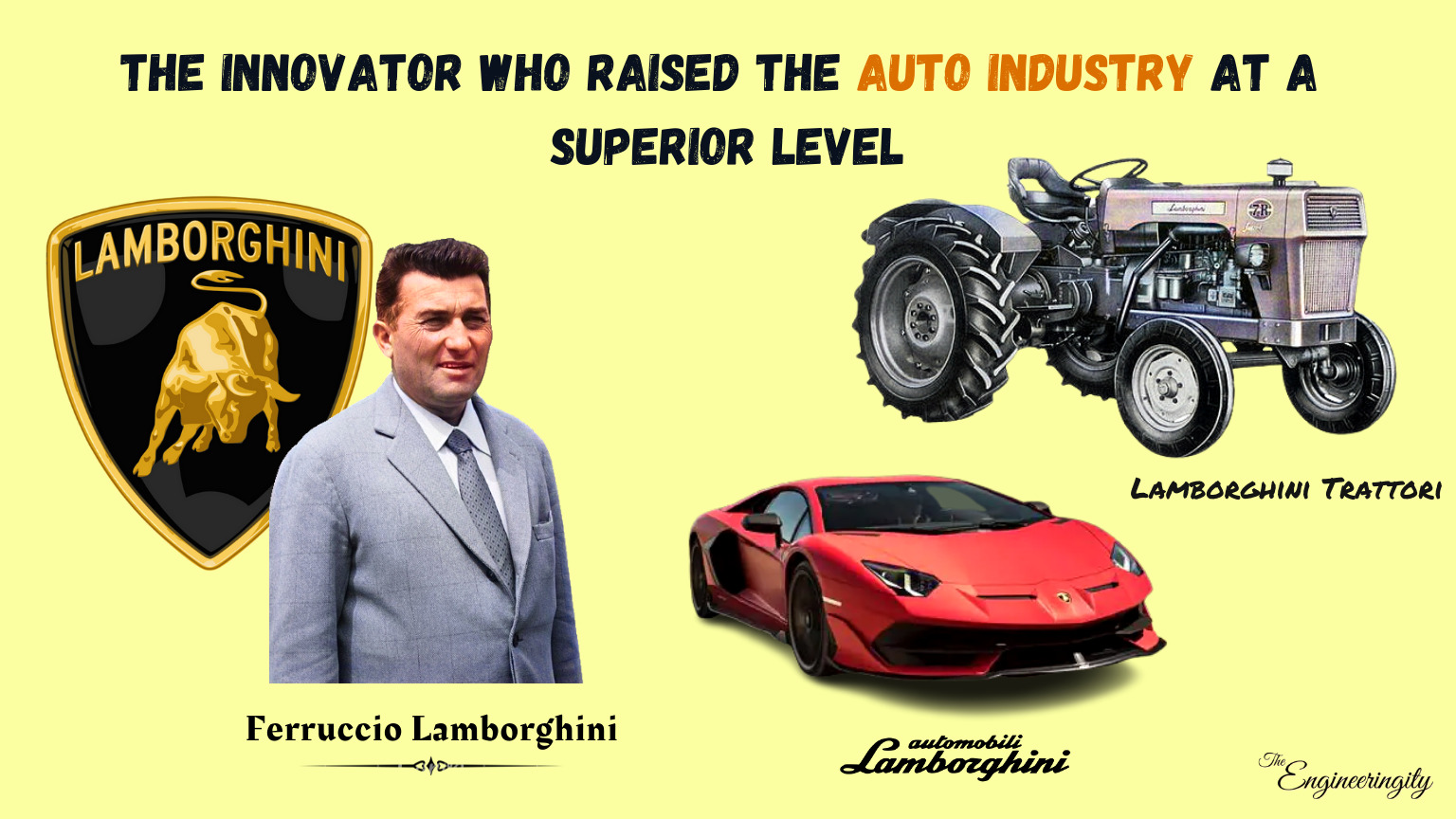
 The anecdote of Lamborghini takes us to the northern Italian province of Emilia-Romagna in a peaceful township of Renazzo di Cento(A place in Italy). Where poor grape farmers Antonio and Evelina Lamborghini raised their son Ferruccio in their family's vineyards. Young Ferruccio was born a Taurus (“Bull” Sign of astrology) though you'll know why it has a significant impact further. More significantly, he was born in 1916 smack dab in the middle of World War I.

How was Automobili Lamborghini founded | Lamborghini story with Ferrari car maker | Lamborghini Bull Logo | Lamborghini Trattori

Despite Ferruccio growing up to be hopeful and enterprising like most wretched Italians, during the early 20th century he had to face one crucial decision. He could either stick with his traditional occupation as a farmer or he could try to stay ahead of the curve and risk-taking up factories and industrial work. For Ferruccio however, the option was obvious he was obsessed with applications of machines and could hardly be kept out of his dad's garage. This eventually led him to study mechanics and in 1935 he felt confident enough to start his own workshop. 5 years later, Ferruccio was pulled from his civilian life thanks to World War II.

How did Ferruccio acquire Experience? 

He was recruited by the Royal Italian Air Force in 1940 and was allotted as a mechanic to the Garrison on the Greek island of Rhode. In the span of his duties, Ferruccio acquired valuable experience with scrapping and repurposing old machinery. In 1943 however, after Italy surrendered, a German formation forcibly took over the Garrison and expelled their former allies. 

Ferruccio could have fled but he decided to stay on as a civilian and with the authorization of the Germans, he started operating his own workshop. As much as the Germans loved Ferruccio’s technical mastery, 1945 came around, and with it arrived the Allied forces. They seized everyone in the Garrison prisoner, but after they noticed what Ferruccio could do, they got him to work fixing their vehicles for a year until they sent him home in 1946.

An opportunity turned into an Idea

Upon reaching back to Italy, Ferruccio started another short-lived workshop, but soon behind he was struck by a brilliant idea. His experience with both allied and axis vehicles gave him an advantage over most other mechanics. He knew that post-war Italy would need to increase its agricultural production to heal the damages of war, and where better to get the machinery to do so than from the extensive reserves of military equipment Mussolini's government head commission.

How did Ferruccio established Lamborgini Trattori 

Ferruccio’s ambitious plan was fixed in motion around the end of 1947 when he founded his first company. With just three other mechanics and ₺2000 (lira currency) in initial capital. Ferruccio took the large-scale production of affordable tractors into his hands. His main supplier was an ARAR(Azienda Rilievo Alienazione Residuati), a government-owned company responsible for selling all the extra military equipment left behind in the war. By taking an old British Morris engine and modifying it to run on cheap diesel instead of costly petrol Ferruccio created a groundbreakingly reasonable-priced tractor that could trade all across Italy. This was to be the foremost of his 'Carioca' unveiled on February 3rd, 1948 and Italy went nuts over them.

The design was so successful that Ferruccio started a second company Lamborghini Trattori(Tractor company), where he hired 4 new workers, purchased a factory in Cento(Place in Italy), and borrowed ₺10 million(lira currency), backed by his family's grapes farm to purchase hundreds of Morris, Perkins, and dodge engines from ARAR. He also arranged to enter of prestigious endurance race called Mille Miglia, he drove his rebuilt Flat Topolino, but he collided beside a restaurant and gave up racing for the rest of his entire life. Despite his company doing excellent, by 1950 Trattori had a workforce of 30 people and could produce upwards of 200 tractors per year. Demand was rising rapidly and so in 1951, Ferruccio acquired 1000 M2(Meter square) of land upon which he built a new factory. 

1951 saw the introduction of the L33 tractors whose rage would greatly satisfy the government allowance to farmers who used domestically built machinery. After assigning a deal with Motorenwerken Mannheim for their diesel engines, Lamborghini could now create tractors completely on their own. Ferruccio's new factory produced its first tractor in 1956 and by that point, he could simplify his engine design around three tiers of HorsePower. Ferruccio even traveled across the Atlantic to purchase heating and air conditioning technologies from the US. By the early 1960s, Lamborghini’s tractor factory had 400 employees stirring out as many as 30 tractors a day. Some of their most prominent developments during the time were a series of air-cooled tractor engines and even helicopter concepts though the government never supported them. In 1961 Ferruccio disclosed an independent oil heater factory and by that point, he was so wealthy that he decided to satisfy his love of sports cars.

How Enzo Ferrari's Insult led Ferrucio to create a car that was better than Ferrari

Being a learned mechanic himself, Ferruccio was imperative to any engineering faults he found in any cars he owned. Among them are two Alfa Romeos, two Maseratis, a Jaguar E-type, a Mercedes Benz, and of course several Ferraris. The Ferraris most appealed to Ferruccio whereas he found them to be needlessly noisy and thought they had a scanty interior. He was largely aggravated by the bizarre tendency of the Ferraris to constantly have a clutch breakdown. 

After finally getting unhappy with all these restoration bills Ferruccio took the problematic vehicle directly to Modena, where he personally confronted Enzo Ferrari regarding the clutches. According to Ferruccio, Enzo basically brushed him off and told him to stick to driving tractors. That's not terribly surprising coming from the guy who fired most of his senior staff when they grumbled about his wife but Ferruccio saw it as a challenge.

How was Automobili Lamborghini founded?

He was well familiar with the returns to be had in the grand tourism industry so in 1963 the tractor tycoon launched an automobile factory near Sant’Agata(Place in Italy). Thus, out of the primordial urge to give Enzo a reply. Ferruccio created a car named Automobili Lamborghini. For the brand's logo, he chose a bull, after all, it was his own astrological sign, and also had a deep infatuation with bullfighting. This preferably fearsome creature proved to be a proper representation of Lamborghini’s company as a head through milestone year after year.

Which was the first Lamborghini?

The first functional Lamborghini GT350 was built in 1964 with the support of young engineer Paolo Stanzani. It integrated some extremely amazing technology including a v12 engine, 5-speed transmission, 4-wheel disc brakes, and four-wheel independent suspension. Creating the GT 350 was complicated and its prototype suffered from some serious design flaws that were made very apparent during its streamed entry into the 1963 auto show in Turin. The most considerable issue was the fact that the engine itself would not even accommodate within the car's body panel. Ferruccio’s solution was to seal the compartment with bricks and to keep the cover shut at all times. After all the show was all about glimpsing at cars, not driving them.

In the end, the GT 350 was a technical masterwork and was complimented by critics and customers alike. 1966 got the 400 GT and Miura P 400. The Miura was especially renowned for setting the Rear mid-engine layout as the benchmark for all high-performance cars of the era, a standard that is still beneficial today.  It was initially developed as a street racing vehicle by a team of fierce engineers directed by Marcello Gandini they kept this project mysterious from Ferruccio since he was against creating race cars due to his own racing incident in 1948. When Ferruccio understood the new design, he was fascinated enough not to discard it but he folded down his no-racing policy. 1968 Saudi Espada established itself as one of Lamborghini's most eminent classics along with the Libero 400 GT. The company continued its successful Spot, debuting renowned models like the Countach LP 500, the Urraco P250, and the Jaramaa 480 GTS.

Evolution of Lamborghini from Fall to Rise

Crisis on Lamborghini

The 1970s however would be a problematic time for Lamborghini. In 1970 two years after the abolition of the Bretton Woods system, the global stock market underwent a dramatic crash with the dove erasing nearly half of its value. And the same time OPAEC(Organization of Arab Petroleum Exporting Countries) started an oil embargo, which greatly lifted the price of fuel and brought the automotive world into its own emergency. As if all of that wasn't enough Lamborghini Trattori was also hurt when a deal to provide Bolivia with 5000 tractors was canceled after the 1971 coup by Hugo Banzer. Ferruccio did his best to keep his various enterprises alive. He eventually found buyers for the unsold tractors and he also relocated his oil heater factory to Dosso in Nigeria in the end though he was forced to sell shares of Lamborghini to outside investors to outlast his business from bankruptcy. The crisis broke Ferruccio and although he managed to save Lamborghini he retired in the face of across-the-board strikes and unionization that had spread across Italy.

In 1973 he sold the Trattori company to another Italian tractor manufacturer. A year later he sold his remaining 49% stake in Automobili Lamborghini to a Swiss businessman named Rene Leimer. A friend of Rene had previously bought the remaining 51% and together they hope to revive the brand. Despite their tries, they failed, and ultimately, Automobili Lamborghini was forced into liquidation. In 1980 Italian government sold Lamborghini for $3 million to the Mimran brothers to French entrepreneurs who owned immense sugarcane farms and Flour Mills in Africa. The brothers had ambitions to renovate all Lamborghini facilities and form a new team of engineers, but they soon ran over funding and ended up selling the company.

Lamborghini into the hands of Chrysler and then Volkswagen

In 1987, Lamborghini went into the hands of Chrysler who wanted to import the luxury car brand into the United States. Less than 5 years later Lamborghini still hadn't gained profits so Chrysler sold it to Indonesian Conglomerate. The Indonesian actually managed to restore the brand moderately and in 1996 Lamborghini made a modest profit of $120000, As luck would have it in 1998 an economic crisis knocked Asia, and Lamborghini was sold again. 

This time the buyer was Ferdinand Piech of Volkswagen who had bought a Bentley and Bugatti the same year. Under the paternal care of Volkswagen Lamborghini found its structure heavily streamlined. This allowed it to finally regain its place in the luxury sports car market. 

To fulfill the challenges of the 21st century Lamborgini started aggressively marketing its brand name while all the same time funding heavily into material research and development. They have diversified their cars to demand a broader range of budgets even though their most subordinate price is still prohibitively costly to the average. The Pinnacle of victory for the modern Lamborghini is undoubtedly the Gallardo which has throughout its 10-year production runs sold barely over 14,000 units thus evolving Lamborginis’s most popular design ever.

Rise of Lamborgini

2015 marked the most profitable year of the company's history as the sales jumped from over 2500 to 3000 cars. They've already manufactured other heavy hitters such as the Urus SUV concept of the Huracan, inheritor of Gallardo. So far it seems that Lamborghini’s game of corporate hot potato has finally reached an end, at least for the time being. It's safe to articulate that if Ferruccio could witness his company now, he would be satisfied that Lamborghini is once again recreating the red flag to Ferrari’s Bulls.

As the cars will be electric in the coming years, Lamborghini is planning to launch its first-ever electric supercar in the coming year 2027.

  • 0 Comments

 Today we are revealing some interesting and surprising facts about one of the most dominant and long-lasting brands in the luxury automotive industry for this we are going to focus all of our attention on Mercedes-Benz. 

Mercedes Benz class


    How Mercedes-Benz was formed?

    Mercedes-Benz was established when two German automobile companies run by Gottlieb Daimler and Karl Benz merged to create the Daimler-Benz patent company in 1926 and soon after it was renamed, Mercedes-Benz. 

    The first Mercedes-Benz owned by Hitler

    The first joint car they produced was the Mercedes 770 model which Hitler was known to drive with a bulletproof windshield over the used. Mercedes-Benz has been a leader in innovation in technology and safety and has developed some of the most popular luxury cars of all time. 

    Mercedes's slogan is the best or nothing and we know this reflects the mindset of many people out there. Mercedes-Benz is an excellent source of inspiration for future billionaires due to their luxury mindset in forward-thinking ways not to mention their longevity and their drive for success.

    Now let's take a look at the facts you didn't know about Mercedes-Benz:

    Karl Benz created the first modern automobile. Karl Benz was actually the first to create and patent the model automobile in 1886 his vehicle was called the patent motorwagen and it was comprised of 3  wheels a Steel Tube frame of wooden panels in a small gasoline-powered engine it only had two-thirds HP. But Karl had to start from somewhere his wife Bertha Benz financed and marketed the invention.

    Story Behind Naming Mercedes

    Mercedes's name came from an 11-year-old girl. The Mercedes brand name came about as a result of Austria diplomat and racing enthusiast Emil Jellinek insisting that the series of 36 sports cars he ordered from the Daimler company be renamed after his 11-year-old daughter Mercedes. 

    The car was completed in 1901 and Jellinek dominated in every racing event entered with them. Daimler decided to stick with the name after quickly developing an impressive reputation and they trademarked the brand in 1902.

    The invention of the Brake pad

    Bertha Benz was the first person to take a road trip in a modern automobile. Bertha Benz the wife of Karl Benz brought National attention to the Benz patent motorwagen when she and her sons drove the car over 130 miles round trip. The first time the automobile had been driven a considerable distance. She took off without telling her husband with her two sons aged 13 and 15 hoping to prove the viability of the invention. 

    But people were not used to seeing cars on the road so many became frightened and some even thought the horseless carriage was to work of the devil she solves several problems with the automobile along the way like cleaning a blocked few lines with her hat pin and having a cobbler install leather when the wooden breaks began to fail to make the world's first pair of the brake pad.

    What does the 3-point logo represent in Mercedes?

    Evolution of Mercedes Benz logo

    The three-pointed logo almost had a fourth point added, the Mercedes-Benz three-point logo represents its domination of the land, air, and water. The Logo has evolved through the years with the first three-point starter being used in 1909, there was discussion about adding the fourth point to represent space as well.

    The First Driver's License

    Karl Benz was given the very first driver's license individual states and countries started exploring the need to issue driver's licenses in the early 1900s but Karl Benz had the distinction of being the first to secure a license to operate a motor vehicle. 

    In 1888 he requested written permission from local authorities after there had been several complaints in his community about the noise and smell of his first modern automobile prototype.

    Now, who owns the Mercedes?

    Daimler Ag | Mercedes | Maybach | AMG

    Daimler AG owns Mercedes. Daimler-Benz was transitioned over a new name Daimler AG in 1998, They own all of Mercedes divisions such as Benz, the AMG, and a Maybach.

    • 2 Comments

     Karl Benz was born on the 25th of November 1844 in Karlsruhe Germany. He attended Polytechnic University there before gaining his first practical experience at various mechanical engineering companies. He was a German Mechanical Engineer.

    Automotive innovator and father of automobile
    Karl Benz - Automotive Innovator


      The early life of Karl Benz

      After gaining some experience from various mechanical firms then he founded his own company with his one fellow companion in 1872 Eisen geese of iron which was later named Factory of Machines and sheet metal however it was not much of a success at first and it was only the dowry of Karls's wife Bertha that saved them from immediate loss.

      Karl Benz developed his two-stroke engine design

      In 1877 Karl Benz started developing 2 stroke engine and after 2 years it ran sufficiently for the first time. The patent for gas-fueled Four-stroke cycle engines was already owned at that time by the Gasmotoren-Fabrik Deutz (Daimlers company). 

      Nevertheless, Benz did patent some of his inventions such as his engine speed regulator, a stock corporation under the name Gasmotoren-Fabrik Mannheim (Karl's company) was set up in 1882 Karl Benz resigned from it a short time later though.

      Benz & Companie Rheinische Gasmotoren-Fabrik

      Only the founding of the Benz & Companie Rheinische Gasmotoren-Fabrik and the entrepreneur Max rose and Frederick Wilhelm led Benz to eventual success. The company established in 1883 expanded quickly and was even able to grant licenses for the construction of gas fuel engines. For Benz, it finally became possible to devote his time to the development of the car engine. 

      What was Karl Benz's company?

      Unlike Gottlieb Daimler who integrated his engine into the carriage. Karl Benz was aiming for the development of an entire vehicle and not installing the engine in the carriage. But to make a full vehicle. 

      Karl Benz's motorwagen | First motorcar

      It featured wire wheels with a four-stroke engine of his own design and the Motorwagen worked as power was transmitted using two roller changes to the rear axial. Karl Benz finished his creation in 1885 and named it Benz's patent Motorwagen (motorcar).

      In 1886 he was able to present his first Benz patent motor car to the public a three-wheeled vehicle powered by a four-stroke gasoline engine. From 1885 to 1887 three models with slight variations were produced. 

      Bertha Benz first lady to drive a car

      One woman thought it was ready for the world. His wife Bertha Benz. Without knowing Karl she took the car. She undertook the first long-distance drive in the world. At that time no one believed it was a car on the road.

      Bertha Benz travelling the motorwagen
      Bertha Benz and her sons traveling on motorwagen

      With the so-called model 3 Bertha Benz, in 1888 at a distance of 100 kilometers from Mannheim to the Pforzheim she experienced an adventurous drive of 65 miles without her husband but with her two sons Eugen and Richard but she only let Karl know after a happy and safe arrival of them.

      • 0 Comments

      The year was 1876, and Nicholas Otto had just invented the first Four-Stroke engine in the world. Gottlieb Daimler and Wilhelm Maybach also worked in Otto’s firm in management positions the two men who had known each other for 10 years were close friends.

      After working with Nicholaus Otto on the invention of the Otto engine. Later, Maybach and Daimler aimed to develop an engine, that could run fast, they succeeded in the stationary engine for industrial purposes and became a sales hit. 

      Father of motor cycle Gottlieb Daimler | king of designers Wilhelm Maybach


      Gottlieb Daimler and Wilhelm Maybach

      Gottlieb Daimler:

      Born: 17 March 1834, Scorndorf, Germany

      Died: 6 March 1900, Stuttgart, Germany

      Invention: High-speed liquid petroleum engine (Reitwagen)

      Wilhelm Maybach:

      Born: 9 February 1846, Heilbron, Germany

      Died: 29 December 1929 Stuttgart, Germany

      Invention: world center for car production, motorboat, Grandfather clock engine


        History of Gottlieb Daimler

        The nostalgia of Schorndorf. A small picture book town in Germany, it is difficult to believe that history was made here on March 17, 1834, the town most inherent was born Gottlieb Daimler, his birthplace where his father ran Bakery and wine items still stand today at the same place.

        Daimler junior was captivated by the world of Engineering which shaped his whole life. Starting as a workshop assistant he was hardworking towards his work and a dedicated student, but he was 48 years old before he could devote himself to his dream.

        Why did Daimler and Maybach leave Otto's firm?

        Maybach's new design also considerably reduce the cost and simplified the manufacturer. However, Maybach and Daimler wanted more they felt that the engine is too slow, too large, and too heavy. These two inventors shared a different version, they wanted to design a fast small light engine that can be installed anywhere.

        The engine should motorize everything that has previously been done using animals or steam power in the future. They had a clear vision. So they left Ottos's firm.

        What did Daimler and Maybach invent

        After leaving Otto’s firm, he converted a greenhouse into a workshop. He started experimenting to his heart's content. He almost possessed a vision of creating a light high-speed Petroleum driven combustion engine. 

        Daimler finally reached his goal in 1886, his 1.1 HorsePower combustion engine reaching 650 revolutions per minute(rpm) could function consistently without ignition problems.

        How was the Grandfather clock engine invented?

        Inventions of Gottlieb Daimler and Wilhelm Maybach | Reitwagen and Grandfather clock engine

        Maybach and Daimler soon vision takes on concrete forms together they designed the first fast combustion engine and the first installable engine named Grandfather Clock. 

        In 1886 the time had come when the first Daimler Motorcoach was ready to try. However, they remain unsuccessful. People until then were frightened of the catering vehicles, the new engine has to prove itself in fire tracks, exteriable balloons only then people will begin to accept the new mode of transport.

        How was Daimler's Reitwagen invented?

        This Inventive genius was awarded patent number 28022, added by William Maybach he installed the engine in the first-ever test carriage (Reitwagen), and the people of Schorndorf were outraged by the smell and clatter of the carriage but the two visionaries were unstoppable. But Daimler and Maybach installed a combustion engine in a standard carriage.

        The motor car was born in it Daimler and Maybach were often seen riding in a prototype, whether it would be a train, ship, or airplane Daimler used his engine in all vehicles.

        The car was born

        In 1889, the first breakthrough in France the World Exhibition of Paris Willhelm Maybach’s four-wheel steel wheel Wagon was successful. Two French companies purchased a license and only a few years later 500 automobiles were already on the roads in France. However, in Germany, people remain reticent.

        • 0 Comments

         Nicholaus August Otto (June 10, 1832 - 26 January 1891) was a German engineer who developed the Four-stroke Internal Combustion engine, which provided the first practical alternative to the steam engine power source. Nikolaus Otto built his first gasoline-powered engine in 1861. 

        Invention of Internal combustion Engine | Otto Engine | Otto cycle

        At that time gas was expensive. The engine was relatively inefficient and required a lot of water for cooling purposes. Yet Nicholaus Otto saw potential in this concept.

        Three years later Nicholaus formed a partnership with German Industrialist Eugen Langen which gave this experiment a boost. They together developed an improvised engine that was selected in the Paris Expo of 1867 and won a gold medal for this invention.


          What is the Otto cycle?

          The Otto engine is a combustion engine and it is considered to be a technological milestone of the human sword, it was named after its inventor Nicholaus August otto. Otto engines are used in motorcycles, cars, and the automotive industry.

          How Otto cycle was named?

          In 1876, Nicholaus Otto build an Internal Combustion engine utilizing the four-stroke cycle. But unfortunately, the four-stroke cycle was patented in 1862 by the French engineer Alphonse Beau de Rochas. Since Otto was the first to build an engine based on this principle, it is commonly known as the Otto cycle.

          About Otto engines

          Because of its reliability, efficiency, and its relation to quietness, the Otto engine was an immediate success. More than 30,000 of them were built during the next 10 years. But in 1886 Otto's patent was officially canceled when Beau de Rochas' earlier patent was brought to light.

          So now we know that the Otto cycle is the ideal cycle for internal combustion engines more specifically gasoline engines there is a need for us to better understand the four-stroke Otto engine.

          How does the Otto cycle work?

          The proposed Otto engine is composed of a piston that moves up and down in a cylinder. 

          The highest point the Piston can reach is called the Top dead center, whereas the lowest point it can reach is called the Bottom dead center. 

          The volume between both points is called engine displacement. The pistons connected to the crankshaft through the connecting rod the crankshaft transmit the rotational movement to the gearbox and consequently drive the wheel of a car or motorcycle.

          Two camshafts are installed on the top of the cylinder which controls the intake and exhaust valve the camshaft is connected to the crankshaft through a belt more than not the crankshaft to the camshaft gear ratio is 2 to 1 which means that for every two revolutions of the crankshaft, the camshaft will rotate only once. 

          How does the Four-Stroke engine works?

          An Otto engine has a spark plug that uses an electric spark to ignite the fuel charge. A four-stroke otto engine is an internal combustion engine in which the piston completes four separate strokes.

          The four stages of the otto cycle are as follows:

          Four stroke Otto cycle | how Otto cycles works

          First stroke

          The first stroke is called the intake stroke where the intake valve is opened by the rotating cam, and the air-fuel mixture is sucked into the cylinder.

          • 0 Comments
          Older Posts Home

          Like and Share our Facebook page

          The Engineeringity

          Blog Archive

          • ►  2020 (13)
            • ►  September (3)
            • ►  October (5)
            • ►  November (2)
            • ►  December (3)
          • ►  2021 (32)
            • ►  January (1)
            • ►  February (2)
            • ►  March (3)
            • ►  April (3)
            • ►  May (5)
            • ►  June (2)
            • ►  July (3)
            • ►  August (4)
            • ►  September (2)
            • ►  October (2)
            • ►  November (2)
            • ►  December (3)
          • ►  2022 (21)
            • ►  January (3)
            • ►  February (2)
            • ►  March (2)
            • ►  April (1)
            • ►  May (1)
            • ►  June (2)
            • ►  July (2)
            • ►  August (2)
            • ►  September (1)
            • ►  October (2)
            • ►  November (1)
            • ►  December (2)
          • ►  2023 (16)
            • ►  January (2)
            • ►  February (2)
            • ►  March (2)
            • ►  April (1)
            • ►  May (1)
            • ►  June (2)
            • ►  August (1)
            • ►  September (2)
            • ►  October (1)
            • ►  November (1)
            • ►  December (1)
          • ▼  2024 (3)
            • ►  January (2)
            • ▼  June (1)
              • Japanese Brands Electric Car Aversion: Decoding Tr...

          Featured post

          Mini Project On "Hydraulic Powered Track".

          What is Hydraulics?  Hydraulics is a technology and applied science using engineering, chemistry, and other sciences involving liquids' ...

          About Blog


          Hi! I'm owner of Engineeringity

          Student by profession, joined blogger as a hobby, and want to explore more about curious things.

          Get latest updates straight to your inbox!

          Enter your email address:

          Delivered by FeedBurner

          Popular posts

          • Mini Project On "Hydraulic Powered Track".
            What is Hydraulics?  Hydraulics is a technology and applied science using engineering, chemistry, and other sciences involving liquids' ...
          • The Inventor of Aeroplane | Story of Shivkar Talpade
             The whole world knows that the first airplane was flown by Wright Brothers, But what the world doesn't know is that 8 years before the ...
          • The great visionary leader Chhatrapati Shivaji Maharaj
             Chhatrapati Shivaji Maharaj was a visionary leader and founder of the Maratha Empire in western India during the 17th century. He was born ...
          • Types of Engine placement in car | Front-Rear-Mid Engines
             Automakers all agree to place the engine in the front of cars, vans, and trucks, after over a century of innovation. Why do we do this? Wha...
          • History of Engineering | Importance of Engineering
            The word engineering has been derived from the term engineer and dates back to around 1325 and the word engineer in those times meant or wa...
          • The Rise and Fall of LML: India's 2nd Scooter Giant Falters
             You must know about this legend if you were also born in the 90s like me or even earlier than that. This scooter was used to carry both peo...

          Search this blog

          Labels

          automobile (22) Facts (12) Inventions (10) stories (10) 7 lessons (9) automotive-innovators (9) Engineering (7) electric vehicle (7) Hydrogen (6) Aircrafts (5) green-energy (5) Fuel cells (3) Projects (3) Fluid Mechanics (2) Solid State battery (2) festivals (2) drone (1)

          Pages

          • About Us
          • Disclaimer
          • Privacy Policy
          • Terms and Conditions
          • Contact Us
          • Sitemap

          Pages

          • Feedback Form
          • Feedback Survey
          • Complaint Form

          Copyright@2019-2022 Engineeringity All Right Reseved

          Created with by OmTemplates | Distributed By Gooyaabi Templates