• Home
  • Projects
    • Hydraulics
    • Kinematics
  • Automobile
    • Automotive Innovators
    • Electric vehicles
  • Inventions
    • Inventions
    • Intresting Facts
    • Stories
  • Aviation
    • Aircrafts
    • Drones
  • About Us
    • About Us
    • Terms in use
    • Privacy Policy
    • Disclaimer
  • Contact Us
  • Sitemap

The Engineeringity

 TATA MOTORS has been indulging in the business of automobile manufacturing since 1945. Mahindra and Mahindra have been developing vehicles for the country for the last 77 years. Bajaj Auto came into existence in the year 1945 and there are many such renowned companies involved in the manufacturing of internal combustion-based vehicles in our country.

Electric Scooters | Indian Brands Electric Scooters

The latest company involved in the business of automobile manufacturing was Hero Motocorp which came into existence with the name Hero Honda. Hero Honda started manufacturing automobiles in our country in the year 1984 with all these facts. Over the past 38-40 years not a single new automobile company has evolved in India which develops vehicles based on engines with Internal Combustion, this thing is happening not only in India. In Japan too, the last company which evolved as an automobile manufacturer was Honda which came into existence in the year 1946 the same goes for other countries as well believe me or not Jeep is the latest automobile manufacturing company in America that came into operation in the year 194. There is a thing common to all automobile manufacturing countries which manufacture ample amounts of vehicles for the past 50-70 years. No new company has come into existence that manufactures vehicles based on ICE Engines. And there are some solid reasons behind this fact.

A new trend that is linked to Electric Vehicles

But we all can experience a new trend that is linked to Electric Vehicles. On one side, no new ICE-based vehicle manufacturer could be observed for the past many years in the whole world. On the other side, many new EV manufacturing brands are evolving. Especially Electric Scooters, Newer brands are based in such countries which evolved as a dark horse. But if I get specific to India. The evolution of EV manufacturers in India is as prominent as the foreign countries or maybe manifolds more than the foreign countries. India has evolved as the epicenter of two-wheeler EV manufacturers and there is an estimation that there are 25-30 such two-wheeler EV manufacturers in India, An estimate is done because there are many two-wheeler EV manufacturers which are developing EVs on a very small scale. Not much information is available about these companies on the Internet. Neither of their websites gives any solid information. Now the point to note is how does this happen? Because for the past many years, no new conventional automobile manufacturer has evolved in our country. 

Whereas many new EV manufacturers have come into existence in the past 5-10 years in India. There are two possible answers to this question the first answer is the manufacturing of EVs is very simpler than the manufacturing of ICE Engine based vehicles. And the second answer is, Chinese Imports it can be observed in India that many EV manufacturers are developing their EV products which are derived from Chinese EVs, therefore, you would get to know this in the future.

Rebaging the Chinese EVs

Which of the EV manufacturers is rebadging the Chinese EVs and how could the Chinese brands capture the Indian EV market through such activities Which happened earlier in the Indian Smartphone Market you would also get to know about the EV manufacturers which are fully developing EVs in India on their own. Before getting specific to India We should understand, Why is the manufacturing of EVs very simple than the manufacturing of an IC Engine based vehicle?

Due to this, the Indian EV market has been crowded with many new brands. Many of you must be aware of the fact that a conventional two-wheeler or four-wheeler consists of pistons in its Engine's moves due to controlled combustion. But this alone is not enough for the operation of a car. This vertical motion is converted into rotational motion through the crankshaft and then the rotation of the wheels is done through many rotating parts in between. For the operation of an ICE Engine based vehicle, many things rotate like gears, clutch, flywheel, and many types of pulleys facilitate the operation of the air conditioning system and liquid cooling system of a car timing chains, etc.

Complexities between Convention ICE Engine and Electric Vehicles

A conventional car consists of around 200 parts that facilitate the smooth operation of a car all the parts which have mentioned differ from Engine to Engine. The size of these parts also depends on the size of the car. If any part is not of the appropriate shape or size then the car would not run smoothly, therefore, the manufacturing of any ICE Engine based vehicle requires a lot of Research and Development. 

A two-wheeler does not have as many parts as a four-wheeler. But still, its manufacturing is quite challenging due to the complexity of the manufacturing of ICE Engine-based vehicles. We observed that when Indian automobile manufacturers started manufacturing vehicles then either they used to outsource the Engines or they used to develop the Engine in collaboration with foreign countries. "Hero-Honda" Due to this complexity in the manufacturing of ICE Engine based vehicles, No new conventional automobile company has evolved not only in India but the whole world for the past many years. 

While the operation of EVs requires the use of very less key components and if we get specific to the Electric Two-Wheelers, Then the amount of components is only around 5 to 7 like motors, controllers, batteries, etc.

Import of Batteries from China, Korea, or Japan

The motors are the parts of EVs that move in actuality the manufacturing of EVs seems to be very simple from this perspective. Comparatively, the manufacturing of EVs is very simple but the manufacturing of one component is still very complex and that is battery cells therefore almost every Indian two-wheeler EV manufacturer imports battery cells from China, Korea, or Japan. But if we get specific to the Indian EV storm then the role of innovation and Research and Development in India is not as prominent as that in China.

The Monopoly of China in Two Wheeler EVs

China has a monopoly in the manufacturing of two-wheeler EVs. China is producing almost 4 crore Electric Scooters per year. This huge amount of Electric Scooters, which are getting manufactured in China are not only sold in China but also in foreign countries. And this is done in two ways either the Chinese manufacturers sell their Electric Scooters with the original brand name or many OEMs in China produce these electric scooters in bulk and sell these Scooters in the wholesale market not only this, these OEMs do some changes to the power configuration and looks. As per the demand and then many foreign companies buy the knockdown form of these EVs from these Chinese OEMs and then these companies sell these EVs in their respective countries by assembling them with their own brand name and logo. A similar could be observed in India on a very large scale many new EV makers have evolved in India and many such people have jumped into the business of EVs.

Which do not belong to the manufacturing or tech field directly Like Evolet India is operated by defense veterans and many such small and unconventional named EV manufacturers are visible in India. Like Kabira Mobility, Komaki, Nij Automotive, Zelta, Etc many Chinese EVs are getting sold in India with the logo of Indian Brands and a very weird thing could also be observed in this and that is, many Indian EV manufacturers are rebadging only these four Chinese Electric Scooters. We found this thread from TEAM BHP in my research which claims that these 22-23 EV manufacturers are rebadging these four Chinese Electric Scooters. But I did not blindly trust this thread and tried to research it on my own and then I found that this fact was almost correct.

Many EV manufacturers are developing Scooters that look like these Scooters and the copied version of Vespa is visible on many brands. One could assume that the brands which are doing so are very small companies with the least expectations. Many EV manufacturers do not have a team of more than 50 people. But what about the big bulls? According to a report from July 2022, these are the top 10 Electric Scooters manufacturers in India.

The downfall of Micromax and the rise of Revolt

But unfortunately, many manufacturers of these are also selling electric scooters which are fully developed in China you might have heard about the smartphone brand Micromax that used to outplay Samsung in terms of smartphone sales in India. Now it is very difficult to find a Micromax Smartphone in the market but its co-founder Rahul Sharma started a new company recently with the name Revolt that manufactures an electric motorcycle RV-400 and Revolt is the 7th largest two-wheeler EV seller in India. Rahul Sharma found a new and very profitable means of developing this Motorcycle and that is, Revolt does not manufacture this motorcycle on its own. This motorcycle is the Rebadged Version of a Chinese Motorcycle from the Chinese Brand Super Soco. Micromax too used to operate in a similar fashion Micromax used to provide bulk orders to the Chinese OEMs and thus the smartphones of Micromax used to be manufactured in China.

Case Study of Electric Scooter Brand Okinawa 

Many EV manufacturers accept this fact with no shame that they are selling the Rebadged version of Chinese Two-Wheelers. Many of you might have heard about the Electric Scooter brand Okinawa This is an Indian brand that sounds like any Japanese brand. This brand is based in Gurgaon, India, and today, Okinawa is the 2nd largest electric two-wheeler manufacturer in India. Autocar was the first magazine to publish about Okinawa in the year 2017. It was mentioned in the article that Okinawa was selling a scooter with its brand name but that scooter was manufactured by a Chinese brand Luyuan. At that time many EV manufacturers were operating similarly. But Okinawa had something unique. 

Okinawa claimed that they have fully developed this scooter in India on their own Next similar article by Autocar was published in the year 2020. This time they found that the latest Cruiser E-Scooter from Okinawa again resembled a scooter manufactured by Luyuan. But again Okinawa claimed that even this scooter is in-house designed and developed by them and again in the year 2022, Autocar published a similar article about Okinawa. Every scooter from Okinawa resembles the scooters manufactured by the Chinese brand Luyuan. The brand logo of Okinawa also resembles the brand logo of Luyuan. 

The two brand logo only differs in their colors, one more thing was found in this article. One scooter from Hero Electric which is the largest Electric Scooter manufacturer in India also resembles a Chinese Electric Scooter and there might be more such scooters of which I am not aware it is not at all illegal to sell Chinese products in India.

Smartphone market pattern in India

Despite being totally legal, this operating model has a drawback you must be aware of the fact that how big were smartphone makers like Micromax, Lava, and Karbon during some time? But then came a period when Chinese smartphone brands like Xiaomi, Vivo, and Oppo entered the Indian market. These Chinese brands brought cheaper and more advanced smartphones to the Indian market. Due to this, the Indian manufacturers lost their market this happened because these Indian brands used to manufacture smartphones through Chinese OEMs and used to sell them in the Indian market when the big Chinese smartphone brands entered the Indian market. Then the Indian smartphone brands were neither technologically advanced enough nor these Indian brands had any Research and Development facilities to compete with the Chinese brands.

The EV market in India

A similar scenario can be observed in the Indian EV market. Chinese EV brands are trying to understand the Indian EV market through Indian EV brands and when they would gather enough information, then the Chinese EV brands would launch their own highly advanced and cheaper Electric Scooters in India and these Scooters sold only by the Indian brand Logo would extinct from the Indian market.

These Indian Startups are working on Electric Motorcycles in INDIA

Many Indian Electric Two Wheelers brands are working very hard and ground up developing advanced Electric Scooters in India. Like Ather Electric which does not require any introduction, Revamp Motors is developing Electric Scooters for Micro-Entrepreneurs Ultraviolette Automotive that is developing a lightning-fast Electric Motorcycle. Ola Electric is working very hard to develop an Indian Futuristic Electric car. There are 9-10 Indian Startups that are fully developing their products in India and these startups would lead the Indian EV market in the future would compete neck to neck with the Chinese brands.

If you have found this article interesting write in the comment section. What do you feel about this Indian Electric Scooters Scenario?

  • 0 Comments

 Batteries are becoming an increasingly important energy storage technique. As the world continues to migrate away from relying on fossil fuel energy and toward energy generated by emission-free electrification. Since their first commercial introduction in the early 1990s, lithium-ion batteries have become the power source of selection for many electronic devices, including mobile phones, electric vehicles, and drones.

Toyota Mirai | BMW iX5 | Hydrogen Fuel Cell car | Toyota and BMW Plans

The demand for lithium-ion batteries for electric power vehicles and energy storage has seen exponential growth, from just 0.5 gigawatt-hours in 2010 to approximately 526 gigawatt-hours a decade later in 2022. This growth is because lithium-ion batteries can accumulate a significant amount of energy. And according to Bloomberg's projections, demand will climb 17 times by the year 2030, which will decrease the cost of battery storage.

Which Automakers are in the race for Hydrogen cars?

In addition, recycling lithium-ion batteries is difficult and expensive. Therefore, now is the right time to grab this opportunity to search for alternative battery technologies that are both effective and affordable. Thankfully, two of the most well-known automotive manufacturers in the world have plans to collaborate on the research and development of a brand-new type of battery that will revolutionize the industry! So, what are these companies, and how exactly will this happen? 

BMW and Toyota plan to develop hydrogen fuel cells for their EVs! 

It has been reported that by the middle of the decade, BMW and Toyota will work together to manufacture hydrogen fuel cell vehicles. According to BMW sales chief Pieter Nota, who spoke with an online news platform, the two will start producing and selling hydrogen fuel cell vehicles they created together as early as 2025. You see, the automakers had collaborated in the past, such as when they developed the iX5 hydrogen, which was based on BMW’s X5 SUV.

Additionally, in 2019, they also jointly built the BMW Z4 and the Toyota Supra sports cars. Toyota has extensive expertise with fuel cell technology, and the company's Mirai mid-size vehicle, which debuted eight years ago and is now entering its second generation, is evidence of this. These vehicles do not have an internal combustion engine or battery, and they use hydrogen and oxygen to generate power. Cars powered by fuel cells have several advantages over battery-powered vehicles since they can get more miles per gallon and can get refueled in as little as 3 to 4 minutes. However, most of the public hydrogen stations in the United States are located in the state of California, and even in that state, the technology is not yet suitable for widespread use. Now, despite BMW's re-entry into the electric vehicle industry with the i4 four-door coupe and the IX SUV, the company has hinted that it may also pursue hydrogen as an energy source in the future.

Oliver Zipse, the CEO of the company, stated in a recent earnings call that the company’s next-generation platform, Neue Klasse, will most likely be designed to support gaseous fuel in addition to pure battery power. The firm has also previously implemented a plan with a platform known as CLAR. That supported internal combustion engines, plug-in hybrids, and fully electric propulsion systems. Now, this method is described as an “all-of-the-above" strategy. And because of CLAR, BMW was able to move fast on plug-in hybrids.

Nevertheless, the company's recent attempts to develop pure EVs have lagged behind its competitors. Neue Klasse may experience the same issues, or they may be able to find a solution to them. Beginning in 2025, when new 3-series sedans and X3 SUVs based on the platform go on sale, the market will have the opportunity to make the decision.

But first, how exactly do hydrogen fuel cell electric vehicles work? 

Fuel cell electric vehicles or FCEVs are similar to all-electric cars because they use electricity to power an electric motor. In contrast to other types of electric cars, fuel cell electric vehicles generate their own electricity by using a fuel cell fuelled by hydrogen rather than just drawing electricity from a battery. Now, the vehicle's power is determined by the vehicle’s manufacturer during the process of designing the car. The vehicle's power is also determined by the size of the electric motor that receives electric power from the fuel cell and the correctly sized battery combination. Even though car manufacturers could design an FCEV with plug-in capabilities to charge the battery, most FCEVs on the market today use the battery to store the energy that is recovered from braking.

This not only offers additional power during brief acceleration events but also helps to smooth out the power produced by the fuel cell. It is done by giving the driver a choice to let the fuel cell idle or switch it off when the vehicle's power requirements are low. The size of the hydrogen fuel tank on board is also what determines the total quantity of energy that can be stored there. However, this is not the same as an all-electric vehicle, in which the size of the battery is directly related to the amount of power and energy available.

BMW sees potential in Hydrogen Fuel cell Technology

So, BMW is one of the few automakers who believe that switching to electric propulsion does not necessarily require the installation of cumbersome and space-consuming batteries in a vehicle. And it continues to see potential in hydrogen technology. As a result, the iX5 will undergo a limited production run in the latter half of 2022. It's interesting to note that the German luxury brand has also already started planning for the future of fuel cell technology. During the conference call to discuss the firm's half-year report, the chairman of BMW Group, Oliver Zipse, stated that the company is "already thinking about a possible future generation." And if the proposal is accepted, it won't be implemented shortly because the current generation of the X5 is scheduled to have a mid-cycle refresh in 2023. This means that the next-generation SUV won't hit the market until 2026. Nevertheless, the executive's statement shows that BMW is serious about pursuing hydrogen as a fuel source. 

Oliver Zipse asserts that “hydrogen is the missing piece of the puzzle that can complement electro-mobility in places where battery-electric drivetrains are unable to gain traction". To that end, the  Neue Klasse platform, scheduled to debut in 2025 with a battery-powered 3 Series Sedan, could be modified to support a fuel cell. The executive, who is 58 years old, has also stated that for the time being,  BMW can only "imagine a hydrogen drivetrain for this new vehicle generation". The top executive at BMW thinks that hydrogen-powered individual mobility "needs reassessing", particularly in some countries where traditional battery EVs have not yet achieved widespread acceptance. 

The BMW iX5 Hydrogen is an SUV that weighs less than a battery-powered vehicle of comparable size. And that's because it replaces huge batteries with two hydrogen tanks constructed from carbon fiber reinforced plastic (CFRP). The SUV has a total output of 374 horsepower (275 kW). And it has a higher power output than a vehicle of a similar size. 

You see, it takes only three to four minutes to refuel a hydrogen-fueled automobile, making it just as quick as a vehicle powered by gasoline or diesel. This is in addition to the fact that a hydrogen-powered car is noticeably lighter than a conventional electric vehicle. In the case of the BMW iX5, the sport utility vehicle (SUV), BMW developed the car to use waste heat to warm the interior cabin. As with other hydrogen-powered vehicles, such as the Toyota  Mirai, the only emission is water vapor. And now, all we need to do is keep an eye on this area to learn more about the production-ready fuel cell SUV, the BMW iX5 Hydrogen, since the first vehicle reviews are scheduled to take place in Europe this fall. 

So, what do you think of BMW and Toyota's initiative to develop this battery? Let me know your thoughts in the comment section below! 

  • 0 Comments

 So every major automaker has announced plans to build lithium-ion battery giga factories. Tesla, Volkswagen, BYD, Ford, and others have plans to build giant gigafactories. In India Ola Electric and the Tata group have plans to make massive plants and manufacture these cells at a large scale, the aim of building these vast factories at an immense scale is to reduce prices.

What are Sodium-Ion Batteries?

Sodium-ion batteries (Na-ion batteries) are a type of rechargeable battery that use sodium ions as the charge carriers in the electrolyte. They are similar to the more common lithium-ion batteries, but they use sodium as the key component in the battery's cathode instead of using lithium. Sodium is an abundant and low-cost element, making sodium-ion batteries a potential alternative to lithium-ion batteries for large-scale energy storage applications.

Na-ion batteries have several advantages over lithium-ion batteries, such as lower production costs and a higher abundance of critical components. However, they also have some disadvantages, such as a lower energy density, meaning they require larger cells to store the same amount of energy. They can be less stable than lithium-ion batteries, which can affect the battery's overall performance and lifespan.

Despite these challenges, sodium-ion battery technology is an active area of research and development, to improve their performance, safety, and durability, so that they can be used in a variety of applications, including electric vehicles, grid-scale energy storage, and portable electronics.

Problems with Lithium Ion Batteries

But lithium has a fundamental problem demand for the element is so great that applications including electric vehicles portable electronic devices and stationary energy storage units that lithium mining companies are struggling to keep up. In addition, about 90 % of the world's lithium supply is controlled by Chinese companies the world needs to do something about this, and yes changes are happening to solve the problem.

Alternative for Lithium Ion Batteries | Farradion | CATL

Let's dive straight into the prices of lithium. Lithium has gone to an insane level, the CEO of Tesla Elon Musk tweeted in April that Tesla might have to get into the mining and refining directly to affect it at scale unless costs improve there is no shortage of the element itself as lithium is almost everywhere on earth but the pace of extraction and refinement is languid. Musk pointed to data from the information service world statistics showing that the price of lithium hydroxide had risen to $78,032 per metric ton from merely 6800 per ton in 2019. As he says there is a lot of lithium last year the world mined a hundred thousand metric tons of lithium for use in consumer electronics and electric vehicles the world's usable reserves are around 14 million metric tons while the amount of the proven reserves to around 62 million tons. So there is a lot of lithium out there even if we continue to use lithium-ion batteries for the next 20 years but the mining industry needs to catch up with the demand.

Most promising Alternative Sodium-Ion batteries

So the alternative is to manufacture batteries based on sodium chemistry but multiple automakers are seeking a secure supply chain for battery materials. The big issue with sodium-ion batteries is that they can store only about 2/3rd of the energy of lithium-ion batteries of equivalent size. But the energy density is steadily increasing and they are reaching the levels which are found in lithium-ion phosphate batteries which are the safest kind of lithium-ion batteries. None of the sodium ion batteries are commercial yet but serious competition for lithium could soon be on the way.

Chemistry of Sodium and Lithium

If you look at the periodic table of elements lithium and sodium are similar metals they are both alkaline metals and both have one electron in the outermost shell. Sodium is bigger and heavier than lithium they both are in the same group. Lithium right now is very expensive and sodium is quite cheap. The price of lithium hydroxide has risen to 78032 dollars per metric ton while the cost of sodium hydroxide is below 800 per metric ton. 

Also, sodium is universally available so there are lots of advantages for sodium-ion batteries we have been hearing about the game-changing battery chemistry like solid-state batteries or graphene batteries, or dual carbon with carbon anode and carbon cathode batteries but those will take a little bit more time may be more than a decade to materialize in my opinion.

So the most promising chemistry is sodium ion which will go into production as early as 2023. The process to extract the raw material is around 100 times cheaper however the battery pack contains lots of other stuff that apart from the elemental lithium or sodium analyzed field that sodium ion cells will be 20 to 40 % cheaper. 

But the challenge will be to bring the technology to scale and we can expect large sodium iron gigafactories only in the mid-2020s the good part is that the manufacturing process is very similar to lithium-ion cell manufacturing, so all of these facilities can be used for either.

Benefits of Sodium Ion batteries

Apart from the cost, there is no risk of thermal runaway with sodium ion technology, in fact, with sodium ion technology you can discharge completely to 0 % and then transport them there is zero risk of them catching fire it is very safe to transport. Another benefit is low-temperature performance this is not much of a factor for India but it's good news for people using EVs in the Himalayas, you don't have to warm up the battery it works great from minus 20 degrees Celsius to plus 65 degrees Celcius which are very well taken care of the entire temperature range of the subcontinent. The biggest problem with sodium iron is the gravimetric energy density is relatively low it's 70 to 160 Wh/kg. 

CATL the Chinese battery behemoth has claimed to have reached that level, and the energy density is approaching that of LFP batteries. So for ultra-efficient vehicles like scooters or motorcycles LFP batteries and sodium iron can work fine.

Which Companies are developing and investing in sodium-ion batteries?

The three major companies working on sodium ion cells are Ferradion a UK-based startup, natron energy bay area san Francisco-based startup, and CATL a huge Chinese battery behemoth. 

CATL is one of the largest battery manufacturers in the world and they announced last year about manufacturing sodium-ion batteries in 2023. 

Ferradion is a small UK startup that has been working on this technology for many years and is bought out by our very own reliance industries, which will build several gigafactories within India by 2024. And reliance is bullish on sodium ion cell technology. 

Neutron is a company based at Stanford University they have a chemistry that uses Prussian blue for both anode and cathode they can achieve an energy density of 70 watts per kilometer per kilogram, which is low but their main focus is energy storage. The life cycle is crazy they claim more than a lakh cycle on their cells while LFP cells have only around 2000 cycles if they can improve the gravimetric energy density they can be a serious player. Just imagine a scooter battery that can be used for a million kilometers it is ridiculous it will outlive the entire civilization.

CATL claims they will reach 200 watt-hours per kilogram which would be better than LFP cells as the Ferradion has reached 180 watts per kilogram. So there is a lot of potentials here the exciting thing is the capability for sodium-ion cells to be recyclable. You can recycle close to 90. So this is a hugely recyclable battery and this is one of the big advantages for the sodium ions. I am very excited that three large companies including Reliance and CATL are pumping money into sodium ion manufacturing, the energy density for the next three to four years may not be ideal for large cars.

But sodium ions should easily fit in electric scooters e-bikes small cars and three-wheelers and of course, grid-level energy storage, if the battery was 30 to 40 % cheaper that would reduce the cost of EVs as well, and things, have already begun to heat up. Chinese scooter startup NIU, which sells electric scooters worldwide, has already announced plans to launch a sodium ion-based scooter in 2023. NIU’s CEO lee yan told Chinese media that NIU wants to keep costs under control but did not specify who will manufacture the battery packs.

Reliance New Energy Solar buys Farradion

India's chairman of reliance industries Mukesh Ambani said we welcome Ferradion and its experienced team to the reliance family. This will further strengthen and build upon our ambition to create one of the most advanced and integrated new energy ecosystems to put India at the forefront of leading battery technologies. 

The sodium ion technology developed by Ferradion provides a globally leading energy storage and safely sustainable battery solution that provides high energy density and is significantly cost-competitive.

Which Indian Companies are developing and investing in Sodium-Ion Batteries?

Several Indian companies are investing in the development and commercialization of sodium-ion batteries. Some of the notable companies in this field include:

Amrita Center for Nanosciences and Molecular Medicine (ACNSMM): Amrita Vishwa Vidyapeetham, a leading research institute in India is conducting research on sodium-ion batteries.

CSIR-Central Electrochemical Research Institute (CECRI): a premier research institute under the Council of Scientific and Industrial Research (CSIR) in India, has a strong focus on sodium-ion battery research and development.

Amara Raja Batteries Ltd.: Amara Raja Batteries, based in Hyderabad, is a leading manufacturer of batteries in India and is exploring the development of sodium-ion batteries for energy storage applications.

Bharat Heavy Electricals Limited (BHEL): BHEL, a government-owned company based in New Delhi, is one of the largest engineering and manufacturing companies in India. It has been involved in the research and development of sodium-ion batteries and has developed prototypes for use in renewable energy applications.

Bharat Energy Storage Technology Private Limited (BEST): is a company focused on the development and commercialization of energy storage technologies, including sodium-ion batteries.

Exicom Tele-Systems: Exicom Tele-Systems, based in New Delhi, is a leading provider of energy storage solutions in India and has developed sodium-ion batteries for use in energy storage applications.

Indo-US MIM Tech Private Limited: Indo-US MIM Tech, based in Pune, is a manufacturer of metal injection molded parts and is also exploring the development of sodium-ion batteries for energy storage applications.

These are some of the notable Indian companies that are investing in the development of sodium-ion batteries, but there may be others as well. The Indian government has also been supporting the development of sodium-ion batteries through various initiatives and programs, which are expected to drive further growth in this field in the coming years.

Applications of Sodium-Ion Batteries

In addition, it has wide-use applications from mobility to grid-scale storage. Sodium ions can be the real deal in this technology compared to all the other chemistries in the coming years, which are brilliant. This decade sodium ion cells will go hand in hand with LFP cells and turbocharge the EV revolution.

  • 0 Comments

 Electric vehicles have spread their charisma all over the world. Tesla and Elon Musk fans are enthusiastic about EVs on various social media platforms. And now the Indian car makers are also shifting towards electric vehicles.

FCEV | Hydrogen car | Electric car |

In the era of EVs, our Road and Transport Minister has introduced Hydrogen cars. He arrived in Parliament in this car (Toyota Mirai) and became part of many headlines. So, what are these Hydrogen cars? Before the mass utilization of EVs, can Hydrogen cars replace them? Let's explore this together in today's article.

History of Hydrogen Fuel

It is not the first time that Hydrogen has been used as a fuel. In the year 1937, Hydrogen was used as a fuel in the Hindenburg Aircraft. But unfortunately, it got ruptured in its flight and 35 people out of 100 died due to the arson. The aircraft was eradicated, but Hydrogen continued as a fuel NASA also uses hydrogen gas as a fuel to shift its crew and cargo from one place to another. In the year 1960, General Motors invented an Electro Van which was an FCEV. The car in which Mr. Gadkari went to the parliament was a Toyota Mirai was also an FCEV. FCEV stands for Fuel Cell Electric Vehicle.

How does a Hydrogen Fuel Cell Car work?

It is very simple Hydrogen is filled in its tank and Oxygen is obtained from the surrounding air. So, there exists a fuel cell where Hydrogen and Oxygen interact and produce water, heat, and electricity. Heat escapes into the atmosphere, and water gets evaporated. And the electricity generated drives the electric motor and accelerates the car.

Benefits of Hydrogen Cars

If you think this type of EV has advantages over both normal fuel-based vehicles and electric vehicles.

It does not need to be recharged via electricity, Fill the hydrogen tank of the vehicle and travel anywhere. The advantage of FCEVs is the use of electric motors, which don't cause any type of pollution. These FCEVs don't even have the issues of Range and Charging.

A range of 250-300 Km in an electric vehicle and the charging time ranges from 6-8 hours. In FCEVs, the range is around 600 Km for this, you only have to get your hydrogen tank full which takes nearly 5 minutes There is one more problem with the EVs which is less spoken.

There is a weight-to-range ratio suppose you have an EV, a battery is installed in it, and it has a range of 100 Km. Now you want your EV to run for 200 Km then how many batteries would be required? You might be thinking of 2 but this is wrong. The battery itself has some weight that will make the EV heavier. So, two batteries won't provide a doubled range you can reach somewhere around 180 Km. The more range one thinks to increase more batteries are required It will become impossible after a certain time to install more batteries.

Hydrogen-based cars are free from all this. Just Increase the size of the tank fill more H2 gas and increase the range. Exactly like conventional fuel-based vehicles. So, the benefit of the Weight to Range ratio is provided in hydrogen-based vehicles.

One more problem with Electric Vehicles is less taken care of the optimum temperature for an Electric Vehicle to perform better is 21 degrees The batteries of EVs exhaust rapidly in colder regions similar to your smartphones. But there is no such issue in hydrogen-based vehicles. There are no special batteries used in FCEV to drive the car. FCEVs use hydrogen gas, and acceleration depends on the burning of Hydrogen gas. If there are so many benefits, you might be thinking that these vehicles should have a good market share.

Market Size of Hydrogen Cars?

Not at all, In the year 2021, a total of 6 Million electric vehicles were sold, but only 15000 Hydrogen-based vehicles were sold. Now there are more than 1000 charging stations for electric vehicles, but there is only 1 hydrogen station in our country. Elon Musk makes a mockery of these FCEVs in Public he terms these infeasible and tells them they have no future.

What are the problems with hydrogen-based vehicles that prohibit their growth?

The first problem is that these are very expensive. A normal car is available for Rs 10 Lacs, and a similar vehicle under the EVs is available at 12-13 Lacs. But the Hydrogen cars would cost you around 24 Lacs. The charging stations of electric vehicles, if cost around $50000 for their development. Then the development of a hydrogen station requires $20 Lacs. The reason is the storage if the hydrogen is stored at a high pressure a lot of expertise is required and that's why it is not at all cost-effective.

The second reason is the issue of Psychological Safety. Everybody has watched the videos of the Hindenburg Disaster. But Toyota Company is determined They declare that these vehicles are safe, and they even fired a bullet at the car to show that it does not catch fire.

But Psychologically many people doubt the safety of FCEVs. So, Safety is a major concern. If we keep the cost and safety aside but still, FCEVs still have many technical disadvantages.

Hydrogen Cars vs. Electric Vehicles

There is no point in comparing these with conventional fuel-based vehicles. As they are already less in demand. So, EVs which are the replacement for conventional cars must be compared with the FCEVs. To know the limitations of FCEVs. 

The first one is low energy efficiency. This whole article has been published which explains this. Let me lucidly tell you that hydrogen gas is required to run a Hydrogen vehicle, It will be extracted from somewhere Suppose you extract it from water for instance, take 100 Watts of electricity and supply it to the water. 25 Watts of electricity was consumed and Hydrogen was extracted. Now you would transport this hydrogen gas It would require compression 10 Watts of electricity will be used for this. When this Hydrogen will be filled in the Vehicle and then it will react with oxygen to produce electricity. 25 Watts will be consumed in this process. So your 60 Watts of electricity has already been consumed 40 Watts of electricity is left. This means the efficiency of hydrogen-based vehicles is around 40%. If we compare it with EVs, then EVs have an efficiency of around 80%. So this article mentions that Hydrogen should not be used in cars. Hydrogen can be used in Industries where natural gas is being used, but Hydrogen is not at all efficient for cars. 

The second one is Performance a car is picked based on good pick-up and acceleration and EVs are far ahead of FCEVs in this criterion. Also If we compare Toyota Mirai and Tesla Model 3 these two vehicles have similar costs Mirai takes around 9 seconds to reach 60 Kmph from 0 Kmph. But Tesla requires a meager 3 seconds. Mirai has a top speed of 170 Kmph And Tesla has a top speed of more than 230 Kmph. So the performance of Hydrogen cars is poorer than the performance of EVs.

Environmental Concerns

The third one includes environmental concerns, Hear it carefully EVs and FCEVs seem to be environmentally friendly from the outside but Hydrogen-based vehicles emit water and EVs don't have any emissions as these have batteries. But the point is what is the primary source of energy? Cobalt which is used in the batteries of EVs comes from mining which causes environmental damage when EVs are adopted on a large scale. Then where will the malfunctioning batteries be dumped? No one has any idea similar problems are present with the FCEVs All the Hydrogen which is made nowadays is made by burning Methane or Coal and the environmental damage caused by these is 3 times more than the damage caused by EVs.

Investments in Hydrogen Fuel

Despite all this Toyota, Hyundai, and BMW are manufacturing Hydrogen based vehicles. The reason behind this is all the issues that I have mentioned will be solved when the FCEVs become efficient and more scalable. The Indian Government has set a target that by 2030. India will produce 5 million tons of green hydrogen every year. Gautam Adani and Total Energy have signed a deal of $ 50 Million to produce green hydrogen. Apart from this Tata and Ambani are also investing in green hydrogen.

What is this Green Hydrogen?

As I told you earlier, nowadays Hydrogen is produced from methane. Green hydrogen will replace this would be produced from renewable resources. And the vehicles using hydrogen emit water. So the environmental damage caused by vehicles based on green hydrogen would be much less when compared to the EVs. Hydrogen Fuel Cells can disrupt the market in two ways.

Where would Hydrogen Fuel Cell Vehicles be used more?

The first is Industrial/commercial vehicles which require long-range EVs would be ineffective as a lot of batteries would be required. Hydrogen-based vehicles can work exceptionally here. FCEV would be more powerful for heavy-duty commercial vehicles, polluting less. The second one is Industrial cases where natural gas has been used. 

The use of hydrogen gas will make them more environmentally friendly and like today, Elon Musk makes a mockery of hydrogen-based vehicles. Similarly, people used to laugh at solar energy around 8-10 years back. But now it has developed a lot and India is not very far in solar energy.

  • 0 Comments

 The world has come around to see we need to produce energy as responsibly as possible however, there is one major hurdle that we face when it comes to producing energy through renewable sources intermittently.

Tidal Energy | Tidal Waves | How does Tidal energy work

Can renewable energy be produced anytime energy is needed? that is a question wind and solar power cannot answer yes to, there is however a breakthrough method of generating energy that neatly solves the intermittency problem that invades wind and solar energy. This game-changing tech is Tidal Energy and is getting many players in the energy industry excited.

Why Tidal energy is 10 times better than wind and solar energy?

Wind and solar energy are great ways to generate the energy they're relatively cheap and do not cause pollution unlike fossil fuel-based generating stations that produce carbon emissions moreover we can't run out of solar or wind power at least not in billion years. However as great as wind and solar energy they have serious drawbacks, they can be affected by environmental seasonal and daily cycles that can limit their use or efficiency as such renewable energy cannot always consistently produce energy at all hours of the day, for example, you can't produce solar energy when the sun has set, this is called intermittency.

Intermittency is a big headache for energy professionals for example solar and wind farms' energy production in Europe has been known to vary between 0 to 23 and 24 gigawatts of energy respectively, during peak times. So these peak production periods provide a large share of energy however sometimes unpredictable lows are the bane of renewables compare this intermittency with the constant power output that can be generated by fossil fuel-based power plants using coal or natural gas and you will see renewable energy Achilles heal energy production companies try to mitigate this inherent flaw with battery solutions. But this only introduces a different set of problems as you shall soon see. This is where tidal energy comes in it is renewable energy that means no damage to the environment and at the same time, it can be available all day and at any time solving the intermittency problem of wind and solar energy.

What is Tidal Energy?

Simply tidal energy is produced by the surge of ocean waters during the rise and fall of tights when the water has risen to its highest level covering much of the shore it's at high tide. When the water falls to its lowest level it's a low tide. Some lakes and rivers can also have types you can thank the sun and the moon because the two celestial bodies responsible for the rise and fall of times how the forces that cause tides are known as tidal constituents, for example, the earth's rotation is a tidal constituent but the major tidal constituent is the moon's gravitational force acting on the earth. The closer objects are the greater the gravitational forces between them and this is why the moon exerts more pull on the planet than the sun does despite being significantly smaller.

So basically the moon is constantly pulling on the earth including on land surfaces. However, land surfaces do not move that much because they are not very flexible they move not more than 55 centimeters a day. But when it comes to the ocean the pull is more dramatic because water is liquid and can respond to gravity more the moon pulls on both the side of the earth facing it and the opposite side. But the greatest force is felt on the side closest to the moon, at the center of the earth the gravitational force is zero. High and low tides come with a degree of accuracy as the earth continues to spin and tidal energy engineers simply take advantage of this phenomenon.

How does Tidal energy work?

The primary maneuver is to harness the kinetic energy created from the rise and fall of ocean tides and currents or tidal flows and turn it into electricity. The larger the tidal range or the height difference between high and low tide sea levels, the more power can be produced. When you want to build a tidal project there are three types that you can choose from.

Tidal Turbine

The first is the tidal turbine which is fairly straightforward it is very similar to wind turbines except that you place them below the water's surface instead of above or on land. So the water's current pushes the blades of the turbine which is connected to a generator and bam you have produced electricity. Tidal turbines can produce much more electricity than wind power plants because water is much denser than air meaning it will move the blades faster. However, the same water's high density also means the tidal turbines need to be much stronger than wind turbines making them more expensive to manufacture. Tidal turbines are large but they have the advantage of causing relatively little disruption to the ecosystem around them. They could cause collision damage like wind turbines however with marine life but the slow speeds of the blades mean it isn't that much of a concern.

Tidal Barrage 

The second type of tidal power project is the tidal barrage here the tidal barrages are actually low-walled dams they're constructed at tidal inlets or estuaries. They're similar to your standard hydroelectric dams because you use sluice gates to form a reservoir on one side of the barrage the barrages attach the sea floor with the top of the barrage just slightly above where the water level hits, during the highest tide you then place your tidal turbines towards the bottom of the barrage inside a tunnel, which lets water pass through the turbines are turned with the incoming and outgoing tides. during an incoming high tide, water flows over the turbines as the water rises then the water flows back through the turbines as it becomes low tide. The turbines are connected to a generator which generates electricity. While tidal barrages are the most efficient way to harvest tidal energy they're also the most costly. Engineers have to construct an entire concrete struct, which adds to the development costs. Also, the barrages have a more serious environmental impact on the surrounding ecosystem than tidal fences or turbines. You are basically building an underwater wall so fish and other sea creatures can't pass through causing a myriad of effects on the local ecosystem.

Tidal Fence

The last type of tidal energy project is the tidal fence which is like a cross between tidal barrages and tidal turbines. Here the vertical tidal fence turn styles are positioned together in what looks like a fence which is why it's called a tidal fence, instead of spinning like a propeller tidal fences spin like a turnstile. You produce electricity by using the energy from tidal currents to spin the turn-style blades which are connected to a generator. Tidal fences have vertical blades that are pushed by moving water these vertical turbines are installed together like a fence, but they don't require the large concrete structure that tidal barrages do. Usually, they'll be installed in between land masses in things like inlets and fast-moving streams they are submerged entirely underwater and have little impact on the surrounding ecosystem.

How do engineers decide if a site is suitable for locating a Tidal energy project?

The fact is that even though water covers two-thirds of the earth's surface not all the nations or regions on the earth are suitable for tidal power projects due to the specific requirements for example the difference between flood tide and herbicide must be minimum of the order of 4.6 meters or above that or the project would not be viable. The volume of water moving around during the tide or the cubature of the tidal flow also matters.

Tidal Energy | Renewable Energy | how does tidal turbine work

Let's say your preferred site is a place where the tide may go up and down by say around 10 meters but with a minuscule volume of water associated with it. It makes no engineering sense because there is not even energy to spin the blades you must also account for wave actions and storms because these two can be destructive so you must find a way to protect your tidal plant or find another site or you could be spending much of your budget on constructing an embankment your site must not interrupt the flow of normal shipping traffic which passes through the estuary, otherwise it will interrupt the economic cycle of the region. there's also the silt index of water in the factory. However, it is very possible to find suitable sites for tidal energy projects it's worth noting here that the first title projects did not involve electricity production but were used by our ancestors to grind grain. They came to be known as tide mills.

Where was the first Tidal Plant built?

The first modern tidal plant used for generating electricity was built in 1965 in the branch estuary in France, It was on a commercial scale and used 24 turbo generators the plant still produces electricity today from the difference between high and low tides up to 600-gigawatt hours per year evidence that tidal power projects can withstand the test of time. The power from this station is enough to power more than 50000 American homes for a year. 

The second commercial-scale tidal barrage was installed in Nova Scotia in 1982 to highlight the working of the Straflo turbine an invention by Escher Wyss of Switzerland. Despite its initial problems the plant now generates electricity with no issues the largest tidal power project in operation is located on Shiwa lake in South Korea. It has an installed capacity of 254 megawatts. However, it was more than just a power generating plant, it was created to provide reclaimed land for the nearby metropolitan area flood mitigation and secure irrigation water by converting the coastal reservoir to fresh water using a 12.7-kilometer-long sea wall at Joni bay. Let's hear what you think of tidal energy in the comments section below.

  • 1 Comments

 Hydrogen Fuel cell vehicles and electric vehicles are both vehicle technologies that have their advantages and disadvantages. Some people think electric vehicles are better than fuel-cell vehicles while some people believe fuel-cell vehicles are far better than electric vehicles.

Hydrogen Fuel Cell Cars | Battery Electric Vehicle | Toyota Mirai | Tesla

It is no secret that electric vehicles are still a more expensive option than regular cars but if money was not a problem would you buy yourself an electric car? Is a hydrogen-powered car an even better option than the electric one that is what we are going to see further in this article? Although both these options seem to be environmentally friendly there are so many hidden factors involving that change in the whole tide of the situation except for the environment. There are a lot of key differences in how the two types of cars function and this definitely affects the usability of the car giving one a clear edge over the other. 

To find out which vehicle technology has more advantages and benefits for our mother Earth, let's start a detailed analysis and comparison between these two vehicle technologies.

Hydrogen Fuel Cell Car How does it work?

A hydrogen fuel cell vehicle has a hydrogen tank that feeds a fuel cell with high-pressured hydrogen gas that will mix with oxygen, this mix starts an electrochemical reaction that produces electricity to power the electric motor. Here the stored hydrogen gas mixing with oxygen produces electricity, this electricity is then used to power an electric motor to run a fuel cell vehicle.

Battery Electric Car How does it work?

While in an electric vehicle, there is no such thing as a Fuel Cell it essentially relies on a battery that is charged up just like we charge our laptops and phones. Electric motors pull current from a rechargeable battery or any other source of electricity and once it is moving there is no chemical reaction happening either there is only an electric reaction. Electric vehicles are powered by electric motors that get current from a rechargeable battery allowing the vehicle to run.

How many Hydrogen Refueling stations are present around the world?

Till the end of 2021, there were 432 hydrogen refueling stations in the world. Europe has 177 hydrogen stations and 87 of them are in Germany, and France has 26. There are 178 hydrogen stations in Asia. 114 of them in Japan and 33 in Korea, North America has 74 hydrogen stations, and most operating stations are located in California. 

What about India India’s first hydrogen fuelling station?

India India’s first hydrogen fuelling station was opened on Sunday 9 October 2005 by the former minister of petroleum and natural gas Mr. Manishankarayer. In 2015 India inaugurated its first solar-powered hydrogen fueling station located at the solar energy center near Delhi. It generates 100% green hydrogen from solar energy through an electrolyzer. Later in 2018 Indian oil corporation, IOC demonstrated the successful trials of India's first hydrogen fuel cell-powered bus in collaboration with Tata Motors.

How many Charging stations are available worldwide?

With more than 5 lakh public chargers China has the most charging stations available in the world, the United States has around 78,000 charging stations, and the Netherlands has 50,000 charging stations. Whereas in India currently there are 250 charging stations operational. In 2020 central government sanctioned 2636 charging stations.

Hydrogen Fuel Cell Efficiency

If we talk about Hydrogen Fuel cell vehicle efficiency, take an example 100 watts of electricity produced by a renewable source such as a wind turbine. To power, a fuel-cell electric vehicle this energy has to be converted into hydrogen by an electrolysis process. Around 25 % of the electricity is automatically lost after the electrolysis process. 

So energy efficiency is reduced to 75 %. The hydrogen produced has to be compressed chilled and transported to the hydrogen station and this process is around 90 % efficient. Inside the vehicle, the hydrogen needs to be converted into electricity which is 60 % efficient. Finally, the electricity used in the motor to move the vehicle is around 95 % efficient so it's only 38 % of the original electricity which is 38 watts out of 100 watts used.

Battery Electric car Efficiency

On the other hand, in electric vehicle battery efficiency with electric vehicles, the energy runs on wires from the source to the car, the same 100 W of power from an electric grid lost about 5 % of efficiency and another 10 % of energy loss from charging and discharging the lithium-ion battery plus another 5 % from using the electricity to make the vehicle move. So electric vehicle batteries use 80 watts out of 100 watts. This means hydrogen fuel cell requires double the amount of energy compared to an electric vehicle.

The range covered by Hydrogen and Electric car

A Hydrogen fuel cell vehicle with a full tank can travel up to 500 km

Electric vehicles on a full charge can travel between 160 to 320 km 

Refueling Time of hydrogen vs. electric car

Hydrogen vehicles have a huge advantage when compared to electric vehicles because a fuel cell car can be refueled in 5 to 10 minutes (presently Toyota Mirai), on the other hand, an electric car takes hours for a full charge. Even the Tesla Model S can take 1 hour for a full charge with a supercharger.

Comparing these two technologies in terms of refueling comfort, in the case of electric vehicles most EV owners prefer to charge at home. rather than visiting a charging station, EV users feel comfortable charging their vehicles at home rather than at a charging station. But in the case of hydrogen vehicles, the owners should visit a hydrogen refueling station.

Fuel cost of Hydrogen and Electric car

An FCEV uses $8 (Rs. 600) per kilogram of hydrogen fuel and the running cost of a hydrogen vehicle is about $0.08 (Rs. 6) per kilometer. So the Fuel Economy is 6 Rs/km

On the other hand, electricity tariff prices range from 0.15 per kW/hr in the world it is Rs. 11 according to Indian rupees. In India, the electricity tariff starts from Rs. 7 so the running cost of an electric vehicle is Rs. 1.6 per kilometer. So the Fuel Economy is 1.6 Rs/Km.

Specific Energy of Hydrogen vs. Gasoline vs. Lithium ion

We also must not ignore the fact that the specific energy of Hydrogen is 142 MJ/kg (compared to gasoline: 46.4 MJ/kg, Lithium-ion batteries: .6 MJ/kg) which is 3x that of gasoline and 200x as compared that of lithium-ion. Thus less fuel is required to produce the same energy as lithium.

Do FCEVs or EVs create pollution? 

Both these vehicles don't produce pollution at the tailpipe but they both have the potential to cause pollution when their fuel is created the electricity will mostly come from power plants. That is the majority of cases are burning fossil fuels to produce that electricity and those fossil fuels. The hydrogen for the fuel cell vehicle will be produced by electrolysis which involves passing electricity through water.

Green Hydrogen Concept

But both these vehicles have the wonderful potential to produce electricity and hydrogen from non-polluting forms the best examples are hydropower, solar power wind power, and nuclear power only then a hydrogen vehicle or an electric vehicle can be completely accepted as green.

The Reality of Hydrogen vs. Battery

And also statistics related to cost, as the production of hydrogen will increase, it will gradually decrease the cost. Whereas as lithium reserves are reduced, it will raise its cost, and exploitation of lithium from the surface of the earth will result in environmental problems. Thus we should focus more on production and hydrogen storage technology than on lithium. 

Fuel Cells vs Batteries: Which One is the Better Energy Storage Solution?

Electric vehicles are currently the widely accepted technology in most countries The world's electric vehicle sales are nearly 2 million in 2021 basic charging infrastructure is a widely available wide choice of Sedan'sand SUVs are some of its advantages. Range constraints, slow charging batteries, and recycling difficulties are some of its disadvantages.

On the other hand, Hydrogen Fuel Cell Electric vehicles are at the early stages of adoption with lower environmental impact and 95 % recyclability are the advantages of hydrogen fuel cell vehicles. Very few vehicles are available expensive refueling networks are some of its disadvantages.

According to IHS Marque reports Fuel Cell vehicle sales will reach half a million vehicles per year by 2032 and as per the International Energy Agency, electric vehicle sales will reach 44 million vehicles per year by 2030. These vehicles will be keeping the earth a safer place to live for the next generations.

That's all the complete analysis between fuel cell vehicles and electric vehicles comment on your favorite vehicle category in the comment section below. Is it a fuel cell vehicle or an electric vehicle? 

Go green Go electric!

  • 1 Comments

 Most of the mishaps with vehicles take place because the driver is unable to see objects around a vehicle in the blind spot zone. Any vehicle traveling in the blind spot is under serious threat as its presence is entirely unknown to the driver. Road collision deaths of pedestrians, cyclists, and bikers are intolerably high and amount to most deaths globally.

Introduction

With the rapid development of vehicle technology and more attention to driving safety, driver assistance systems are making driving easy and safe. With traffic accidents occurring frequently in recent years, safe driving assistance systems have become one of the hottest and most critical technologies. It can improve road transportation efficiency and decrease accidents. Blind Spot Detection Warning (BSDW) is one of the methods through which we can solve the issue.

Blind spot monitoring | Lidar technology

Recently, car manufacturers have started designing blind-spot monitoring systems to avoid collisions due to blind spots. There are many blind spot systems, like radar-based, ultrasonic-based, and camera-based detection systems.

Presently in the Indian auto market, blind spot detection technology is only present in extravagance automobiles with narrow features. Yet, the majority of Indian roads consist of mid-range cars which do not have this technology. As 10-20% of the total road accidents happen due to blind spot crashes, devising a reliable system that prevents collisions and warns the driver is a necessity of time. Here's where the proposed model solves this problem.

What is a Blind Spot in a vehicle?

A blind spot in a vehicle is an area around the vehicle that cannot be directly observed by the driver while at the controls, under existing circumstances.

Because of the vehicle's blind spot area, especially the rear spot area, and the driver's weak vision, traffic collision accidents easily occur when the driver changes lanes.

What is Blind Spot Lidar Monitoring(BLiM)?

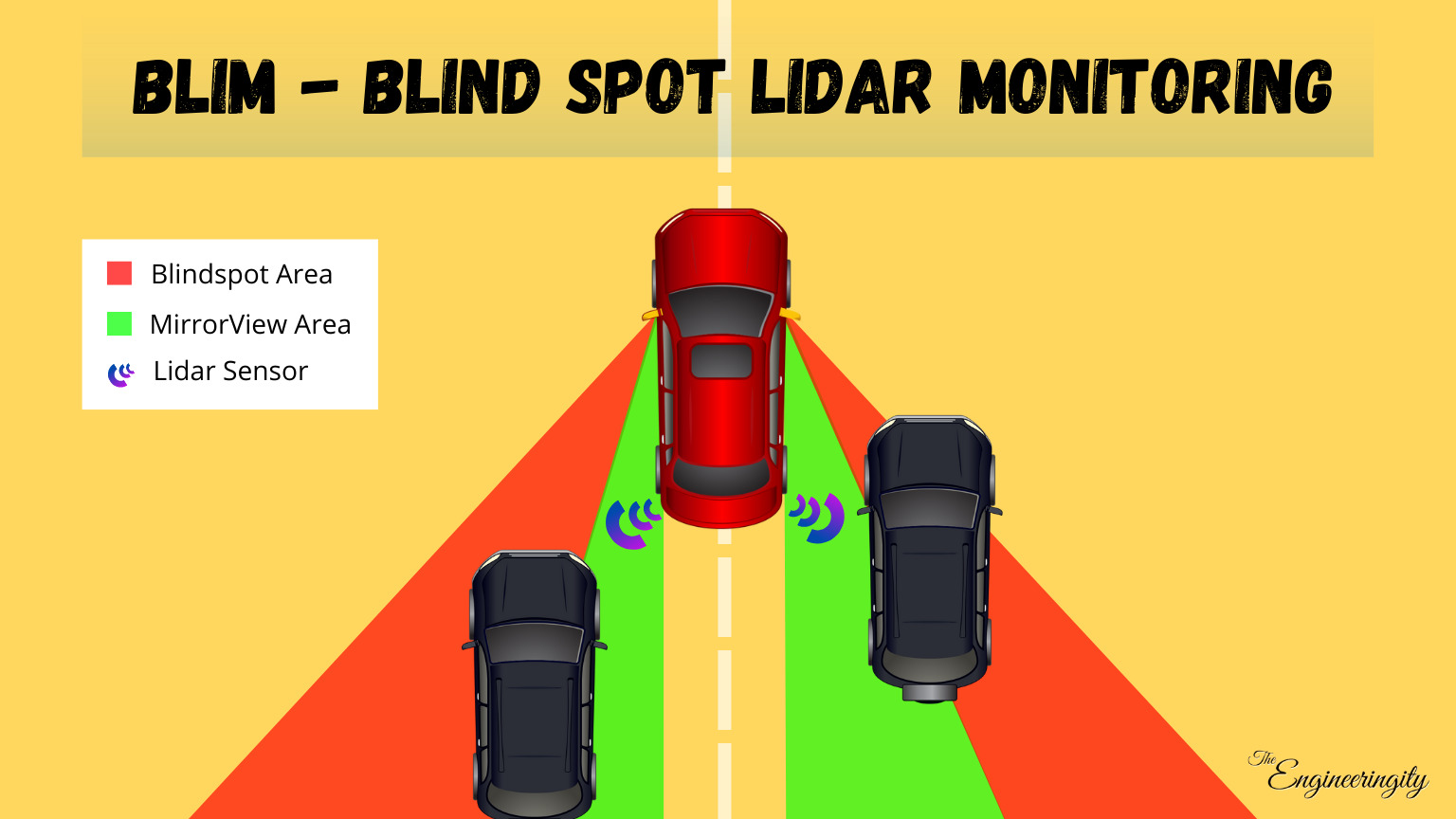
The Blind Spot Monitor using Lidar alerts drivers of vehicles in their blind spot and the rear cross-traffic alert warns drivers of approaching vehicles when backing up. The Blind Spot Monitor enables alerting the driver to the presence of a car that might evade detection in side-view mirrors, improving conviction and helping to optimize safe operation.

Blind-Spot Lidar Monitoring and alert system that is devised to provide an early warning about the proximity of surrounding vehicles to the driver using the Lidar technology.

The presented system is highly accurate and most importantly cost-effective. Such systems are only available in the higher segment vehicles. Most mid-range cars that comprise a central component of vehicular traffic ignore these systems. Thus the system is a solution for the mid-range segment.

The objective of the project

The focus of this project is to identify the causes of automobile collisions, notably the side collision impact caused by the blind spot.

To develop a system that can accurately monitor the rear blind-spot area of the vehicle which is also affordable for normal car users.

So with this system, accidents can be avoided.

System Components

The system mainly consists of 2 parts 

1. Hardware 2. Software,

The hardware component consists of the Lidar sensor, the microcontroller & the Bluetooth module.

A lidar sensor is a light-emitting sensor. That calculates distance using Time of Flight(ToF). So here in this project, the TF Luna Lidar sensor is used which can travel distances up to 8m. It can perform steady, accurate, sensitive, and high-frequency range detection.

The second component is Arduino Uno is a microcontroller Other variants of microcontroller Arduino Uno, Arduino Mega, and Arduino Nano can be used and can work perfectly having no issue with latency. But used for single-operator use.

HC-05 Bluetooth Module is an easy-to-use Bluetooth. Enabling the Arduino to exchange data with other Bluetooth devices. It works between the baud rate of 9600-115000.

The software component consists of an application (BLiM) on which the data collected from the Lidar sensor (Distance) will be displayed and seen by the driver.

What is Lidar? How does Lidar work?

Lidar Sensor (Light + Radar) stands for Light Detection and Ranging. It means a sensor that works on the principle of light. Here we have used the TF Luna Lidar sensor which is a single-point ranging sensor that has having FOV of 3 degrees. TF Luna Sensor emits infrared waves for detecting objects. It uses the Time of Flight Principle. It calculates time by measuring the phase difference between the original and reflected pulse and using that time to get the relative distance.

𝑫 = 𝒄/𝟐  ∗  𝜟𝝋/𝟐𝝅𝒇 


where,

c = Speed of Light

f = Signal Frequency

Δφ = Phase Difference.

The detection range of TF Luna is up to 8m.


Now, why didn't we use an ultrasonic sensor over lidar in this project because,

Ultrasonic-based systems are relatively inexpensive, while their detection range tends to be fairly short, and they take more time to detect cars when in use, their resolution is also quite low.

Speed of Light = c = 3x10⁸ m/s

Speed of Sound = 343.2 m/s

Disadvantages of Ultrasonic sensor:

  • Air temperature has the greatest impact on the measuring accuracy of an ultrasonic sensor.
  • Noise can also affect the performance
  • Dust rain snow

Overall Look of the System:

TF Luna | Arduino Uno | HC-05 | Power bank

The hardware devices are on the left with a wired connection and on the right is the software BLiM opened in Mobile which is connected wirelessly. 

On the left In the hardware section. There is a box containing Arduino and HC-05. Beside it is the Lidar(TF Luna) sensor and connecting to it there is a power source.

All this hardware has having wired connection. But the BliM app connects it wirelessly via Bluetooth and the output can be displayed.

Working on the system

If we go in-depth into the topic then thought must have appeared in the mind How will this system work?

Blind spot monitoring kit | Lidar sensor

The system starts when the car runs above 20 kph with the detection of the vehicle in the blind spot zone by a LIDAR sensor, detecting the car sends the signal to the microcontroller. Further, this data is sent from the Arduino microcontroller wirelessly to the application (BLiM) on which the alert is shown via the HC-05 Bluetooth module.

The data is then processed and displayed on the BLiM App and displayed in front of the driver. If the approaching is at a critical distance then the driver will get an alert sound will be activated and the distance will be shown in red on the distance dial.

Working on App BLiM

The App comes into the picture when data is received. The App is named BliM(Blindspot Lidar monitoring). Having a clean user interface. When we enter the Application We come across the Start interface where user can set their minimum, moderate, and maximum values as per their convenience. Where the minimum distance is critical and the rest is safe.

Then connection Bluetooth is done connecting with the hardware so that we can receive the data.  Then we land on the main interface. Here there are two main components the color dial which has red, green, and blue, and the other is the real-time distance.  The red color is for minimum distance blue is moderate and green is for maximum safety.

Now whenever the car is approaching our car the Lidar sensor will detect the range of the approaching car. And send it to the App. Then the App segregates whether the distance is in minimum moderate or maximum If it is minimum then it is considered as a critical range and in that case, the color dial will be red with the distance highlighted in red and a chime will sound (beeping) will be activated and as the projected car goes far away (outside the blindspot area) then the color on the dial will be green or blue and the buzzer will stop Beeping.

What if the car is in the critical range (Red) for a long time?

If the car is in the critical range (Red) for a long time then there is an off button on the header of the app. By pressing it in the Red area, the buzzer will stop for an instant and it will automatically turn ‘ON’ when the distance is i.e. when it reaches the green and blue areas. The buzzer sound stops and the driver will be less irritated.

The reason behind making the app was to show the output wirelessly to the driver. Instead of having the LED display with the tangled wire.

Advantages of the System

Of all the existing research covered, many systems using the Ultrasonic sensor were found to be less accurate during bad weather conditions. It also has a lower detection range (2-4m) & is not good at detecting fast-moving objects.

A lot of existing systems warned the driver through audio (buzzer) & a very basic visual aid (LED) which failed to provide the driver with sufficient information.

System installation on car

Lidar sensor application | Blindspot Monitoring App

The sensor was placed above the fuel tank lid of the car (Wagon-R). The horizontal viewing angle of the sensor as noticed from the top was about 45°. The sensor’s detection zone is 8m to 9m. The flat distance from the bottom to the sensor was 104 cm. The absolute arrangement of the LIDAR sensor and the screen on which the warning would be displayed i.e., the BLiM Application in the mobile placed on the dashboard is pictured in the above image. 

Conclusion

The proposed system is highly accurate and most importantly cost-effective. Such systems are only available in the higher segment vehicles. However, most mid-range cars that form a major component of vehicular traffic skip these systems. Thus the system is a solution for this segment.

This project model is Patented under Indian Patent and has a Research Paper published in the Journal of the Institution of Engineers, Series C [Springer Journal] (Scopus Index) (UGC approved)

To read more details about this system the entire Research Paper is available on the Springer website [Click Here]

This was our Final year Project model of Engineering. Please let me know about it in the comments below.

  • 0 Comments

 Hydrogen has been praised as a fuel of the future that could enable the end of the world’s reliance on fossil fuels and benefit change to net-zero emissions. But for this hydrogen revolution to take place, some big barriers need to be overcome. So is the hype about hydrogen justified?

Hydrogen Fuel | Hydrogen cars | Sustainable Energy

The most plentiful element in the universe is Hydrogen. It’s necessary for life, the sun is specially made of it and it’s present in almost all alive things. But on earth pure hydrogen is very inadequate. Instead, it mainly exists integrated with oxygen in the form of water. So how does this ample element get turned into a fuel that could help preserve the planet?

Advantages of using hydrogen fuel

One of the advantages of hydrogen in a hydrogen vehicle is the only emission that comes out of the tailpipe is undiluted, drinkable water. In contrast, the internal-combustion engine puts out loads of harmful chemicals and carcinogens. This signifies that as long as the energy used to produce it is sustainable hydrogen can be a certainly green fuel.

How hydrogen fuel is Generated?

Generation of Hydrogen fuel | Hydrogen Molecules

The first hydrogen needs to be obtained. This is done by splitting molecules. Hydrogen is a power carrier unlike, petroleum which is a primary power source. To make hydrogen from something requires an input of energy. Methane can be used via a process called steam reforming or a source of electricity through electrolysis. Once you have some hydrogen you can either burn it directly or mix it with oxygen in a fuel cell, which is somewhat like a battery. The reaction in the fuel cell creates electricity and heat. And the mere waste is water.

How hydrogen fuel could be used?

NASA began using hydrogen fuel cells to develop electricity in its space capsules in the 1960s. Today it’s not only considered rocket fuel in space but also for planes, trains, and automobiles. As well as the industrial sector. The most potential early applications are going to be in heavy industry, for example, steel- and cement-making. These are heavy, heavy greenhouse-gas polluters and they ingest tons of energy, a lot of coal in respect. And it’s very challenging to substitute that with electricity which is probably how most of the decarbonization of the global economy will occur.

Why hasn't hydrogen fuel been accepted in past?

This isn’t the foremost time hydrogen has been called the energy of the future. So the question is why has it never taken off? Until renewables existed at scale producing hydrogen required extensive quantities of fossil fuel, or nuclear energy which caused hydrogen both more expensive and less efficient than other ways of storing and delivering energy until climate change moved up the political agenda. Hydrogen simply wasn’t worth it. The existing fossil-fuel infrastructure has been in place for decades. It’s trillions of dollars of invested legacy equipment and the companies that built it defend their assets. And so it makes it very difficult for governments to force that legacy equipment to be pushed aside in favor of radically new rival equipment like hydrogen infrastructure or for that matter, renewable energy.

Is hydrogen fuel safe?

The passengers look down to see the east coast of America gliding by beneath them. There has also been a battle against public perception of hydrogen safety sparked by the Hindenburg disaster in 1937. Within moments there was a tremendous outburst and sharp orange flames formed the backdrop for a tableau of death. Hydrogen gas is very combustible and does need to be stored in a precise way. But fears about its protection are overblown. The Hindenburg did not burst because of the hydrogen it's been authenticated. That’s a misperception and what’s more, the industry has shown that hydrogen vehicles can be safer than internal-combustion vehicle cars that use gasoline which, of course, is an explosive product. Every day hydrogen across the world is used by industry quite safely. 

Advantages of Hydrogen over batteries

One advantage hydrogen has over batteries is that it’s much more energy-dense which means that with a very high-pressure storage system it takes much less space to make a vehicle go any distance. If you have a hydrogen tank on board you can refuel a vehicle quickly compared to batteries and electric cars. But we do have issues with the cost we have issues with refueling stations and fuelling infrastructure that has to be built out. So that’s another obstacle that stands in the way of hydrogen.

Is hydrogen sustainable?

There’s also a question over how sustainable hydrogen is despite some advances in the technology to generate it still requires energy-intensive processes that are fuelled largely by fossil fuels or lots of electricity. The only method to make truly green hydrogen is to produce it using sustainable energy. At the moment, a lot of the hydrogen that’s used in the world is made from natural gas but that does produce some greenhouse-gas emissions. Some people see this as terrible. And other people say this could be a bridge. It can help build a market until there’s enough renewable energy and electrolyzers become more efficient and more cost-effective.

But even if renewable energy is used in the electrolysis process the energy content that comes out is less than what goes in. Which leads some to argue that hydrogen is just a waste of renewable energy. They have a point that there are a bunch of applications in which electricity is the most promising thing to use and more efficient. Whereas there are other applications in the hefty industry especially long-distance transportation, for example where hydrogen could find a niche quite a big niche.

Unlike earlier waves of enthusiasm, hydrogen fuel could be here to stay this time. Technological advancements are causing hydrogen production more efficient and cheaper and this along with the government’s affirmation of decarbonizing is helping push a new hydrogen economy. We see huge improvements in the vehicles or the processes that use hydrogen and we see much more sophistication among the companies that are using it 

According to a study by McKinsey, there are more than 350 large-scale global projects underway right now. The whole investment projected in the hydrogen sector amounts to an evaluated $500billon. Scientific advancements, driving from the laboratories to pilot plants and eventually fetching towards a marketplace because they know a market that will pay for low-carbon techniques or green hydrogen is arriving. 

Germany has declared a €7billon program and the Chinese government wants to include 1 million fuel-cell-powered vehicles on its roadways by 2030.

Will there be a hydrogen revolution in the future years?

When we think about the tools that are needed to get to a net-zero carbon world There’s no doubt that hydrogen will play a role. In the short term, electrification is going to lead to the decarbonization charge. Still longer-term, I think there is great potential for a real hydrogen revolution that would play a big role in a decarbonized society.

Are hydrogen cars possible?

As of 2022, there exist two models of hydrogen cars publicly available in select markets: the Toyota Mirai (2014), which is the world's foremost mass-produced reliable fuel cell electric vehicle (FCEV), and the Hyundai Nexo (2018).

  • 0 Comments
Newer Posts Older Posts Home

Like and Share our Facebook page

The Engineeringity

Blog Archive

  • ►  2020 (13)
    • ►  September (3)
    • ►  October (5)
    • ►  November (2)
    • ►  December (3)
  • ►  2021 (32)
    • ►  January (1)
    • ►  February (2)
    • ►  March (3)
    • ►  April (3)
    • ►  May (5)
    • ►  June (2)
    • ►  July (3)
    • ►  August (4)
    • ►  September (2)
    • ►  October (2)
    • ►  November (2)
    • ►  December (3)
  • ►  2022 (21)
    • ►  January (3)
    • ►  February (2)
    • ►  March (2)
    • ►  April (1)
    • ►  May (1)
    • ►  June (2)
    • ►  July (2)
    • ►  August (2)
    • ►  September (1)
    • ►  October (2)
    • ►  November (1)
    • ►  December (2)
  • ►  2023 (16)
    • ►  January (2)
    • ►  February (2)
    • ►  March (2)
    • ►  April (1)
    • ►  May (1)
    • ►  June (2)
    • ►  August (1)
    • ►  September (2)
    • ►  October (1)
    • ►  November (1)
    • ►  December (1)
  • ▼  2024 (3)
    • ►  January (2)
    • ▼  June (1)
      • Japanese Brands Electric Car Aversion: Decoding Tr...

Featured post

Mini Project On "Hydraulic Powered Track".

What is Hydraulics?  Hydraulics is a technology and applied science using engineering, chemistry, and other sciences involving liquids' ...

About Blog


Hi! I'm owner of Engineeringity

Student by profession, joined blogger as a hobby, and want to explore more about curious things.

Get latest updates straight to your inbox!

Enter your email address:

Delivered by FeedBurner

Popular posts

  • Mini Project On "Hydraulic Powered Track".
    What is Hydraulics?  Hydraulics is a technology and applied science using engineering, chemistry, and other sciences involving liquids' ...
  • The Inventor of Aeroplane | Story of Shivkar Talpade
     The whole world knows that the first airplane was flown by Wright Brothers, But what the world doesn't know is that 8 years before the ...
  • The great visionary leader Chhatrapati Shivaji Maharaj
     Chhatrapati Shivaji Maharaj was a visionary leader and founder of the Maratha Empire in western India during the 17th century. He was born ...
  • Types of Engine placement in car | Front-Rear-Mid Engines
     Automakers all agree to place the engine in the front of cars, vans, and trucks, after over a century of innovation. Why do we do this? Wha...
  • History of Engineering | Importance of Engineering
    The word engineering has been derived from the term engineer and dates back to around 1325 and the word engineer in those times meant or wa...
  • The Rise and Fall of LML: India's 2nd Scooter Giant Falters
     You must know about this legend if you were also born in the 90s like me or even earlier than that. This scooter was used to carry both peo...

Search this blog

Labels

automobile (22) Facts (12) Inventions (10) stories (10) 7 lessons (9) automotive-innovators (9) Engineering (7) electric vehicle (7) Hydrogen (6) Aircrafts (5) green-energy (5) Fuel cells (3) Projects (3) Fluid Mechanics (2) Solid State battery (2) festivals (2) drone (1)

Pages

  • About Us
  • Disclaimer
  • Privacy Policy
  • Terms and Conditions
  • Contact Us
  • Sitemap

Pages

  • Feedback Form
  • Feedback Survey
  • Complaint Form

Copyright@2019-2022 Engineeringity All Right Reseved

Created with by OmTemplates | Distributed By Gooyaabi Templates